

Preached at Hilltop UMC Mankato, June 25, 2023
Let’s start with a Pop Quiz! This one is called, “Who Said It?” These are all quotes by famous theologians, on the topic of judging others. Ready? Here we go!
Question number one:
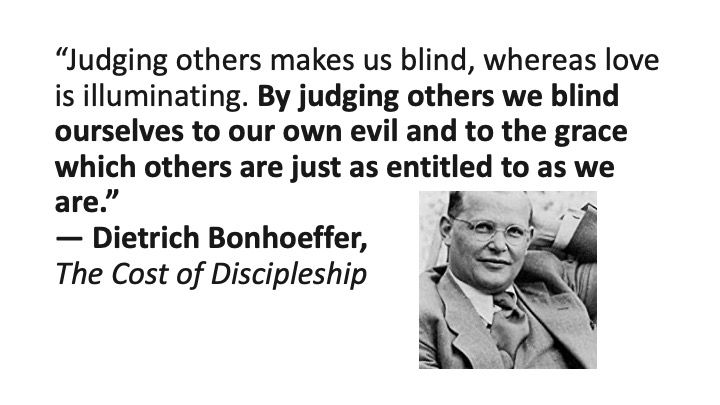
Who said, “By judging others, we blind ourselves to our own evil, and to the grace which others are just as entitled to as we are.”
Was it –
A) Martin Luther
B) John Wesley
C) Brené Brown, or
D) Dietrich Bonhoeffer?
Did you guess Dietrich Bonhoeffer?
Question Two:
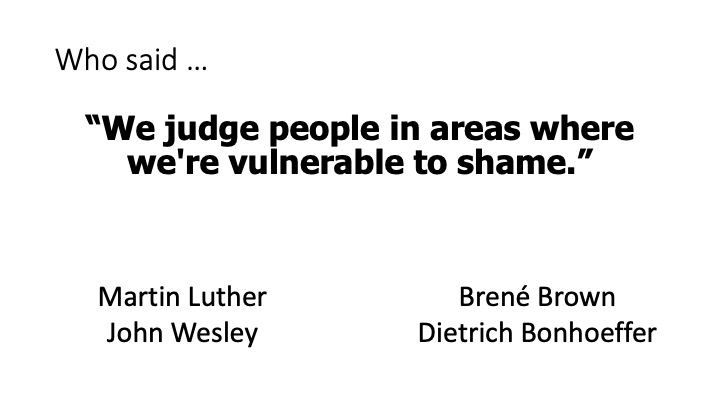
Did you recognize Brené Brown?
“…research tells us that we judge people in areas where we’re vulnerable to shame, especially picking folks who are doing worse than we’re doing. … We’re hard on each other because we’re using each other as a launching pad out of our own perceived shaming deficiency.”
― Brené Brown, Daring Greatly: How the Courage to Be Vulnerable Transforms the Way We Live, Love, Parent, and Lead
Question Three:
Who said, “We should be rigorous in judging ourselves and gracious in judging others” – Luther, Wesley, Brown, or Bonhoeffer?
I hope you recognized John Wesley!
Final Question: Who said, “Be careful not to measure your holiness by other people’s sins.
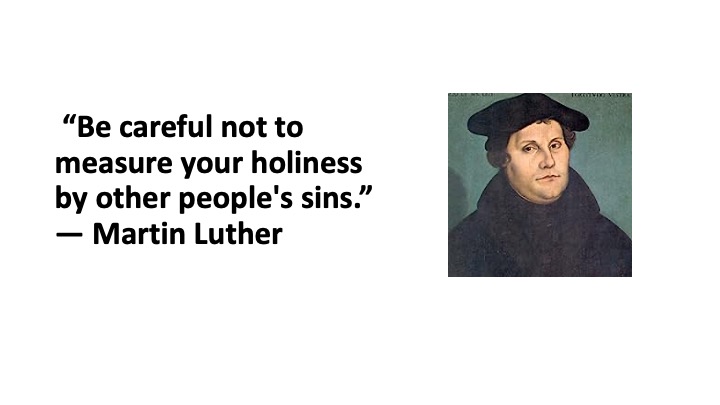
That Martin Luther cuts right to the quick, doesn’t he? Don’t go measuring your own holiness against the sins of others. We do that, though, don’t we? “There but for the grace of God go I,” my mother used to say whenever someone she knew had stepped out of bounds. What she didn’t realize was, every time she said that, we knew she meant the same thing the Pharisee praying loudly in the temple meant – “God, thank you for making me better than everyone else.” (Luke 18:11, my paraphrase)
And that’s usually the way we interpret this teaching of Jesus about judging others. When we put ourselves in the position of judge, it’s easy to look down on the person we’re judging, to consider ourselves better than they are.
And that’s where we’d be wrong, Jesus says.
So let’s look at this word judgement for a minute. It has several levels of meaning. There’s the legal term, where an authoritative judge hears evidence and makes a decision that is legally binding. There’s that kind of judgement.
And there’s the kind of judgement your parents want you to show when you are first stepping out on your own– they want you to have good judgement. Make good decisions.
There’s spiritual discernment, when we make decisions based on what we believe God wants us to do. Or not do. All these forms of judgement have something to do with decision making. Choosing right over wrong, or choosing the best path.
But when we hear this passage, we immediately recognize Jesus is talking about condemnation. This is the kind of judging we do when we think someone is wrong, and we want to point out just how wrong they are – and how right we are by comparison. And Martin Luther says, don’t go measuring your holiness by someone else’s sins. Because your own sin is just as bad. You know, whenever you point a finger at someone else, three more are pointing back at you.
Jesus uses a great metaphor to show us what he means.
Have you ever had a speck of sawdust in your eye? It can be pretty uncomfortable. In fact, your body will do everything it can to rid you of that speck of sawdust. Your tear ducts will start working overtime, trying to wash it out with tears. You will reflexively reach up and try to rub it out, working it toward the corner of your eye where those tears can help get it out.
So why on earth, Jesus wonders, would you try to help someone else get a speck of sawdust out of their eye, when you have a whole tree trunk in your own? First of all, God created a mechanism for removing foreign objects from the eye – tears. But more so, you can’t even see the speck well, because your own view is obstructed. Like Bonhoeffer says, By judging others we blind ourselves to our own evil and to the grace which others are just as entitled to as we are.”
Remember when Nicodemus came to Jesus at night, asking how to enter the Kingdom of Heaven, and Jesus told him, “For God so loved the world that he gave his only Son, so that everyone who believes in him may not perish but may have eternal life.” (John 3:16) But Jesus didn’t stop there. He went on to say, “Indeed, God did not send the Son into the world to condemn the world but in order that the world might be saved through him.” (John 3:17) See, if God didn’t send his only Son into the world to condemn it, I’m pretty sure he didn’t send you into the world for that purpose, either.
There’s a story in John 8 about some people bringing a woman to Jesus who had been caught in adultery. They’ve already judged her, but they want Jesus to affirm their decision to condemn her to death. And Jesus won’t do it. He says, “Whoever among you is without sin can throw the first stone.” And then he ignores them. One by one, they drop their stones and leave. When Jesus asks the woman where they’ve gone, he says, “Has no one condemned you?” “No, sir,” she answers. And he says, “Neither do I condemn you. Go your way and don’t sin anymore.”
Now scholars can’t find this story in any of the earliest versions of John’s gospel. So most Bibles these days put this story in brackets. Doesn’t mean it didn’t happen, just that they can’t find evidence of it in the earliest copies. But it sure sounds like something Jesus would do, doesn’t it? And I love the way he both acknowledges and encourages the woman when he releases her. I don’t condemn you. Stop sinning. This is the kind of judgment Jesus expects from us between each other.
This would have been clear to the disciples, and probably to many of the people listening to Jesus preach beside the Sea of Galilee. They understood the Hebrew term for justice, or righteousness, to include both judgement and mercy. So, when Jesus told us, back in the last chapter, “strive first for the kingdom of God and his righteousness,” (Matt 6:33) this is what they would have understood righteousness to mean: clear judgment, and mercy, walking hand in hand.
Here, in verse 5, when Jesus says, “You hypocrite, first take the log out of your own eye, and then you will see clearly to take the speck out of your neighbor’s eye,” he is showing us how to judge rightly, how to care for our brother or sister’s soul by tending to our own first. Jesus’s very words are a perfect example of calling out the problem – “you hypocrite” – and then offering mercy. “Tend to your own sin, so your vision isn’t clouded with poor judgement when you look at another’s.”
The Apostle Paul puts it a little differently in Romans 2:1 – “Therefore you have no excuse, whoever you are, when you judge others; for in passing judgment on another, you condemn yourself, because you, the judge, are doing the very same things.”
Whenever you feel like condemning someone else, examine yourself first. Don’t condemn without some self-examination, but don’t be stupid, either. Don’t throw your pearls to pigs. If your brother or sister in Christ doesn’t want your help, let it be. God will do God’s job. Remember last week’s passage? Each day has enough trouble of its own; you don’t need to make more. (Matthew 6:34)
What you do need to make, however, is space for grace. Room for mercy. Discern wisely, but be sure to confess your own sin before you condemn anyone else for theirs. Seek first the kingdom of God, and his righteousness, and God will take care of the rest.
 A pastor sings
I no longer preach from the lectionary. Thank you.
<
div>
LikeLike
Dale, I usually do, but this week and last have been part of a Sermon on the Mount series, and I was happy to explore this text, since it doesn’t show up in the RCL anywhere! Christ’s peace to you, Jo Anne
LikeLike
Thanks for your wonderful blog and sermons. I have been trying to find the information on how to ask your permission to use your sermon for this Sunday Sept 10 2023. I serve a rural church in Manitoba Canada but had been part of the UMC when we lived in California. I very much appreciate the way you handled the subject of conflict. Please let me know if I may use this with the appropriate acknowledgements. Blessings, Lynne
LikeLike
Lynne, thank you for your kind words. Permission requests can be sent to pastorsings (at) gmail (dot) com and I have sent you a message. Blessings!
LikeLike