Author Archives: pastorsings

Unknown's avatar

About pastorsings

Follower of Jesus/Pastor/Singer/Teacher/Wife&Mom

Holy Fear – Sermon on Mark 4:35-41

June 21, 2015 – Pentecost 4B, Father’s Day
Another sermon on this text for June 20, 2021 can be found here.

I don’t like to preach about current events. I’m much more interested in the timeless truths of the Gospel than the fleeting nature of the daily news. I’d rather tell you about Jesus than talk about the latest political crisis or natural disaster.

It’s not that I don’t think we have a responsibility to stay informed. And I know for certain that the timeless truths we find in scripture apply directly to our everyday lives. Looking at the evening news through the lens of discipleship is a great exercise for small group discussion, helping us to determine what it means to follow Jesus through the events that shape our culture and our lives together in this community of faith.

When this week’s news brought us those alarming images of a church surrounded by police tape and the faces of nine people who died there, my first impulse was to just work this into the pastoral prayer. After all, the bulletin was already printed. The scriptures were already chosen. The songs and hymns had been selected weeks ago.

There wasn’t time to change gears. It seemed the simplest thing to do was add our prayers to those of people everywhere, prayers for comfort to the grieving, prayers for justice, for God’s Kingdom to come and put an end to hatred and killing.

But my clergy colleagues wouldn’t let me get away with that. Continue reading

Growing Like Weeds – Sermon on Mark 4:26-34

June 14, 2015 (You can view a video of this sermon here.)

A high school friend posted on Facebook the other day that wheat harvest has already begun down in southern Kansas. While our harvest up here in Minnesota might be a few weeks out yet, my friend’s comment reminds me that the cycle of planting, cultivating, and harvesting follows a predictable pattern. The steps in the cycle follow the same order, year after year.

Lots of variables can affect the final outcome of each year’s crop: weather conditions, seed quality, disease, pests. But the cycle of planting, growing, and harvesting is still the same cycle that’s been in place since God created plants. In today’s gospel reading, Jesus uses the very familiar process of plant growth to teach some important lessons about the Kingdom of God.

Whoever has ears to hear, Jesus says, listen to the Word of the Lord as given to us in the Gospel of Mark, chapter 4, beginning at verse 26. Jesus is already talking:

He also said, “The kingdom of God is as if someone would scatter seed on the ground, and would sleep and rise night and day, and the seed would sprout and grow, he does not know how. The earth produces of itself, first the stalk, then the head, then the full grain in the head. But when the grain is ripe, at once he goes in with his sickle, because the harvest has come.”

He also said, “”With what can we compare the kingdom of God, or what parable will we use for it? It is like a mustard seed, which, when sown upon the ground, is the smallest of all the seeds on earth, yet when it is sown it grows up and becomes the greatest of all shrubs, and puts forth large branches, so that the birds of the air can make nests in its shade.”

With many such parables he spoke the word to them, as they were able to hear it; he did not speak to them except in parables, but he explained everything in private to his disciples. (Mark 4:26-34)

Jesus told lots and lots of parables. These stories that drew on familiar, everyday events and circumstances were his primary teaching tool. On the surface, a parable might seem to be the same as a fable – a story that has a moral, like “slow and steady wins the race,” in The Tortoise and the Hare. But they aren’t exactly the same thing. Continue reading

Gluten free Communion bread that the congregation kinda liked

i have been testing various gluten-free recipes over the past year, and each has received mixed reviews from the congregation. The Hawaiian style loaf was moist and sweet, but very crumbly, and crumbs on the carpet at my feet made some parishioners pretty uncomfortable. I’m not sure if they stepped gingerly around the crumbs to avoid making a mess for the custodian, or they were just being careful not to step on Jesus.

During Lent, we went with a soft cracker kind of bread that was very easy to make (half an hour from start to finish) and tasted good, but was a bit too chewy for some folks. At least it didn’t crumble onto the floor, since I scored the loaf before baking and then cut it into half inch squares. When I did an informal survey, asking for feedback on these two recipes, I got three different kinds of responses (not counting the “I don’t understand why we all have to get gluten free if there are only a few people who need it” answers). Great.

This month, I finally hit on a recipe that most people, even the gluten free critics, said was worth repeating. So I offer it to you here. Continue reading

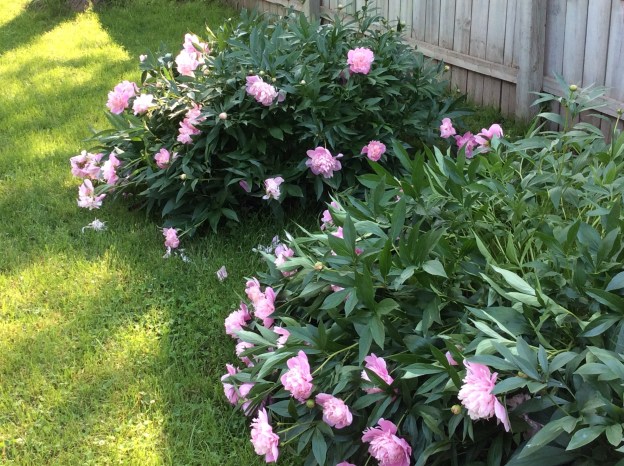
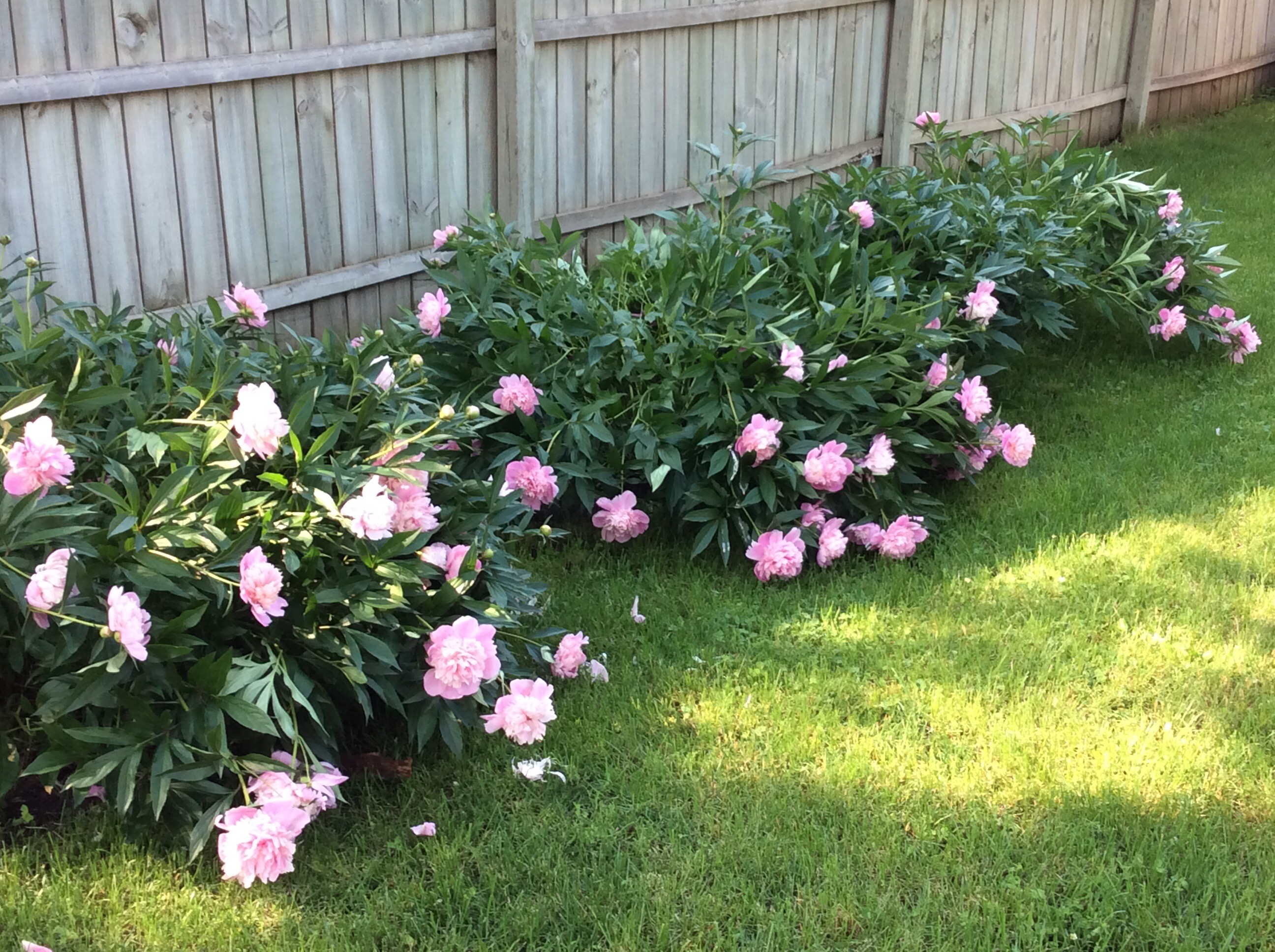
Peonies worshiping after rain

 
We had a tremendous thunderstorm yesterday. Sheets of rain blew down the street, and we wondered if we should go to the basement. Instead, we stood on the front porch, marveling at the power of the storm. When the storm had passed, there was an inch and a half in the rain gauge and the peonies in the back yard were lying smashed to the ground. I went from bush to bush, lifting and shaking the heavy blooms in hopes they would right themselves.

This morning, the peonies were still bowed down in a posture of worship. They  may stay that way. Today, may I also remain in an attitude of worship, bowed before my Maker in awe and reverence. May I keep in mind throughout this day that God is God, and I am not. Thanks be to God for rain-soaked peonies.

Framing the Picture: An Undivided Heart – Sermon on Mark 3:19b-35

2nd Sunday after Pentecost
June 7, 2015

What frames the central truth of our lives?

Imagine a picture that has been beautifully matted and framed. The matting material has been cut with great precision, and sets off the picture from its frame with a color that both contrasts and complements the colors in the painting. The frame itself gives structure to the artwork. Its form is both functional and aesthetically pleasing. The overall effect is satisfying and complete. The painting looks finished. Its frame and matting are not distracting. They focus attention on the artwork itself.

In today’s passage from the Gospel of Mark, we are given a beautifully framed and matted picture. Mark has taken great care to frame the central idea inside a pair of contrasting, yet complementary ideas. We pick up the story just after Jesus has chosen his twelve disciples. As we join these disciples at Jesus’ feet, we are about to witness our Lord face opposition from two different camps. Continue reading

Trinity Sunday Year B

Nobody really gets the Trinity, do they?  Understanding how God can be three distinct Persons, yet One – we just can’t quite explain it. The minute we try, we find ourselves spouting unintentional heresy. 

But we can experience God’s interrelational personhood, and lots of folks will tell you it’s this interrelationality that matters. The community of the Godhead invites us all into that shared relationship, that love. I’m beginning to think this is what “God is love” really means.

In worship today, we honored our high school graduates and sent them off as apostles to their next season of discipleship. We celebrated the good news that the Minnesota Annual Conference of the United Methodist Church, to which our congregation belongs, had a productive and Spirit-filled meeting this week. And we sang a lot. We heard the Word of the Lord. We prayed, and recited the Nicene Creed. 

We embraced, if only for a moment, the ambiguity that surrounds our idea of Trinity. We leaned a little further than we have before into the paradox of a God who is One, yet Three. 

And Love showed up. 

When the Spirit Comes – Sermon on John 15:26-27; 16:4b-15

Pentecost B May 24, 2015 (Viewa video of this sermon here.)

What happens when Jesus leaves?  

When the one on whom all your hopes were pinned is gone, what then? Last Sunday, we celebrated the Ascension, and Luke’s version of that story has the disciples skipping off to Jerusalem with great joy. It’s a nice ending to the story that began with angels announcing “tidings of great joy” to shepherds in a field outside Bethlehem. There’s sort of a “they lived happily ever after” sense that the story has come to a satisfying conclusion, at least for the moment.

But we know better, with our twenty-fifteen hindsight. We know that those disciples were about to experience hardships and persecution they couldn’t possibly imagine. We know that they would soon fall into disagreement, Continue reading

Being God’s Kids – Sermon on 1 John 5:1-6 Easter 6B 

5/10/2015 (Mother’s Day)

It may seem that the heretics we read about in John’s letters are far removed from us. After all, they lived more than 2000 years ago, and a lot of theological water has gone under the bridge since then. We’ve had plenty of time to figure out what it means to be Christians.

Biblical scholars have written tons of books to explain the hard parts of scripture for us, and great leaders in the church have managed to refute most of the questionable beliefs that emerged during the early years of the faith. Those crazy ideas about Jesus being just a spirit who appeared to be human sound strange to us. It would never occur to us that Jesus was ever anything but fully God and fully human.

We live in a time when we don’t hear much about people standing their ground in theological debate. Our scholars and Christian leaders aren’t famous for hashing out the finer points of Christ’s identity as the Son of God. Instead of arguing about who God is and who Jesus is, we argue about who can be married in our churches or preach in our pulpits, or how we should respond to global warming, or what we should do about bigotry in all its forms.

That time seems far away, when Paul and John and Mark and Luke were still defining the very essence of Christian faith. And yet, the questions they faced were very much like the questions our culture asks today:
Who is God, anyway?
Why does Jesus matter?
What if I want to be “spiritual, but not religious?”
How can I know what lies beyond this life?
Who is going to love me, when I don’t love myself? Continue reading

Abiding – Sermon on John 15:1-8 Easter 5B

Note: The devotional meditation on jelly making referred to throughout this sermon can be found here. You can view a video of this sermon here.

May 3, 2015

During Lent this year, our ecumenical noontime worship centered on the “I AM” statements of Jesus, that we find in the Gospel of John. The final week’s text was the gospel lesson we are going to hear today, from John 15. “I am the true vine,” Jesus told his disciples. As we gathered for lunch and worship, I shared some thoughts on this passage that came out of my first attempt to make grape jelly several years ago.

Some of you told me afterward that I had left you hanging – I never told you how the jelly turned out! Well, today, you get to hear the end of the story. But first, for those of you who weren’t there, I probably should give you the background.

Our neighbor’s grapevine straddled the fence between our yards. One year, I decided it was time to put those grapes on our side of the fence to good use. I read the complete article on jelly making from Joy of Cooking, and decided to try the “old-fashioned natural” method that didn’t require a thermometer or commercial pectin. I knew the jelly probably would be less stiff, but the cookbook promised “a far superior product, depending on the quality of the fruit.” Continue reading

Good Grapes 

I am the vine, you are the branches.  Those who abide in me and I in them bear much fruit, because apart from me you can do nothing.” – John 15:5 

Our neighbor’s grapevine straddled the fence between our yards.  A few years ago, I decided it was time to put those grapes on our side of the fence to good use.  I read the complete article on jelly making from Joy of Cooking, and decided to try the “old-fashioned natural” method that didn’t require a thermometer or commercial pectin.  I knew the jelly probably would be less stiff, but the cookbook promised “a far superior product, depending on the quality of the fruit.”   As I mashed grapes, waited for them to cook, and strained the grapes and juice through a jelly bag, I kept thinking about that “quality of the fruit” phrase.  <!–more–> I had time to sit down with John 15 again, and think about Jesus’ vine metaphor.

‘I am the true vine, and my Father is the vine-grower. He removes every branch in me that bears no fruit. Every branch that bears fruit he prunes to make it bear more fruit. You have already been cleansed by the word that I have spoken to you. Abide in me as I abide in you. Just as the branch cannot bear fruit by itself unless it abides in the vine, neither can you unless you abide in me. I am the vine, you are the branches. Those who abide in me and I in them bear much fruit, because apart from me you can do nothing. Whoever does not abide in me is thrown away like a branch and withers; such branches are gathered, thrown into the fire, and burned. If you abide in me, and my words abide in you, ask for whatever you wish, and it will be done for you. My Father is glorified by this, that you bear much fruit and become my disciples. As the Father has loved me, so I have loved you; abide in my love. If you keep my commandments, you will abide in my love, just as I have kept my Father’s commandments and abide in his love. I have said these things to you so that my joy may be in you, and that your joy may be complete.

‘This is my commandment, that you love one another as I have loved you. No one has greater love than this, to lay down one’s life for one’s friends. You are my friends if you do what I command you. I do not call you servants any longer, because the servant does not know what the master is doing; but I have called you friends, because I have made known to you everything that I have heard from my Father. You did not choose me but I chose you. And I appointed you to go and bear fruit, fruit that will last, so that the Father will give you whatever you ask him in my name. I am giving you these commands so that you may love one another.” (John 15:1-17)

First, it’s important to remember that we are the branches, not the fruit.  We may be cut off from Christ, the vine, if we produce no fruit at all.  We may be pruned to produce more and better fruit, and we are admonished to abide in Christ, just as the branch abides in the vine.  Notice that we can only produce fruit if we abide in the vine.  That fruit is love, given freely.

Our job, as branches, isn’t to focus on the fruit. Our job is to stay connected to the Vine. God will take care of the fruit. For jelly, it’s best to harvest the grapes when they are just barely ripe, and maybe a few are even a little green.  Branches don’t like to let go of their grapes, so the clusters have to be cut from the vine.  Likewise, we may enjoy feeling God’s love for us, but refrain from sharing it – it’s sweet to hold on and savor that goodness; it’s hard, sometimes, to make ourselves vulnerable to others, to give away the love God has made known to us.  But Jesus encourages us to let God the vine dresser distribute the fruit according to His plan.

Sometimes, that may mean that the fruit is a little green, not so sweet.   Mature fruit has its own purpose, however.  By definition, fruit holds seeds. Unless the fruit ripens, it will be impossible for those seeds to develop into something worth planting.  As followers of Jesus, our purpose is to make more disciples.  We need to allow our own seeds of faith, surrounded by the ripe fruit of God’s love, to develop into something worth planting in the hearts of others.

A couple more observations:  When you make jelly, draining the cooked grapes through a jelly bag strains out everything but the clear juice.  If you squeeze the bag to get more juice faster, all you accomplish is getting stuff in your jelly that belongs in the compost.  It’s important to let God refine us in His own good time, for the highest quality, for the clearest product.

And finally, sometimes things get messy.  Love isn’t always tidy.  Following Christ isn’t always neat and easy.  Grape juice stains easily.  But, depending on the quality of the fruit, God promises a far superior product to anything the world can offer.

May the gift of Christ’s Spirit bear much good fruit in our lives.  Let us allow God to take his time with us, as we share his love with others, planting seeds of faith in those around us.  May God prune us and tend us, that the fruit we bear for his Kingdom might be sweet and plentiful.