Category Archives: Epiphany

Selfless: Grateful In the Grind – sermon on Colossians 3:12-17

Epiphany/Baptism of Our Lord B
January 7, 2018

We have a lot of threads to weave together this morning. We recognize the close of the season of Christmas …

… as we celebrate the feast of the Epiphany, that “aha!” moment when Jesus was revealed as a King to the Wise Ones traveling from the East, …

and the Baptism of our Lord, when Jesus submitted himself to John’s baptism in the River Jordan, …

… and it’s the first Sunday of the New Year, when Methodists traditionally renew their baptismal vows to shine Christ’s light into the world through prayers, presence, gifts, service, and witness.

To top it off, this is Communion Sunday!
It looks a little busy up here on the platform – there’s a lot going on. Notice that all of our worship, busy as it may seem at first, has one focus: turning our attention toward God.

As we enter this new year, I’m inviting you to abandon all those New Year’s resolutions that have anything to do with self improvement. You see, ultimately, those resolutions focus our attention on ourselves. They are, to put it quite bluntly, self-ish. And that is not what Jesus calls us toward as Christians. Jesus asks us to center our lives on God, and then offer God’s love to others.

So over the next few weeks, we will explore what it means to be self-less followers of Jesus Christ. We’ll see how serving, generosity, and sharing our stories of faith help us get re-oriented away from working to get our own needs met, toward something much more satisfying, much more rewarding: knowing Christ and becoming more Christ-like.

Continue reading

How Blessed You Are! – Sermon on Matthew 5:1-12

Watch a video of this sermon from 11/1/2020

We are reading through Matthew’s version of the gospel this year, and by All Saints’ Day, the story will be nearing its conclusion. Throughout the Gospel of Matthew, Jesus is teaching us the way of discipleship. This is more than stewardship of our resources. It is a commitment to become as much like Jesus as possible, and to let that transformation show through our prayers, our presence, our gifts, our service, and our witness. It’s a promise to do everything through Christ, who strengthens us. Continue reading

The Great Invitation: To What End? Sermon on Matthew 5:38-48

February 19, 2017 Epiphany 7A
Watch a video of this sermon here. 

What’s the point, exactly, of following Jesus? Why do we do it? Over the past several weeks, Jesus has been issuing The Great Invitation to us through his Sermon on the Mount. Christ has been inviting each of us into his life. He has told us that we are salt and light, seasoning the world with God’s love and shining into the world’s darkness.

Jesus has raised the barre for the way we behave toward one another, inviting us to live into the spirit of the law. He encourages us toward a higher quality of righteousness than following the letter of the Law can provide.

Today’s passage brings us to the heart of the Sermon on the Mount. Continue reading

The Great Invitation: This, Not That – Sermon on Matthew 5:21-37

February 12, 2017
Epiphany 6A
View a video of this sermon here.

Effective teachers know that good corrective instruction starts with an evaluation of what the student has already mastered. That’s just a fancy way of saying it’s easier to help a student fix what needs to be fixed if you start by affirming what’s already going well. Good teachers point out the positives before they get to what needs to be improved. So, Jesus has begun his teaching in the Sermon on the Mount with the good news: You are blessed, you are salt and light.

Jesus reminds us that God is at work, and we already are salt and light to the world, seasoning it with God’s love and shining God’s light into every dark corner. We also heard him insist that he did not come to abolish the Law, but to fulfill it.

As Jesus digs deeper into what it means to live into the spirit of the Law, he makes it clear that being his follower requires more from us than obeying a few rules. In this week’s passage, Jesus is moving from the positives to what we, his students, need to improve, as citizens of the Kingdom of heaven. Continue reading

The Great Invitation: Salt and Light

February 5, 2017
Fifth Sunday after Epiphany A
View a video of this sermon here.

You are the salt of the earth; but if salt has lost its taste, how can its saltiness be restored? It is no longer good for anything, but is thrown out and trampled under foot.

You are the light of the world. A city built on a hill cannot be hid. No one after lighting a lamp puts it under the bushel basket, but on the lamp stand, and it gives light to all in the house. In the same way, let your light shine before others, so that they may see your good works and give glory to your Father in heaven.

“Do not think that I have come to abolish the law or the prophets; I have come not to abolish but to fulfill. For truly I tell you, until heaven and earth pass away, not one letter, not one stroke of a letter, will pass from the law until all is accomplished.

“Therefore, whoever breaks one of the least of these commandments, and teaches others to do the same, will be called least in the kingdom of heaven; but whoever does them and teaches them will be called great in the kingdom of heaven. For I tell you, unless your righteousness exceeds that of the scribes and Pharisees, you will never enter the kingdom of heaven.” – Matthew 5:13-20

Last week, we heard Jesus offer a radical view of blessing to his listeners. To them, wealth and power were strong indications of God’s blessing, while poverty and suffering were signs of being cursed. These people believed that you got what you deserved, so anyone who held wealth and power must have done something really good to deserve them. Likewise, anyone who suffered in poverty must have done something really bad.

But Jesus turned this around, and said, “You are blessed when people revile you and persecute you and utter all kinds of evil against you falsely on my account. You are blessed when your spirit is poor, when you hunger and thirst after righteousness, when you mourn. Yours is the Kingdom of Heaven.”

Jesus packs a lot of new ideas into his Sermon on the Mount. We will only look at part of this sermon during the season after Epiphany, but I urge you, sometime before next Sunday, to go ahead and read the whole thing, Matthew 5-7, at one sitting. In the meantime, let’s take a look at the way Jesus tells us who we are, who he is, and how we can be part of the Kingdom of Heaven.

Let’s start with who we are. Continue reading

The Great Invitation: What Are You Looking For? – Sermon on John 1:29-42

January 15, 2017
Second Sunday after Epiphany A
Watch a video of this sermon here.

Today’s gospel lesson picks up the story right where we left off last week, after the baptism of Jesus by his cousin, John the Baptist. John and a few of his disciples are together as Jesus approaches.

The next day he saw Jesus coming toward him and declared, “Here is the Lamb of God who takes away the sin of the world! This is he of whom I said, ‘After me comes a man who ranks ahead of me because he was before me.’ I myself did not know him; but I came baptizing with water for this reason, that he might be revealed to Israel.” And John testified,
“I saw the Spirit descending from heaven like a dove, and it remained on him.
I myself did not know him, but the one who sent me to baptize with water said to me, ‘He on whom you see the Spirit descend and remain is the one who baptizes with the Holy Spirit.’ And I myself have seen and have testified that this is the Son of God.”

The next day John again was standing with two of his disciples, and as he watched Jesus walk by, he exclaimed, “Look, here is the Lamb of God!” The two disciples heard him say this, and they followed Jesus. When Jesus turned and saw them following, he said to them, “What are you looking for?” They said to him, “Rabbi” (which translated means Teacher), “where are you staying?” He said to them, “Come and see.” They came and saw where he was staying, and they remained with him that day. It was about four o’clock in the afternoon. One of the two who heard John speak and followed him was Andrew, Simon Peter’s brother. He first found his brother Simon and said to him, “We have found the Messiah” (which is translated Anointed). He brought Simon to Jesus, who looked at him and said, “You are Simon son of John. You are to be called Cephas” (which is translated Peter). – John 1:29-42

Do you ever get discouraged at your own thick-headedness? I sure do. I’m pretty sure there is a groove in my skull where a 2×4 fits just perfectly, because I seem to constantly need that kind of a wake up call. So I take a small amount of comfort in knowing that John the Baptist’s disciples were just as thick in the head as I often am.

After all, John has to tell them two days in a row, “ Look, there goes the Lamb of God!” They have to hear it at least twice before they get it, and start following Jesus instead of John. But they follow him at a distance. Maybe they are just curious. Maybe they are uncertain what John’s story about baptizing Jesus really means. Whatever their reasons, these two disciples stay far enough behind Jesus that I’m sure they were surprised when he turned and faced them.

“What are you looking for?” he asks.

These are the first words Jesus speaks in John’s gospel. Continue reading

Fulfilling All Righteousness – Sermon on Matthew 3:13-17

January 8, 2017 – Baptism of Our Lord
Watch a video of this sermon here. 

Last week, as my siblings gathered in my mom’s kitchen, we looked at pictures of ourselves when we were children. As often happens on such occasions, looking at pictures reminded us of stories. My brother talked about his memories as a football player in junior high school, which reminded me of his high school football career, when his team went undefeated That’s right. My brother never lost a high school football game under Coach Kayo Emmot. Kayo’s teams won every game for six years straight. In the previous two years, they did manage to lose a couple of games, but from 1957 through 1962, my brother’s senior year, they won 49 games in a row, a state record. His teammates still call themselves “Kayo’s Boys” – even though they all qualify for Medicare now. 

I remember that the cheerleaders had a special cheer for my brother whenever he had the ball. “Let’s go, Lesco!” For me, being a Lesco meant being David’s little sister, and I wore that name proudly. Even now, in Independence Kansas, the name Lesco means something.

Today we celebrate the baptism of Our Lord, and we remember that in baptism, we are each given a name that means something. In baptism, we are called, “Child of God.” We are called, “Beloved.” Hear the Word of the Lord, as given to us in the third chapter of the Gospel of Matthew, beginning at the thirteenth verse:

Then Jesus came from Galilee to John at the Jordan, to be baptized by him. John would have prevented him, saying, “I need to be baptized by you, and do you come to me?” But Jesus answered him “Let it be so now; for it is proper for us in this way to fulfill all righteousness.” Then he consented. And when Jesus had been baptized, just as he came up from the water, suddenly the heavens were opened to him and he saw the Spirit of God descending like a dove and alighting on him. And a voice from heaven said, “This is my Son, the Beloved, with whom I am well pleased.” – Matthew 3:13-17

This is the Gospel of our Lord Jesus Christ. Thanks be to God.

Whether you were sprinkled, poured over, or dunked, your baptism required water. Water is essential to life, and we can’t live very many days without it. The average human body is about 65% water. Water plays a major role in the biblical story, all the way from Genesis, with Creation and Noah’s Flood, through the Exodus, as God provides water in the desert, into the New Testament, where Jesus lives and teaches by the Sea of Galilee, right through to Revelation, where the River of Life flows through the City of God. Jesus told the Samaritan woman at the well that he, himself, was the source of Living Water.

Water also washes us, and the origins of baptism in Jewish worship included the symbolic act of washing and being purified through water. New converts to Judaism were baptized, you may remember, as part of the initiation ritual that demonstrated they were now clean, ready to enter the Temple. The mikveh where they were baptized was supplied by a fresh spring, or “Living Water.” As John baptized repentant sinners in the Jordan River, I wonder if anyone remarked on the irony of being cleansed from sin in one of the dirtiest looking rivers around.

There’s a story in the Old Testament about another man, Naaman, who also walked down into the Jordan River. I have sometimes wondered why it isn’t one of the assigned readings for this Sunday, when we celebrate the baptism of our Lord.

Naaman was a powerful general in the army of the King of Aram, during the time of the prophet Elisha. Naaman had a skin disease. His wife’s servant, a young girl who had been captured from Israel by an Aramean raiding party, told her mistress about Elisha the prophet, and said, “I wish my master would go to him and be healed.”

One thing led to another, and soon Naaman was on his way to Samaria with a load of gifts for the King of Israel. You can read the whole story in 2 Kings 5, but the short version is that the king sends Naaman to Elisha, and Elisha doesn’t even come out of his house to meet the great warrior. He sends his servant to tell Naaman to dip himself in the River Jordan seven times.

Naaman is insulted. Aren’t there cleaner, nicer rivers back home? And why doesn’t this prophet come out and wave a magic wand, say some mumbo jumbo and make the disease disappear? Naaman leaves in disgust. But his servants, who are traveling with him, urge him to reconsider. They remind him that he would have done a great thing if he’d been asked, so why not do this little thing he’s been told to do? Naaman changes his mind, does what he’s told, and is healed of his skin disease.

Naaman repented. He turned around and went back to the river, and obeyed the Word of the Lord, given through the prophet Elisha. His disgust and unwillingness to submit to Elisha’s command was replaced with obedience. He was changed for good.

Like Naaman, John also protested, but relented and became obedient. John knew Jesus. We don’t know if these two relatives spent any time together as children, but keep in mind that John was only about six months older than Jesus, and their mothers had been close. So we can speculate that they knew each other as “cousins” before Jesus waded into the river to meet John.

But John knew Jesus as something more than a cousin. He recognized that the man standing in front of him was The One for whom he had been preparing the way. John knew that this was the Messiah. John knew that Jesus didn’t need to be baptized. John knew that his own ministry was about to come to a close, because here stood the whole reason for John’s preaching, teaching, and baptizing. John knew that the Kingdom of God was looking him in the eye.

John’s question has troubled Christians from the beginning. Why did Jesus think he needed to be baptized? He had never sinned; he didn’t need to repent. Yet, here he was, asking John to baptize him along with all those repentant sinners.

It’s quite possible that Matthew’s first-century church had argued over this question, and that is why Matthew makes a point of explaining a motive for this peculiar behavior by the Son of God. Jesus tells John, “Allow this to happen for the time being, to fulfill all righteousness.” “Trust me on this one,” Jesus says to his cousin John. “Even if it seems weird to you, just trust me. God has a plan in mind, and this is part of it.” So John is obedient, and baptizes Jesus, and righteousness is fulfilled.

That word, “righteousness,” is loaded with meaning. Matthew uses it seven times[1] in his Gospel, and each use signals a slightly different understanding of the word. For Matthew, righteousness is more than “being good.” Righteousness is closely connected to an awareness of the coming Kingdom. Righteousness means following Jesus as a faithful disciple, and participating in that kingdom.

Righteousness is becoming aligned with God’s deep desire to save us. When Jesus tells John, “permit it to be so now, to fulfill all righteousness,” he’s saying, “Let’s do this! It’s part of God’s plan to redeem the world from sin!”

It’s important to see that Jesus includes John in the plan. They have to do this together. This moment when John lowers Jesus under the water connects the ministry that went before, preparing the way, with the ministry that is just beginning – that is the Way.

As Jesus submits to baptism, he puts himself in the same position as the people he came to save, and he does it in a very literal, tangible way that they can see. Three years from this moment, he will take on the sins of the entire world on a cross at Golgotha. But in a very real way, his baptism serves as the initiation for that saving work.

So, just as Naaman obeyed Elisha, and John obeyed Jesus, Jesus becomes obedient. In their obedience, Naaman and John are changed for good. In his obedience, Jesus changes us for good.

And then something else amazing happens. The heavens are opened, and Jesus sees the Spirit descend on him like a dove, and a voice says, “This is my Son, the Beloved, with whom I am well pleased.”

The voice names Jesus as God’s own beloved Son, anointing him as both King and servant of all. When we baptize an infant or a new believer, we lay on our hands and breathe over the one being baptized, to signify that a New Creation has begun in us. We anoint the newly baptized with oil, as a symbol that the Holy Spirit has marked this one as belonging to God. We name this child, not only with the name parents have chosen, but with the name Beloved. And with that name comes a new identity – child of God.

That name, that identity have never been more important. The world continually tries to rename us, identifying us by our occupation or skin color or age or social status. Advertisers work hard to get us to identify with their products.

David Lose writes, “It’s not that all these other names are worthless; some of them may be quite important to us. Rather, it’s that while all these other names, affiliations, and identifications may describe us, the dare not define us.” http://www.davidlose.net/2017/01/baptism-of-our-lord-a-family-name/ Only the name we receive at Baptism really tells us who we are, and whose we are. We are each a Beloved Child of God.

Theologian Greg Garrett writes that baptism symbolizes birth and rebirth throughout the Bible, and whenever this happens, “people enter the water as one thing,” [slaves out of Egypt, or wanderers entering the Promised Land, for example] … and emerge as something entirely different”[2]. Jesus entered the water as ‘just another guy’, as far as the crowds around John were concerned. But when he emerged from those baptismal waters, he’d been changed for good.

Christ’s baptism marked the beginning of his public ministry on earth, but it also marked him as God’s own Son, the Beloved, in whom God took great pleasure. If Jesus was going to baptize with the Spirit, as John had announced, he had to first experience that anointing himself.

Baptism marks us as belonging to God. The old catechism calls it a visible, outward sign of an invisible, inward grace. It’s important to remember that the Holy Spirit does this work in us; it is not some transaction we perform. It is also important to remember that, once we are sealed with the mark of baptism, that seal is a permanent one. We belong to God, now and forever. He has claimed us as his own.

In a moment, we will renew our baptismal vows using a distinctive Wesleyan liturgy. As we each reflect on our own baptism, we must also consider how we ended up here, in this Methodist Church, living and working together for Christ’s kingdom through this particular congregation. How is God calling us to obedience? How is God’s Spirit working among us? What is the outward sign of our inward grace, and how are we to show that grace to the community of New Ulm? How is Christ asking us to fulfill all righteousness in his name?

For over three hundred years, the Methodist movement has been “seeking the fulfillment of God’s reign and realm in the world.”[3] John Wesley held three simple rules that have become known as “The Wesleyan Way.” Those rules are to do no harm, to do good, and to stay in love with God. They are reflected in the Minnesota Conference Gospel Imperatives to reach new people, cultivate spiritual vitality, and heal a broken world.

As we renew our baptismal promises, we need to make them count for something, to honor them in spirit and in truth as we live out our faith together in this time and place. This year, I encourage you to focus on Wesley’s third rule: stay in love with God. Cultivating a deep and rich friendship with God gives us a reason to do good, to reach new people, to heal a broken world.

Let me put it another way, a way that might have a more familiar ring: Staying in love with God keeps us centered in Christ. Reaching new people happens when we accept that we are sent by Christ. We heal a broken world when we offer Christ to others. That’s why we say that at First Church, we are centered on Christ and sent by Christ to offer Christ.

Baptism won’t save you. Baptism isn’t some secret initiation rite with magical properties. Baptism is a sign of obedience. It’s a promise you made, or a promise that was made on your behalf by your parents and the congregation that witnessed your baptism. Renew the promise to be faithful, to love God and neighbor, to seek righteousness, to be a true follower of Jesus. Then go out, marked by grace and obedient to God, named as God’s own Beloved Child, centered on Christ, sent by Christ, to offer Christ.

[1] dikaiosu/nh – Matthew 3:15; 5:6, 10, 20; 6:1, 33; 21:32

[2] Greg Garrett, Feasting on the Word Year A, Volume 1, 239.

[3] 2012 Book of Discipline, ¶121.

snow-covered trees

What Are You Looking For? – Sermon on John 1:29-42

January 15, 2017
Epiphany 2A

Today’s gospel lesson picks up the story right where we left off last week, after the baptism of Jesus by his cousin, John the Baptist. John and a few of his disciples are together as Jesus approaches.

The next day he saw Jesus coming toward him and declared, “Here is the Lamb of God who takes away the sin of the world! This is he of whom I said, ‘After me comes a man who ranks ahead of me because he was before me.’ I myself did not know him; but I came baptizing with water for this reason, that he might be revealed to Israel.” And John testified,
“I saw the Spirit descending from heaven like a dove, and it remained on him.
I myself did not know him, but the one who sent me to baptize with water said to me, ‘He on whom you see the Spirit descend and remain is the one who baptizes with the Holy Spirit.’ And I myself have seen and have testified that this is the Son of God.”

The next day John again was standing with two of his disciples, and as he watched Jesus walk by, he exclaimed, “Look, here is the Lamb of God!” The two disciples heard him say this, and they followed Jesus. When Jesus turned and saw them following, he said to them, “What are you looking for?” They said to him, “Rabbi” (which translated means Teacher), “where are you staying?” He said to them, “Come and see.” They came and saw where he was staying, and they remained with him that day. It was about four o’clock in the afternoon. One of the two who heard John speak and followed him was Andrew, Simon Peter’s brother. He first found his brother Simon and said to him, “We have found the Messiah” (which is translated Anointed). He brought Simon to Jesus, who looked at him and said, “You are Simon son of John. You are to be called Cephas” (which is translated Peter). – John 1:29-42

Do you ever get discouraged at your own thick-headedness? I sure do. I’m pretty sure there is a groove in my skull where a 2×4 fits just perfectly, because I seem to constantly need that kind of a wake up call. So I take a small amount of comfort in knowing that John the Baptist’s disciples were just as thick in the head as I often am.

After all, John has to tell them two days in a row, “ Look, there goes the Lamb of God!” They have to hear it at least twice before they get it, and start following Jesus instead of John.

But they follow him at a distance. Maybe they are just curious. Maybe they are uncertain what John’s story about baptizing Jesus really means. Whatever their reasons, these two disciples stay far enough behind Jesus that I’m sure they were surprised when he turned and faced them.

“What are you looking for?” he asks.

These are the first words Jesus speaks in John’s gospel. We heard the opening verse of John on Christmas Eve: “In the beginning was the Word, and the Word was with God and the Word was God…” But that Word doesn’t actually utter a word until 38 verses later, and when he speaks,
it’s a simple but profound question.

When Jesus asks Andrew and the other disciple, “What are you looking for?” it means a lot more than just, “Can I help you find something? Is there some object you’ve lost?” Jesus is really asking, “What are you searching for in life? What is your soul’s deepest desire? What are you seeking with all of your being?” What are you looking for?

Jesus asks us the same question. What do you seek? What are you hunting for, to satisfy your soul’s deep longing? He’s still asking. He still wants to know, because we are really good at looking for all the wrong things, in all the wrong places.

We can devote ourselves to all kinds of self-help programs, diets, and workout routines, in an effort to improve our physical and emotional lives. We can also devote ourselves to destructive habits that eat up our time and financial resources, and tear down our bodies and our minds. We can waste our lives looking for the next big thrill, expecting to be entertained at ever-increasing levels of stimulation. We are really good at consuming, as if buying material goods will somehow make us feel important, accepted, and loved.

What are you looking for? What will satisfy your deepest need? What will bring you joy?

When Jesus asks them, “what are you looking for?” the disciples of John don’t give him an elevator speech or a thoughtfully prepared mission statement. But they know what they are looking for. They know that the thing they’ve been seeking is this man standing in front of them. They respond with a question of their own. They only want to know, “Rabbi, where are you staying?”

Again, this means more than, “what’s your current address?” They are really asking, “Teacher, what is it like to abide with you? Is there room for us in your life? Can we come live where you live? Will you teach us? Because, what we are looking for something to devote our lives to. We are looking for someone who will teach us the things of God. If you are who John says you are, we want to spend every possible moment in your presence. Where are you abiding, so we can come abide with you?”

And Jesus invites them to “come and see.” He doesn’t give them a business card with an address they can find later. He invites them immediately into his life. He does this with the understanding that they may choose not to follow. Once they’ve seen his accommodations and had a taste of his teaching, they may not want to stay. But his invitation is open anyway. Come, and see.

When Jesus says, “what are you looking for?” he’s asking if we are ready to be disciples. If we are looking for comfort, or security, or some assurance that we are right, we might not be ready to follow Jesus, to abide with him and become his devoted students. If we are looking for acceptance into the “Cool Kids Club” or recognition for belonging to the most popular leader’s inner circle, we might not be ready to ask where Jesus lives.

But if we want to be with him day in and day out from this moment and for all eternity, if we recognize that following Jesus is the only way to know the fullness of God’s love, then it just makes sense for us to want to spend every moment in Christ’s presence.

Asking, “Where are you abiding? Can I stay with you?” puts a different twist on our usual thinking about becoming a Christian. We often talk about making Jesus part of our lives, inviting him into our hearts to live with us. But what if we turn that around, and realize that Jesus is welcoming us into his life? Jesus invites us to come and see where he lives. He offers us the opportunity to become part of what he is doing. Jesus invites us to join him in his life.

His invitation is open, but it’s up to us to follow, up to us to “come and see.” We must decide if we can make that kind of deep commitment, if we can devote ourselves to that kind of close relationship. It means letting go of our own desires and expectations, and surrendering our whole being to God’s desire and plan for us.

What are you seeking with all your being? What is your soul’s deep longing? Are you ready to go be part of Jesus’ life, so you can find what you seek? Once you’ve found Christ, what happens next?

Andrew shows us. Notice that it doesn’t take long for Andrew to go find his brother Simon. And the instant Jesus meets Simon, he gives him a new name: Peter, or “Rock.” In Matthew’s gospel, Jesus waits until later in his ministry to rename Peter, and he goes on to say, “on this rock I will build my church, and the gates of Hell will not prevail against it.” (Matt 16:18) But here, Jesus gives him a new name the moment he meets him.

Jesus gives each of us a new name the moment we meet him, too. Last week, we talked about the name given to us at our baptism. We are called “Beloved” and “Child of God.” In 1 John 3:1 we are reminded of this new identity. John writes, “See what great love the Father has lavished on us, that we should be called children of God! And that is what we are!”

But Christ gives us another name, a specific one, just as he renamed Simon to indicate what his new mission in life would be. Maybe your name is “servant” or “healer” or prayer warrior” or “teacher.” Maybe you have been named “reconciler” or “leader” or “joy-bringer.” Whatever your new name is, it is an invitation to live into your new identity as a follower of Jesus in a particular way.

It may take a couple of times hearing someone else say, “Look! There goes the Lamb of God, who takes away the sin of the world!” before you realize that following Jesus wherever he goes, living with him more than allowing him to live with you, is the only way you are ever going to find what you are seeking. Entering into a life-long commitment to live with Jesus, and to be part of his saving work in the world, is the only way you will ever fulfill that deep longing inside you. It’s a longing that you might not even be able to name. But it’s there. And only Jesus Christ, the Lamb of God, can fill the God-sized hole in your heart. It isn’t so much a matter of inviting him into your life. It’s a matter of accepting the invitation to become part of Christ’s life.

This season of Epiphany follows a theme called “The Great Invitation.” Over the next few weeks, Jesus will invite each of us to follow him, to sit at his feet and learn from him, to come and see what life in Christ has to offer.

Jesus isn’t sitting around waiting for us to invite him into our lives. Instead, Jesus invites us into his life. With his “come and see” Jesus includes us in his Lamb of God work. It isn’t really about looking for something to fill the God-sized hole in our lives, after all. It’s about filling the us-sized place we can claim in God’s family by accepting Christ’s invitation to grace.

Pastor Mike Lyle writes, “When will we stop being challenged? Never. When does God stop asking difficult questions and expecting extraordinary feats of faith? Never. When do we get to rest on our laurels? Never. When can we become self-satisfied, self-congratulatory and complacent? Never. When will God stop loving us, stop feeding us, stop protecting us, stop nurturing us? Never. When will God give up on us, leave us to our fate, sell us out to that which would destroy us? Never. What are we looking for? Nothing that we thought [was important], but everything that we most want and need. Where do we find it? Where Andrew and Simon, James, John and the others found it, in Christ our Lord.” (Mike Lyle, http://wsumc.com/wp-content/uploads/1.19.14.pdf)

The Great Invitation has been extended to you. Come, and see.

Let’s pray.

Lord Jesus Christ,
Son of God,
Lamb of God,

you invite us into your life, to be with you, to learn from you,
to abide in your love.

Help us to accept your invitation to grace,
knowing that it requires more of us than we are equipped to offer.

There is nothing we can do to save ourselves;
it is your grace alone that saves us.

Forgive us for trying to rule over our own lives.
Help us completely surrender to your love.

Grant that we may desire you more than anything.
Show us the way to the Father,
that we may claim our place in your Kingdom as beloved children of God.

All glory and praise belong to you, Almighty God,
Creator, Redeemer, and Sustainer, now and forever. Amen.

walking behind the bishop2015-01-10 10.15.09

Revealed – Sermon on Matthew 2:1-12 Epiphany A

1/1/2017

Happy New Year! There are lots of reasons to be glad to see the back side of 2016. Celebrities died at an alarming rate. Wars and rumors of wars continued to devastate throughout the world. Then there was the weather … And let’s not even get started on politics!

My husband was going through a box of things that had belonged to his father recently, and found some old newspaper clippings that had been neatly folded and tucked into a small box. They were bits of political commentary from the Teddy Roosevelt era. We laughed to read opinions that very closely resembled some of the invective hurled about in our most recent presidential campaign. The more things change, the more they stay the same!

Each year fills up with embarrassing examples of our brokenness. As the year draws to a close, we look forward with hope to the year that is dawning. Maybe this time we will get it right, we think. Maybe this is the year we will finally get in shape or win the lottery or get our recipes organized. We’ve had our fill of the past, but we hunger for something new in the year to come. We look for some light to shine into our darkness.

This is the Sunday we celebrate the Epiphany, or the revelation of Christ to the world, specifically to the Gentile world. It’s a world that has always been hungry for something new. Even today, more than 2000 years after the events we read about in Matthew’s gospel, the world is still looking, still seeking for the one thing that can satisfy its great hunger.

In the time of King Herod, after Jesus was born in Bethlehem of Judea, wise men from the East came to Jerusalem, asking, “Where is the child who has been born king of the Jews? For we observed his star at its rising, and have come to pay him homage.”  When King Herod heard this, he was frightened, and all Jerusalem with him;  and calling together all the chief priests and scribes of the people, he inquired of them where the Messiah was to be born.  They told him, “In Bethlehem of Judea; for so it has been written by the prophet:
 ‘And you, Bethlehem, in the land of Judah,
    are by no means least among the rulers of Judah;
for from you shall come a ruler
    who is to shepherd my people Israel.’”

 Then Herod secretly called for the wise men and learned from them the exact time when the star had appeared.  Then he sent them to Bethlehem, saying, “Go and search diligently for the child; and when you have found him, bring me word so that I may also go and pay him homage.” When they had heard the king, they set out; and there, ahead of them, went the star that they had seen at its rising, until it stopped over the place where the child was.  When they saw that the star had stopped, they were overwhelmed with joy.  On entering the house, they saw the child with Mary his mother; and they knelt down and paid him homage. Then, opening their treasure chests, they offered him gifts of gold, frankincense, and myrrh.  And having been warned in a dream not to return to Herod, they left for their own country by another road.” – Matthew 2:1-12

This familiar story contains a number of details that are really quite odd. One of those details is what’s missing, because Matthew really doesn’t give us a birth story. The previous chapter describes Joseph’s concern when he learns that Mary is pregnant, and his obedience when an angel tells him in a dream to go ahead and marry her, but the actual account of Jesus’ birth is barely a prepositional phrase in the last sentence of chapter one.

Suddenly, we have magi from the east interrupting this story with a story of their own. They have seen a star, and these astrologers have determined that it means a new king has been born in Israel.

Matthew doesn’t give us very much information about these magi. Most of what we have come to believe about them is based in tradition, not the Bible. They probably were not kings. We don’t know exactly how many there were, or where they came from. We don’t know if they really rode camels, and no one knows who decided to give them the names of Caspar, Melchior, and Balthazar. It certainly wasn’t Matthew.

We can assume they were astrologers, because they studied the night skies. In that time, they would have been considered scientists. It’s possible they were even Zoroastrian priests. We can assume they had some amount of wealth at their disposal, because of the gifts they brought. Based on what Herod does after they leave, we can guess that it has taken them a long time to arrive in Jerusalem, so it is safe to assume they came from somewhere far away, which means they probably were not Jews, but Gentiles.

And here’s one more thing we know about the magi: The star they followed did not give them enough information to get them where they wanted to go. They had to stop in Jerusalem to ask directions.

Keep in mind that Matthew was writing for a primarily Jewish audience. His church was made up mostly of Jewish Christians who were struggling to accept the growing number of Gentile believers in their congregations. They wanted Christianity to stay a nice, tidy Jewish sect. And in the middle of Matthew’s story of Christ’s birth, he gives center stage to these Gentiles from the east, and lets them be the first to announce that the king of the Jews has been born. What a shock that must have been! But it gets worse.

When the magi start asking around Jerusalem for some guidance, King Herod hears about it. Herod isn’t even Jewish, and he is not a nice king. He has already killed off members of his own family to protect his throne. When Herod hears there’s a new king in town, it makes him nervous. And when Herod gets nervous, so does everyone else. When Herod is afraid, he becomes volatile, so it’s no surprise that all Jerusalem is afraid, too.

Fear is a powerful motivator. Advertisers play on our fears, assuring us that their products will help us rest more easily at night. The daily news headlines are written to shock us into a higher level of anxiety, playing on our fears to keep us anxious to learn more news. On the way to the airport, there are signs that color code our fear of terrorist attacks. The message that we live in a dangerous world bombards us constantly.

David Lose writes, “And that is what is at the heart of Matthew’s … story of Jesus’ birth: the promise that it is precisely this world that God came to, this people so mastered by fear that we often do the unthinkable to each other and ourselves that God loves, this gaping need that we have and bear that God remedies.”[1]

Herod was the first one to recognize that this new king was not just any king, but the Anointed One of God, the Christ. It was Herod who connected the magi’s question “where is he who is born King of the Jews?” to the prophecies of a Messiah. In Matthew’s gospel, this title, “King of the Jews” is only used one other time – at Jesus’ crucifixion.

Herod’s first response may have been fear, but his second response was actually a pretty good one: he started a Bible study. He had his advisors look into scripture to find the answers they needed. But knowing where to find the answer in scripture isn’t enough, either. The chief priests and scribes knew their Bible, but they didn’t know the Christ. The magi were looking for a human king in a Jerusalem palace. They didn’t realize that what they were seeking was God.

The magi may have been distracted by their expectations, but once Herod sent them on their way, a wonderful thing happened. They caught sight of their star. It had been there all along, but their side trip to see Herod had blocked their view. Instead of trusting the sign they had been given, they had been pulled aside by their own ideas of what a king should look like and where a king should be found.

Out on the road again, they could see the star, and they were overjoyed. So they followed that star to the very place where the child Jesus could be found. By itself, the star was not enough to show the magi where they needed to go. The detour through Herod’s Bible study had allowed scripture to speak into their lives, clarifying the blurry view they held, and pointing them in the right direction again.

This is why scripture is so important to our faith, why we read it together every Sunday in worship, and why our individual reading of God’s Word matters so much: Scripture forms us. It clears up our blurry vision and confused expectations. Scripture helps us make sense of our experience. It is the lens through which we can interpret our lives.

But scripture can only have such an impact on us when we recognize what it shows us, and allow God’s Word to work in our lives. When the magi caught sight of the star again, they were overjoyed because scripture had shown them what the star really meant. They weren’t just looking for a king anymore. They were seeking Messiah. They were looking for the face of God. And their encounter with Emmanuel, God With Us, changed them.

They went home by a different way.

Finding God requires looking in unexpected places, and interpreting what we see through the lens of scripture. When Christ is revealed to us, this encounter has the power to change us, to send us in a new direction.

The question is: how do we respond? When God breaks into our lives with the unexpected miracle of grace, what do we do about it? Are we afraid, like Herod, of losing what little power we hold? Do we go through the motions of religious activity, like the scribes and priests who searched the scriptures, but did not recognize what scripture was saying to them?

Christopher Burkett[2] writes that the Epiphany of our Lord offers us three questions to ponder:
1. How did you first come to see Jesus?
2.  How do you see Jesus now?
3.  How do you show Jesus?

So think for a moment, how did you first come to see Jesus, to recognize him as God’s Son, to call him Savior and Lord? (Seriously, take a moment to think about it….)

It isn’t enough to experience the Big Reveal one time, at the beginning of our faith journey. That first “aha” moment sets us on the right path, but it is still a road fraught with danger and distraction. It’s easy to find ourselves taking detours when we depend more on our assumptions than on a desire to see what God wants to reveal to us. We may find ourselves standing before Herod, when we should be looking for a lowly feeding trough. So as you have traveled your road of faith, how have you come to see Jesus in the present moment? How does Christ reveal himself to you now?….

Remembering how Christ was first revealed to us, and recognizing how Christ continues to reveal himself as our faith grows deeper, brings us to the next stage of our journey – showing Christ to others. Notice I didn’t say, “Telling others about Jesus.” How does the way you live your life reveal Christ?….

Today is Epiphany Sunday, the day we celebrate God’s revelation of his only Son to the world. It is also the first Sunday of the New Year, when we celebrate all the possibilities that lie ahead of us in the year to come. As we come to this Table, where Bread and Cup unite us with one another in Christ Jesus, may we resolve to look for Messiah in unexpected places, seeing him show up in unexpected ways. And may the light of Christ shine through us, revealing God’s deep and abiding love to others. Amen.

[1] David Lose: “The ‘Adults Only’ Nativity Story” for December 20, 2012 http://www.workingpreacher.org/craft.aspx?m=4377&post=1509

[2] Christopher Burkett, PreacherRhetorica, 2014. http://www.preacherrhetorica.com/the-epiphany.html


Centered and Sent – Sermon on Jeremiah 1:4-10 Epiphany 4C

January 31, 2016
View a video of this sermon here.

I do not think it is a coincidence that the passage we are studying this week in our trek through The Story also happens to be the OT lesson from the Revised Common Lectionary for this fourth Sunday after the Epiphany. This coming together of two paths through scripture – the one we’ve been traveling since September, and the one we would have traditionally traveled had we not followed The Story this year – brings us to an important crossroads.

We find the nation of Israel torn apart, and the northern tribes have long ago been carried off into exile. In the southern kingdom, more evil kings have sat on the throne than good ones. Jeremiah is called into his prophetic ministry during the reign of Josiah – one of the good kings – but his work will continue through four more regimes, and he will see the last of Judah’s kings carried off to Babylon. Jeremiah will witness the destruction of the Temple, and the people of Judah being led into captivity.

His ministry is a long one, but Jeremiah is not what you might call a success story, at least not by human standards. No wonder he is reluctant to answer the call, much as Moses was reluctant to respond to his particular calling centuries before. Yet, “God is constantly equipping people for the call that will come.”[1]

How often do people find themselves called into a line of work they had never considered, given work that they never in their wildest dreams ever thought they would do, only to discover that God had been equipping them for years for that specific task! I know that’s what happened to me. This is exactly what happened to Jeremiah. It must have come as a surprise to Jeremiah that God had been preparing him as a prophet. Jeremiah had good reason to feel confused.

The lower story of Israel’s rise and fall is sometimes confusing, but God’s upper story has always been clear. God simply wants his people to love him freely, as he loves them. Time and again, he has called his people to repentance and faithfulness. Even when they fail and turn away, he does not give up on the people he loves. Once again, he calls someone to speak his words into the ears and hearts of his people.

4 Now the word of the Lord came to me saying, 5 “Before I formed you in the womb I knew you, and before you were born I consecrated you; I appointed you a prophet to the nations.” 6 Then I said, “Ah, Lord God! Truly I do not know how to speak, for I am only a boy.” 7 But the Lord said to me, “Do not say, “I am only a boy’; for you shall go to all to whom I send you, and you shall speak whatever I command you. 8 Do not be afraid of them, for I am with you to deliver you, says the Lord.” 9 Then the Lord put out his hand and touched my mouth; and the Lord said to me, “Now I have put my words in your mouth. 10 See, today I appoint you over nations and over kingdoms, to pluck up and to pull down, to destroy and to overthrow, to build and to plant.” – Jeremiah 1:4-10

Jeremiah may have been surprised to hear God’s call, but he answered it, however unwillingly. His work would be difficult, and he would suffer imprisonment, persecution, false accusations of treason, and forced exile to Egypt. He would be forbidden to marry or have children, he would see King Jehoiakim destroy his prophetic writing, and he would search for just one righteous person without finding any.

By all accounts, Jeremiah’s ministry would best be described as a failure. His calls to repentance would go unheeded, and his warnings would fall on deaf ears. Through the reign of five different kings, he would risk everything, even his own life, to proclaim God’s word. He wouldn’t do it happily – there’s a reason why his other book in the Old Testament is called “Lamentations.”

Even in this first conversation with God, we get the clear image of a difficult task. No wonder Jeremiah balked. He could see the risks to his personal safety – why else would God say, “Don’t be afraid of the people to whom I’m sending you. I will rescue you from them”? Those aren’t encouraging words, really. And even the announcement that Jeremiah would be appointed over nations and kingdoms doesn’t sound so enticing when the verbs God uses are more negative than positive: “build and plant” have a hard time standing up to “pluck up, pull down, destroy, overthrow.” These aren’t comforting words God gives to Jeremiah. They are challenging words, dangerous words.

In the gospel lesson we heard earlier (Luke 4:21-30), Jesus also issues some challenging and dangerous words to the people of Nazareth. What starts out as a “hometown boy makes good” story ends up with a riot, as the angry crowd drags Jesus to the edge of town, so they can throw him off “the brow of a hill” to stone him for blasphemy.

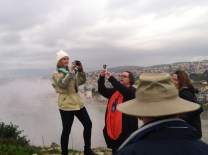
About a year ago, we were standing on that “brow of the hill” – or at least what is traditionally accepted as the spot. The modern city of Nazareth lies below the hill to the west, and Mt. Tabor can usually be seen off to the east, toward the Sea of Galilee. However, on the day we visited Mt. Precipice, it was rainy and cloudy. As the clouds rolled in over Nazareth, we had to use our imaginations to picture the vista below us. (You can see some photos in this blogpost.)

We could mostly make out Nazareth to the west, but the rich farmland to the south and the valley between us and Mt. Tabor to the east were completely obscured by clouds. I noticed that our little group of tourists reacted to this phenomenon in a surprising way. Keep in mind that we really couldn’t see anything – the view was completely obscured by clouds and rain.

But that didn’t stop us from lifting our phones and cameras. Even in the rain, we took as many pictures as we could. But do you notice something here? Everyone is looking in a different direction.

shawna and amanda taking photos on mt precipice2015-01-09 07.37.48

Here we are at the top of the very hill where Jesus was attacked by his own hometown, where his ministry might have ended before it had really begun…


tourists on mt precipiceAnd we are looking in every single direction, through the fog, for things we cannot see.

If we inch out to the edge of the path, we can look down the hillside and imagine a person being thrown down over those rocks. But the precipice itself is the only thing that is clearly visible, and it does not look too inviting.

The precipice of Mt Precipice 2015-01-09 07.46.49

Jesus knew his ministry was going to be rough. He knew he would ultimately “fail” just as Jeremiah’s had done. But here’s the thing: we don’t get to decide what failure looks like.

God did not call Jeremiah to convert the people of Judah, only to proclaim God’s word to them. If Jeremiah was expecting hundreds and thousands of people to repent and begin living according to God’s plan for them, he was deeply disappointed.

In the same way, Jesus failed to overthrow the Roman government as Messiah was expected to do. Instead, he died a horrible death, nailed to a cross. That looked like failure to many of the people who watched him die. But we don’t get to decide what failure looks like.

God’s idea of success can’t be measured in numbers of converts or military conquests. It can’t even be measured in Average Worship Attendance or Apportionments Paid, important as those things might be to our conference office.

God measures success in lives changed, in relationships restored. God measures success in every soul redeemed, in every person who turns away from death and sin, toward everlasting life. God measures success in the depth of love we show to people who are not like us, in the way our faith grows in maturity and richness, in the way our lives look more and more like the life of Jesus Christ, and less like the broken lives we leave behind when we choose to follow him.

I won’t sugar-coat this for you. We are about to enter a very challenging season, as we look at ways we must change what we do and how we think, if we are going to be faithful followers of Jesus Christ. Growing in faith means taking some risks. It means living into our call, no matter how uncomfortable that makes us.

Pastor Matt Kennedy writes, “ Experts who study organizational change say that groups basically have three phases of any transition they face: stability, de-stabilization, and new orientation. Every transition involves all three, and the most anxious moment in any change is going from stability to de-stabilization. This is what you see in the story of Israel in the Wilderness. When you enter that moment of destabilization, there is a strong gravitational pull back to the stable place, even if that stable place was being a slave in Egypt.” But for transitions to lead us into the new beginning God has in mind for us, we must be strong in faith, centered on Christ Jesus, depending completely on the power of the Holy Spirit to lead us through the anxiety of wilderness.

Because going through the wilderness is the only way to get to the promised land.

What does it mean for us to be centered and sent? Will we limit our view to a cloudy vision, constricted by a tiny lens in a viewfinder? Or will we open our eyes wide to the possibility God has in mind for us, and take in the broad vision of God’s call? It will not be easy. I assure you of that. But it can be fruitful, and we can experience spiritual renewal in ourselves that leads to a spiritual awakening in our community.

Following Jesus is very risky business, and we don’t get to decide what success looks like. Sometimes clouds of doubt obscure our vision, and we are unwilling to take a risk. Sometimes we are simply looking in the wrong direction, unaware that the broad vista behind us shows the magnitude of God’s grace. Sometimes we just have to step out on faith, depending on the Holy Spirit to guide us through the murkiness until we can see, in 20/20 hindsight, that every step of the way was part of God’s plan for us.

It may feel like we are teetering on the edge of a precipice, and the fog is obscuring our path. It may feel like we are entering the wilderness as we move through the changes we see necessary for our own growth and deepening discipleship. It may even feel, at times, like we are failing miserably. But God gives us his promise that He will be with us every step of the way. Let us claim that promise, and go with God. Amen.

[1] http://cep.calvinseminary.edu/sermon-starters/epiphany-4c/?type=old_testament_lectionary#sthash.s4Sd3EnI.dpuf