Category Archives: Sermons

God With Us: Endure with Hope – Sermon on Luke 21:25-36 Advent 1C

Video

Happy New Year!

That’s right. Today marks the beginning of the new church year. For you liturgy geeks, this is Year C in the Revised Common Lectionary cycle, which means we will be hearing a lot from the gospel according to Luke over the next 12 months.

But the gospel passage assigned for the first Sunday in Advent, this first Sunday in the new church year, does not come from the beginning of Luke. It comes from near the end, as Jesus is preparing his disciples for the time when he will no longer be with them in the flesh. Jesus has come to Jerusalem for one purpose only: to give his life for the redemption of us all. His earthly ministry is nearing its completion, and he knows it.

So see if this gospel reading sounds a little familiar, like something you’ve heard from Mark and John over the past couple of weeks:

Continue reading

Lamenting All the Saints

All Saints 2021

It’s been a long slog through pandemic times as we celebrate All Saints Sunday this year. We are weary of grief. Some of us cannot even weep anymore, as Jesus wept at the tomb of his friend Lazarus. We’ve grown numb to the pain, to the loss.

Some of us are too angry to cry. We’d rather shake our fists at God and yell for God to do something, anything. If God is so omnipotent, why is there no end in sight to this suffering? Does God even care?

Continue reading

Getting Closer to the Kingdom – sermon on Mark 12:28-34

Confirmation Sunday, October 31, 2021
Video

It’s Confirmation Sunday! Over the past several months, three young women have been exploring their faith to determine what they believe, and why they believe it. We’ve had some interesting conversations! If they’ve learned anything at all, they’ve learned that easy answers are never enough, and sometimes finding answers to our questions just raises more questions.

We joke sometimes that Confirmation is too often like graduating from church – once teenagers get confirmed, we never see them or their families again. But that isn’t the way it’s supposed to work.

These confirmands are just beginning a journey of faith that will carry them into adulthood. This isn’t the end of the road – it’s the starting line. This is where we equip young people with the basic tools of faith, and teach them how to use those tools, to continue to grow into Christ-likeness. As they move into the next stage of faith development, we the church come alongside them, helping them get closer to the Kingdom of God.

We just heard a couple of scripture passages that highlight the way the Law of the Old Testament is fulfilled in the New Testament through the saving work of Jesus Christ. Our gospel reading for today connects the dots between these two ideas – Law and Grace. It’s perfect for Confirmation Sunday! As these confirmands have wrestled with what they believe over the past few months, they have had to consider how the Law and Grace intersect at the point of personal faith in Jesus Christ.

Today’s reading from the Gospel according to Mark introduces us to a scribe – one of those legal experts who have been trying, along with the Pharisees, to trap Jesus. Only this particular scribe has been paying attention. He sees something in Jesus the others don’t see. And Jesus sees something in him we might not expect. Jesus can tell this particular scribe – just like our confirmands – is getting closer to the kingdom of God.

One of the legal experts heard their dispute and saw how well Jesus answered them. He came over and asked him, “Which commandment is the most important of all?”
Jesus replied, “The most important one is Israel, listen! Our God is the one Lord, and you must love the Lord your God with all your heart, with all your being, with all your mind, and with all your strength. The second is this, You will love your neighbor as yourself. No other commandment is greater than these.”
The legal expert said to him, “Well said, Teacher. You have truthfully said that God is one and there is no other besides him. And to love God with all of the heart, a full understanding, and all of one’s strength, and to love one’s neighbor as oneself is much more important than all kinds of entirely burned offerings and sacrifices.”
When Jesus saw that he had answered with wisdom, he said to him, “You aren’t far from God’s kingdom.” After that, no one dared to ask him any more questions.
– Mark 12:28-34

What’s the most important commandment of all?

613 rules define what was known as The Law. But the first rule, the first commandment in the Ten Commandments, is known as the Shema: “Hear, O Israel!” The Lord our God, the Lord is One!” Or, as our modern translations put it: Israel, listen! Our God is the Lord! Only the Lord! This acclamation of who God is doesn’t even sound like a Commandment. It’s more of an affirmation of faith. Our God is the One, the Only One. Not a bunch of little statues made out of wood or stone, but a living, all-powerful being who made us to reflect that one-ness. Pretty powerful stuff, when you think about it.

But the second most important commandment of all does sound like a true command. Or does it? “You will…” (or ‘Thou shalt’) could mean “do this.” It could also mean “this is what will happen” – not so much a command, as a prediction.

Because when we love God with all our heart, soul, mind, and strength, doesn’t it just naturally follow that we will love our neighbor as ourselves? When loving God is at the very core of who we are, won’t we naturally want to include others in that vast love?

You’d think so, wouldn’t you? And yet, throughout history, we know that has never really been the case for God’s people. Maybe it’s because we don’t love God as deeply as we say we do. Maybe it’s because we get distracted by satisfying our own needs and desires, and forget to look out for the needs of others.

Whatever the reason, the simple truth is we don’t do a very good job of loving God or loving our neighbors. Left to our own devices, we would never even get close to the Kingdom of God. We might talk the talk, but we don’t do a very good job of walking the walk. No wonder people outside the church call us hypocrites.

Come to think of it, that’s what Jesus often called the scribes and Pharisees. Scribes just like this one, who notices Jesus is teaching real truth. This legal expert, who would normally be on the opposite side of any argument with Jesus, finds himself in complete agreement. Perhaps no one is more surprised about this than the scribe. “You aren’t far from God’s kingdom,” Jesus tells him. And I can’t help but imagine these two men locking eyes in mutual recognition, nodding to one another with a little smile that says, “You get me. Cool.”

But the best part of this story, in my opinion, is the last line. “After that, no one dared ask him any more questions.” It’s the first century Palestinian version of the mic drop. Boom.

But here’s the good news. You can ask Jesus anything. The ones who wouldn’t dare ask him any more questions were only trying to trap him into saying something they could use against him.

But when we recognize Jesus for who he is, when we see that the most important rule is the rule of love, and we start to live according to that rule, Jesus locks eyes with us and smiles. You’re getting closer to God’s kingdom, he tells us. Or, as John Wesley would say, “you’re going on toward perfection.”

In a moment, you will see a short video of a Zoom call among our candidates for confirmation. They will tell you what they can confirm about their faith right now. This is not the end of their story. It’s the beginning. I hope, as you listen, your own faith is kindled anew. I hope you find yourself coming maybe just another step closer to the kingdom of God.

Faith Works: Pray for One Another – Sermon on James 5:13-20

September 26, 2021
Video

We’ve made it to the final chapter of James, and the final message in this series called Faith Works. James has urged us to avoid showing favoritism to the rich, he’s admonished us to be slow to speak, but quick to listen, and he’s given us further instruction on taming our tongues. Last week, James compared heavenly wisdom to earthly wisdom, encouraging us to lean into wisdom that comes from God. We can recognize that kind of wisdom as “first pure, then peaceable, gentle, willing to yield, full of mercy and good fruit, without a trace of partiality or hypocrisy” (James 3:17), and the result of cultivating this kind of wisdom is “a harvest of righteousness.” (3:18)

When James compares heavenly wisdom to earthly wisdom, something else becomes clear, and it’s the underlying lesson James has been trying to teach us throughout this letter: wisdom from God focuses our attention on the needs of others, while earthly wisdom focuses our attention on ourselves. This whole letter is about how to behave toward one another, so our lives will reflect faith at work in us. Because when we work our faith, we develop a faith that really works. One place we can really see our faith growing is in the practice of prayer. You might think James is going to focus on how prayer connects us to God, but James knows the way prayer really helps our faith grow is in our prayers for each other.

Continue reading

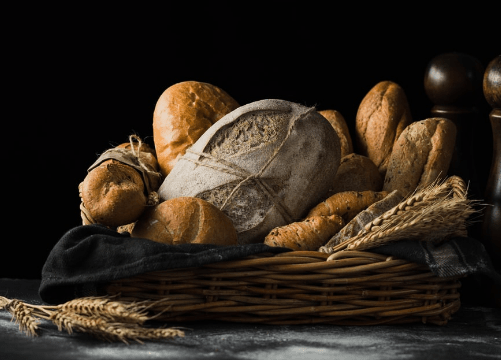
Bread for All: Bread of Life – Sermon on John 6:(22-23) 24-35

August 1, 2021
Video

Children’s Message
Last week we heard the story of Jesus feeding 5000 people with bread and fish that kept multiplying until everyone had enough, and there was some left over. I talked about how, in Communion, we break the bread just as Jesus did, and ask God to make us be the Body of Christ for the whole world, as we eat it together.
Today we will hear Jesus talk about himself as the Bread of Life, and I want to help you understand how we see Jesus giving himself to us when we receive Communion.
Who knows what a symbol is? It’s usually a picture or an object that stands for something else. For example, we have a steeple on our church building, and that’s a symbol for our purpose as a church. The church is supposed to point people to God. Some churches believe that the bread and the juice we use for Communion are just symbols of Jesus to remind us that he gave himself for us. In the Methodist Church, we say the bread and cup become Christ’s real presence among us when we take them. They are more than just a symbol.
So let’s go back to the steeple on our church. Did you ever play “here is the church, here is the steeple, open the door and see all the people?” Let’s do it together. See, the steeple is just a symbol of what the church does – it points people to Jesus. But when you open the door and see all the people, they are the real presence of Christ in the world. It’s the people in the church who point others to God. Let’s pray.
Jesus, help us point others to you for real, not just be a symbol of you. We love you, Jesus. Amen.

Continue reading

Why Are You Afraid? – Sermon on Mark 4:35-41

Pentecost B+4 Video

For the past six months, this church has been in transition between pastors. It’s been my privilege to walk with you through this season of change. Back in January I told you it was a “liminal” season, a time on the threshold between what has been and what will be. The thing about standing on that threshold is that we can’t quite see what that change is bringing. Some of us face this uncertainty with dread, while others see possibilities the future promises. In fact, we aren’t so different from the disciples who followed Jesus through Galilee as he taught and healed and shared the good news of God’s kingdom coming into the world

Those disciples knew they were on the cusp of change, but they couldn’t imagine what lay ahead. Some of them were convinced Jesus would soon lead them in a military takeover. Others were confused by the way he turned upside down everything they had known to be true.

But there was one thing they could all agree on: Jesus was worth following. Staying close to Jesus was worth risking everything, even their lives. In today’s gospel reading, they get to do just that.

Continue reading

Four Questions – Sermon on Acts 8:26-40

Video of this sermon from May 2, 2021

Our readings from the Book of Acts have been skipping all over the place in these weeks after Easter. Instead of a logical, sequential story line, we’ve danced all around the healing of a crippled man at the Beautiful Gate, without ever hearing the story itself. And we won’t get back to Chapter Two, where all the post-resurrection activity began, until the Day of Pentecost at the end of Eastertide.

Today’s reading is literally full of hops, skips, and jumps. At this point, you might be wondering why this whole sermon series is even called “Getting our ACTS Together.” It seems so disorganized and chaotic. Stay with me. Our story is shifting from Peter and John to Philip the Deacon. The ride might get bumpy, so hold on.

Continue reading

“Anything Good?” – Sermon on John 1:43-51 for Epiphany 2B

This is the second Sunday after the Epiphany, and even though our focus for this church year will be in Mark’s gospel, the second Sunday after the Epiphany always brings us to John. We’re still in the first chapter, and our reading today will bring us to “what happens next” after Jesus is baptized.

Continue reading

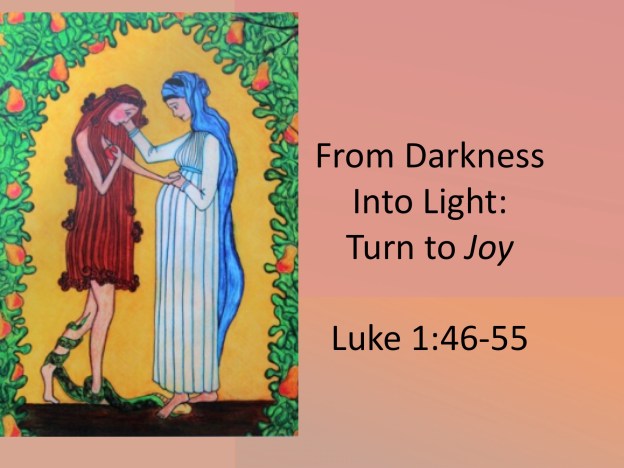
From Darkness into Light: Turn to Joy – Sermon on Luke 1:46-55

Have you ever wondered why one of the Advent wreath candles is a different color than the others? In the traditional church calendar, the third Sunday of Advent is called “Gaudete” Sunday. Gaudete is Latin for “Rejoice!” We light a rose-colored candle, to contrast with the purple or blue candles used on the other three Sundays of Advent, to represent joy.

In the early church, Advent was a penitential season, much like the season of Lent. New believers prepared for baptism through spiritual practices such as prayer and fasting. Gaudete Sunday was a break from that fast, a time to rejoice in the promise of Christ’s coming as Emmanuel, God With Us.

One of the features of Gaudete Sunday is the use of Mary’s song from the first chapter of Luke. Next week, we will get the story surrounding this song, now known as the Magnificat – that’s Latin for the first word in the song: “magnify”. We’ll hear how Mary sings this song when her relative Elizabeth greets her and calls her ‘blessed.’ This week on the third Sunday of Advent, the Sunday of Joy, let’s focus on the song itself:

Continue reading

From Darkness Into Light: Awake to Hope – Sermon on Mark 13:24-37 for Advent 1B

Watch a video of this sermon from November 29, 2020.

“But in those days, after that suffering, the sun will be darkened, and the moon will not give its light, and the stars will be falling from heaven, and the powers in the heavens will be shaken. Then they will see ‘the Son of Man coming in clouds’ with great power and glory. Then he will send out the angels, and gather his elect from the four winds, from the ends of the earth to the ends of heaven.

“From the fig tree learn its lesson: as soon as its branch becomes tender and puts forth its leaves, you know that summer is near. So also, when you see these things taking place, you know that he is near, at the very gates. Truly I tell you, this generation will not pass away until all these things have taken place. Heaven and earth will pass away, but my words will not pass away.

“But about that day or hour no one knows, neither the angels in heaven, nor the Son, but only the Father. Beware, keep alert; for you do not know when the time will come. It is like a man going on a journey, when he leaves home and puts his slaves in charge, each with his work, and commands the doorkeeper to be on the watch. Therefore, keep awake—for you do not know when the master of the house will come, in the evening, or at midnight, or at cockcrow, or at dawn, or else he may find you asleep when he comes suddenly. And what I say to you I say to all: Keep awake.”

Mark 13:24-37 (NRSV)

Do you ever find yourself lying awake in the middle of the night? I think the older I get, the more trouble I have staying asleep. It used to be thinking about work I needed to get done, or dreaming about how I would redo my kitchen if I won the lottery… now it’s more likely the aches and pains of aging that keep me awake at night. But one of the key causes of insomnia is stress, and during the pandemic, lots of people were experiencing sleeplessness as a side effect of pandemic stress. Researchers even coined a term for it: “Caronasomnia”.[1]

Continue reading