Category Archives: Sermons

Making All Things New – sermon on Revelation 21:1-6

April 24, 2016 Easter 5C

Will your mourn with me? Will you rejoice with me? Twice before I have preached on this text from the book of Revelation, but they were both funeral sermons. Twice this week, we have gathered in this sanctuary to celebrate the promise of eternal life for members who have gone to be with the Lord.

Friday night, as I finished one funeral sermon and sat down to review my notes for this one, I was listening to a live broadcast of The Minnesota Chorale and the Minnesota Orchestra performing the Brahms Requiem under the direction of Helmuth Rilling. Some of you know that I sang under Herr Rilling’s direction for eight years, and we performed this beautiful work by Johannes Brahms at least twice in that time. I knew what to listen for on Friday night. “How lovely is thy dwelling place… blessed are they who die in the Lord …”

Brahms didn’t use the standard Requiem Mass Latin text, but put together selections from scripture, using the Luther Bible. He wanted the words to be easily understood in the language of the people. It was a new way of presenting a Requiem. No composer had ever done something like this before. “Blessed are those who mourn, for they shall be comforted. All flesh is grass.” This beautiful music has given comfort to many who grieve.

But something stood out to me this week, as we laid Mike and Florian to rest, and as I listened to Brahms. Continue reading

Fish and Sheep – Sermon on John 21:1-19

Easter 3C
April 10, 2016
Watch a video of this sermon here.
An updated version of this sermon can be found here.

Many psychologists will tell you that there are two things all human beings need in order to live happy, productive lives: we need a sense of belonging, and we need a sense of purpose (David Lose). By “belonging” I don’t mean “fitting in.” In fact, fitting in might be the exact opposite of belonging. When you try to fit in, you adapt yourself to a group’s expectations. When you belong, you don’t have to change a thing. You are accepted the way you are. Being accepted as we are by a larger group gives us a stable view of ourselves, and helps us shape our individual identity, according to the psychologists.

And a sense of purpose gives us a reason to get up in the morning. We need to believe that what we do matters, that we make a difference in the world. Our sense of purpose drives our decisions about the way we spend our time and energy and financial resources. Believing that your life has meaning and value can motivate you to face challenging circumstances with courage and perseverance, even joy.

We need to feel like we belong, and we need to feel like we have a purpose in life. In today’s gospel lesson, Jesus offers us both. Continue reading

What’s in a Name? Sermon on Acts 2:37-47

April 3, 2016
Watch a video of this sermon here.

When my older son was in third grade, he decided to change his name. The name he had been given at birth was no longer an option. A girl in his class had the same name. It was spelled differently, but it sounded the same. They were both Gail. And that would not do. So for several months, he tried out different options. The one that lasted the longest was “Spike.” Over the summer, the name thing seemed to be less of an issue, but when school began in the fall, I wondered what he would want to call himself. I didn’t have to wait long to find out. On the afternoon of the first day of fourth grade, I got a phone call from my son’s teacher.

It seems she had distributed index cards to each of her students at the beginning of the day, and had asked them to write across the top of the card their full names, as those names appeared in her official records. Then she said, “Underneath your full name, write the name you want me to call you. For example, if your name is Robert but you want me to call you Bobby, write it down so I’ll know.” My son had written “Gail Young II” across the top, and underneath that, he’d written, “Kevin.” The teacher wanted to know where this name had come from. I had to think a minute. It did sound familiar. Then it struck me. Kevin is Bruce’s middle name. My son, Gail, had decided to name himself after his step-dad, Bruce. That name has stuck, more or less, for more than 25 years.

“What’s in a name?” Shakespeare’s Romeo once asked Juliet. While a rose by any other name might smell as sweet, in the Bible, a name has great significance. A name carries with it the essence of a person’s character. Your name defines what kind of person you are. But what happens when your name changes? As we move from the shock of Easter morning into the beginning of the Christian era, we find a group of Jesus’ followers who struggle to define their identity. Like my son, who had to try on several names before he found one that fit the way he saw himself and wanted others to see him, these early followers of Jesus didn’t know quite what to call themselves. Continue reading

Resurrection Hope – Sermon on Luke 24:1-12 EasterC

March 27 2016

But on the first day of the week, at early dawn, they came to the tomb, taking the spices that they had prepared. They found the stone rolled away from the tomb, but when they went in, they did not find the body. While they were perplexed about this, suddenly two men in dazzling clothes stood beside them. The women were terrified and bowed their faces to the ground, but the men said to them, “Why do you look for the living among the dead? He is not here, but has risen. Remember how he told you, while he was still in Galilee, that the Son of Man must be handed over to sinners, and be crucified, and on the third day rise again.” Then they remembered his words, and returning from the tomb, they told all this to the eleven and to all the rest. Now it was Mary Magdalene, Joanna, Mary the mother of James, and the other women with them who told this to the apostles. But these words seemed to them an idle tale, and they did not believe them. But Peter got up and ran to the tomb; stooping and looking in, he saw the linen cloths by themselves; then he went home, amazed at what had happened. – Luke 24:1-12

You’ve heard this story before, right? It has either changed your life, or you have let it wash over you every year without having any measurable effect on you. It’s an all or nothing story. Either it makes no difference to you at all, or it makes all the difference in the world to you. Why is that? Why do some of us listen to this story year after year, but never see why it matters?

My guess is that some of us aren’t very different from those first disciples who heard the news from the women – this message doesn’t make any logical sense, and so we dismiss it as an “idle tale.” Or maybe we accept the story as fact, but it happened so long ago, we can’t imagine how it matters to us now, in our current situation. You might believe it, but it hasn’t changed the way you act or think. Your life has not yet been transformed by the story of Jesus’ resurrection from the dead.

I could give you a verse-by-verse explanation of the important details Luke puts into his version of the resurrection story, and we could compare and contrast Luke’s version to the other gospels. I might even be able to share some bit of knowledge from biblical scholars with you that you didn’t know before, and if you could remember it past coffee time, you could discuss it with others over Easter dinner. But it would not change your life. And Jesus died and rose again to change your life. Continue reading

Hope Aflame: Even the Rocks – Sermon on Luke 19:39-48

Palm Sunday, March 20, 2016

Watch a video of this sermon here.

At the beginning of the service, we heard Luke’s account of the Palm Sunday parade. Only Luke doesn’t mention palms, and he doesn’t tell us that the crowds were crying out ‘Hosanna!’ either. Instead, Luke tells us that the “whole multitude of the disciples began to praise God joyfully with a loud voice for all the deeds of power that they had seen, saying,

“Blessed is the king who comes in the name of the Lord!
Peace in heaven, and glory in the highest heaven!”

The crowds are shouting the same refrain the angels sang at Jesus’ birth: “Glory to God in the highest heaven, and on earth peace among those whom he favors” (Luke 2:14). Just as the angels announced the birth of Jesus, now the disciples announce the coming of Messiah into his kingdom. But, even though they claim to know that Jesus is the Messiah, they still don’t quite understand what that really means.

Some of the Pharisees in the crowd said to him, “Teacher, order your disciples to stop.” He answered, “I tell you, if these were silent, the stones would shout out.”

As he came near and saw the city, he wept over it,  saying, “If you, even you, had only recognized on this day the things that make for peace! But now they are hidden from your eyes. Indeed, the days will come upon you, when your enemies will set up ramparts around you and surround you, and hem you in on every side. They will crush you to the ground, you and your children within you, and they will not leave within you one stone upon another; because you did not recognize the time of your visitation from God.”

Then he entered the temple and began to drive out those who were selling things there; and he said, “It is written,

‘My house shall be a house of prayer’; but you have made it a den of robbers.”

 Every day he was teaching in the temple. The chief priests, the scribes, and the leaders of the people kept looking for a way to kill him; but they did not find anything they could do, for all the people were spellbound by what they heard. – Luke 19:39-48


Last January, I walked with our tour group down the pathway from the Mount of Olives, following Palm Way in a pilgrims’ procession. We had started out early in the morning, and even though most of the trip had been cold and rainy, this day was filled with sunshine. Continue reading

Burning Hope: The Kingdom of God is Near – Sermon on Luke 10:1-12


March 13, 2016

Note: The congregation of First United Methodist Church received a report from its Healthy Church Initiative consulting team earlier in the service. That report identified five strengths and five concerns for this congregation’s future growth. Five recommendations were also part of this report, but these recommendations were shared at a potluck dinner following worship. You can learn more about the report and the process at the church’s website.

You’ve just heard the first two thirds of our Healthy Church Initiative Report. Reports like this always try to give you the good news first. I think that’s so you’ll be nice and comfortable, feeling good about yourself and relaxed before they sucker punch you with the bad news. But did any of these concerns sound insurmountable to you? Did any of them knock the wind out of you?

In our reading today from Isaiah, the prophet tells us that God is about to do a new thing. “Do not remember the former things, or consider the things of old,” says the Lord. God is about to do a new thing for his people, the ones he claims as his own. God says these are “the people whom I formed for myself so that they might declare my praise.” That’s our purpose in life: to declare God’s praise.

We do that through our strengths of hospitality, commitment to love and serve, spiritual leadership, things like Wednesday Night and NUMAS Haus that demonstrate our capacity to expand ministry, and even through this well-placed and well-maintained building.

But fulfilling our purpose to declare God’s praise takes more than identifying our strengths. In fact, relying on our own strength alone won’t get us where we need to be at all. The Apostle Paul makes this clear in his letter to the Philippians when he writes that he has more reason than anyone to be confident in the flesh, that is, confident in his own strength. Continue reading

Kindled Hope: Following Jesus – Sermon on John 1:29-42 (and 6:56-69)


March 6, 2016

Welcome to the New Testament! We managed to condense those four hundred years of prophetic silence between the last writings of the Old Testament and the birth of Christ into a single week! And since we heard the story of Jesus’ birth back in December, we’re skipping ahead about thirty years to the beginning of Jesus’ ministry in Galilee. This week, our story takes us to the day after Jesus is baptized. The hope that was kindling at the end of the last chapter in God’s story has caught flame in this new chapter. The kingdom of God is breaking into our world.

Here’s the scene: John the Baptist notices Jesus walking down the street, and points out the Lamb of God to a handful of his own disciples. John tells them about his own experiences of baptizing Jesus the day before, and his disciples take off after Jesus.

The next day he saw Jesus coming toward him and declared, “Here is the Lamb of God who takes away the sin of the world! This is he of whom I said, ‘After me comes a man who ranks ahead of me because he was before me.’ I myself did not know him; but I came baptizing with water for this reason, that he might be revealed to Israel.” And John testified, “I saw the Spirit descending from heaven like a dove, and it remained on him. I myself did not know him, but the one who sent me to baptize with water said to me, ‘He on whom you see the Spirit descend and remain is the one who baptizes with the Holy Spirit.’ And I myself have seen and have testified that this is the Son of God.”
The next day John again was standing with two of his disciples, and as he watched Jesus walk by, he exclaimed, “Look, here is the Lamb of God!” The two disciples heard him say this, and they followed Jesus. When Jesus turned and saw them following, he said to them, “What are you looking for?” They said to him, “Rabbi” (which translated means Teacher), “where are you staying?” He said to them, “Come and see.” They came and saw where he was staying, and they remained with him that day. It was about four o’clock in the afternoon. One of the two who heard John speak and followed him was Andrew, Simon Peter’s brother. He first found his brother Simon and said to him, “We have found the Messiah” (which is translated Anointed). He brought Simon to Jesus, who looked at him and said, “You are Simon son of John. You are to be called Cephas” (which is translated Peter). – John 1:29-42

This story gives us three simple actions that point people to Jesus. Continue reading

Kindling Hope: Building with Courage – Sermon on Nehemiah 8:1-12

February 28, 2016

How is your Lenten journey going? Or, as Wesley would put it, “How is it with your soul?” However you ask it, the question holds us each accountable for the hard work of being a disciple.

Following Jesus isn’t always easy, but these days in the middle of Lent always seem to require more of me. The novelty of my commitment at the beginning of Lent has worn off, and the anticipation of Resurrection glory is still too far in the future. Here in the middle, I need someone walking the journey with me, to ask after my soul and keep me walking the discipline I promised to follow at the beginning of Lent. That’s why I hold myself accountable to you!

You might remember that Bruce inspired me to give up sugar this year. So far, I’ve managed to stay away from sweets and desserts, but Bruce even gave up peanut butter, because he noticed that sugar is the second ingredient listed on the label.

I decided not to be that picky, and there was about enough peanut butter left in the jar for one sandwich, so I had a peanut butter sandwich for lunch on Friday. No jelly, just peanut butter. And I was surprised to realize I could taste the sugar. Commercial peanut butter is really sweet. Peanut butter is part of my standard diet. I love peanut butter. But I didn’t notice the sugar in it until I’d gone without sugar for three weeks.

Remembering just how much hidden sugar there is in processed food also reminds me of just how much hidden sin there is in my life. Isn’t it just like the devil to make us think we aren’t sinning when we really are? We get accustomed to our patterns of sin, and soon they don’t seem quite so sinful. We don’t recognize the sugar in our peanut butter. We get used to it.

That’s what had happened to the Jews who returned from exile. They had lived away from God’s law for so long, they’d gotten used to it. They had forgotten what it meant to be faithful to God, to worship God in the temple, and submit themselves to God. Continue reading

Kindling Hope: For Such a Time as This – Sermon on Esther 4:6-17

February 21, 2016 (Lent 2C)

The story reads like a melodrama. For hundreds of years, there was lots of argument about this story. Did it belong in the Bible or not? Some Jewish scholars loved it, but Martin Luther hated it and wished it didn’t exist. The story has some unique literary and theological features that suggest Luther might have had a point:

  • The details of the plot seem exaggerated and the main characters aren’t developed very well, from a literary standpoint.
  • Historical accuracy is questionable, at best.
  • There’s enough sex and violence to make the story into a movie, but we tend to fast forward through those parts when we are in church.
  • The actions of the characters do not reflect their faith so much as struggles about their ethnic identity.
  • Most problematic of all, the story never mentions God by name.
  • Neither is prayer or worship mentioned, though we can make some assumptions that prayer, at least, plays an important part in the climax of the story.

With all this going against it, we have to wonder how the story of Esther made it into the Bible at all. Yet, there it is. Accepted as the Word of the Lord, even though the Lord is never mentioned.

Some scholars insist that the story of Esther was made up to justify celebrating the Feast of Purim – or the feast of dice. It’s a major Jewish celebration, but it is not one of the feasts named in the Law of Moses. During Purim, people dress up in costumes, put on silly plays, and enjoy lots of food.

There is even a tradition that encourages drinking wine in excess, just as King Xerxes and his guests did at their feasts. But the humor and silliness of the celebration highlight an underlying seriousness. The story is about escaping death, after all.

Kathryn M. Schifferdecker writes, “Indeed, the joke goes that Jewish holidays can be summed up in this way: “They tried to kill us. We survived. Let’s eat!”[1]

So what does the story of Esther tell us about God and God’s plan to win his people back? The answer is found right in the middle of the story, in chapter four. Continue reading

Kindling Hope: Coming Home – Sermon on Haggai 1:2-9 for Lent 1C

February 14, 2016 (You can watch a video of this sermon here.)

Going home as an adult is quite an experience. Everything looks smaller than when you were a kid. Visiting my parents after I had been away for several years, the house seemed smaller, my bedroom was smaller, everything was familiar, but different. Visiting my old elementary school – everything looked smaller. It was exactly the same as I remembered it from childhood, but it was different, too.

Imagine what it would be like to leave your home as a small child, and then return to that same place when you retired. Other people would be living in your house. Businesses would have moved in and out of town. Buildings that stood tall when you were a child would be gone. Trees that had been saplings when you left would be tall and full. Everything would be the same, but it would be different. That’s what happened to the Israelites. Only now, for the first time in the Old Testament, they were called “the Jews.” (Ezra 4:23)

It had been more than 60 years since the exile into Babylon. That kingdom had been taken over by Cyrus of Persia, and Cyrus had issued a decree to allow the people of Israel to return to Jerusalem. More than 42,000 had accepted the invitation to return to their homeland. Some of those who made the trip had never seen Jerusalem, so they didn’t know what to expect. But others had been young enough to remember the glory of Solomon’s temple. They had carried that memory with them in hope of this very day.

The prophet Ezra writes that the returning exiles immediately set up the altar “because they were in dread of the neighboring peoples” (Ezra 3:3). Even though they were returning to the land that God had given them as an inheritance, they were afraid. They turned to God for protection and shelter.

We have to remember that the ‘neighboring peoples’ included that remnant of the poorest Jews, who had been left behind in the exile. They had been scratching out an existence among the rubble for more than sixty years. It isn’t hard to imagine that tensions arose between the returning exiles and those who had been left behind. There would have been questions of land ownership, who was to govern, who could be priests, and how they would share the limited resources that were available. Rebuilding the altar was not just a religious act, it had legal, political, and social implications for this newly integrated nation.[1]

Even so, the ones who returned set about the work of worshiping God, and as soon as the altar was in place and sacrifices were being offered, work began on the foundation of the Temple itself.
2015-01-12 11.43.58 dressed stone temple

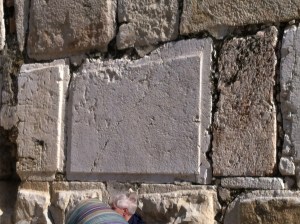
Nothing is left of Solomon’s temple, or even the second temple that the returning exiles built in its place. Dressed stones from Herod’s temple, the temple that Jesus knew, give you some idea of the immensity of the project. These massive blocks are about three feet high and six feet across. When we visited the Temple mount last year, the guide told us we could tell which ones had come from Herod’s temple because of the dressed edge around each stone facing.

great shot not one stone upon anotherThese were the same stones that the disciples pointed out to Jesus. But Jesus refused to be impressed. “You think these are something?” he asked them. I have news for you. “Not one stone will be left upon another. All will be thrown down.” (Matthew 24:2; Mark 13:2; Luke 21:6)

 

2015-01-12 11.57.08Herod would cut new stones for the temple he built, but the returning exiles had only the materials at hand, and that meant the stones that had fallen when Solomon’s temple had been destroyed.


This wasn’t neat and tidy work, as it had been in Solomon’s day, when the stones were carefully dressed at the quarry and set together without tools. This was slap-dash, “fill in the chinks with mortar, don’t take time to make it pretty” work. Solomon had built out of strength and glory. This foundation was laid out of weakness and fear.

Ezra describes for us the noisy business of laying this foundation:

“10 When the builders laid the foundation of the temple of the Lord, the priests in their vestments were stationed to praise the Lord with trumpets, and the Levites, the sons of Asaph, with cymbals, according to the directions of King David of Israel; 11 and they sang responsively, praising and giving thanks to the Lord, “For he is good, for his steadfast love endures forever toward Israel.” And all the people responded with a great shout when they praised the Lord, because the foundation of the house of the Lord was laid. 12 But many of the priests and Levites and heads of families, old people who had seen the first house on its foundations, wept with a loud voice when they saw this house, though many shouted aloud for joy, 13 so that the people could not distinguish the sound of the joyful shout from the sound of the people’s weeping, for the people shouted so loudly that the sound was heard far away.” (Ezra 3:10-13)

“For he is good, for his steadfast love endures forever toward Israel.” This was the same song sung at the dedication of Solomon’s temple (2 Chronicles 5:13) but this song of praise was “mingled with weeping from those who had seen the temple in its former glory.”[2] Those who could remember Solomon’s great temple found it impossible to celebrate this new foundation. Instead, they wept at this puny substitute. Yes, it was time to celebrate the fulfillment of prophecy, but what a disappointment that fulfillment was to them! Instead of joy, the ones who could remember the good old days felt only loss.

When we are discouraged and we harbor disappointment, we are most vulnerable to opposition. There isn’t much room for courage and determination in the middle of a pity party. This is when attacks can do the most damage, and that’s exactly what happens next in the story of the returned exiles. Their neighbors began to challenge their right to build, even their ability to build. Their neighbors made it as difficult as possible for the work to continue, and under this pressure, the work stopped. Ezra writes,

“4 Then the people of the land discouraged the people of Judah, and made them afraid to build, and they bribed officials to frustrate their plan throughout the reign of King Cyrus of Persia and until the reign of King Darius of Persia.” (Ezra 4:4-5)

2015-01-12 12.00.10

The work halted when opposition came along, as opposition always will. For many years, the stones lay stacked and ready to build, but no one did the building. Instead, they focused their attention on building their own homes. Life in Israel was a struggle. Building the temple got moved to the back burner, as the people turned their attention to their own needs and desires.

Haggai rose up as a prophetic voice to call the people back to the work they had been given to do.

Thus says the Lord of hosts: These people say the time has not yet come to rebuild the Lord’s house. Then the word of the Lord came by the prophet Haggai, saying: Is it a time for you yourselves to live in your paneled houses, while this house lies in ruins? Now therefore, thus says the Lord of hosts: Consider how you have fared. You have sown much, and harvested little; you eat, but you never have enough; you drink, but you never have your fill; you clothe yourselves, but no one is warm; and you that earn wages earn wages to put them into a bag with holes.

 Thus says the Lord of hosts: Consider how you have fared. Go up to the hills and bring wood and build the house, so that I may take pleasure in it and be honored, says the Lord. You have looked for much, and, lo, it came to little; and when you brought it home, I blew it away. Why? says the Lord of hosts. Because my house lies in ruins, while all of you hurry off to your own houses. (Haggai 1:2-9)

Here’s the good news: the people listened to Haggai, and they repented. They got to work building the house of the Lord. It didn’t look like much, especially when compared to the fond memory of Solomon’s temple, but it was the Lord’s. And the people prospered.

In the second chapter of Haggai, the Lord asks the people, “Who of you is left who saw this house in its former glory? How does it look to you now? Does it not seem to you like nothing? But now be strong, … Be strong, all you people of the land, and work. For I am with you,’ declares the Lord Almighty.  And my Spirit remains among you. Do not fear.’” (Haggai 2:2-5)

Today is the first Sunday of the season of Lent. During these forty days, God calls us to repentance. Since the very beginning, God has been working out his great purpose in us, to redeem us to himself if we will only turn to him.

In a devotional written for Ash Wednesday, J. D. Walt urges us to “realize that Jesus was not plan B or plan C. Jesus was always plan A. For God to create human beings in his own image meant they would be made in the image of perfect love. To be made in the image of perfect love meant they would be endowed with perfect freedom. And to be endowed with perfect freedom necessarily required the possibility of choosing something other than the will of God, which is the way of love. … God is not love because he loves. God loves because he is love. In similar fashion, a person is not a sinner because he sins. Rather, a person sins because he is a sinner.”

But we don’t have to stay stuck in that identity, anymore than the returned exiles had to stay stuck in their self-pity over the loss of the great temple they remembered from long ago. They repented of living in fear instead of courage. They repented of putting themselves before God. They repented of leaving the work for someone else to do. They repented, and started building.

Here we stand at the beginning of Lent, but also at the beginning of a process called Healthy Church initiative. It’s a process that gives us the opportunity to use the stones of our past that are still good and sound, to build a foundation for the future into which God is calling us.

Now is our time to return to the call God made on this congregation 158 years ago when a German Methodist missionary named Henry Singenstreu came to New Ulm to reach people who didn’t even know they needed Jesus.

Now is our time to repent of living in fear instead of courage.

Now is our time to repent of putting our own comfort and interests ahead of God’s call on our lives.

Now is our time to repent of leaving the work for others to do.

Now is our time to repent of the grudges we’ve held and the hurts we’ve nursed, to let go of our skepticism and our pride.

It’s time to admit to Jesus what he already knows — “that [we] are tired of living from the stuck identity of sinners, which is death, and that [we] are ready to live from the unleashed identity of [beloved children of God], which is life.” As J. D. Walt puts it, “It’s time to repent and believe the Gospel, which isn’t so much trying harder to stop sinning and start loving as it is to stop seeing oneself as a sinner and start seeing oneself as a lover…. And what is the Gospel? It is this: “But God demonstrates his own love for us in this: While we were still sinners, Christ died for us.” (Romans 5:8)[3]

The Jews who returned to Israel had to figure out what it meant to live into a future that they could not see, but they knew God was creating right in their midst. What was past was past. But God was kindling a new hope in them, and he promised that his Spirit would remain with them. They had no reason to fear or be discouraged. God didn’t need a fancy new temple of stone. God wanted to establish his temple in the hearts of his people.

God speaks through the prophet Haggai to us, more than 2500 years later.

“My Spirit remains among you. Do not fear. … The glory of this present house will be greater than the glory of the former house,’ says the Lord Almighty. ‘And in this place I will grant shalom,’ declares the Lord Almighty.”

The work that lies ahead may discourage us. We may long for the glory days of this congregation’s past. But we don’t have to stay stuck there. God calls us to repent, and to start building. What God calls us to build probably won’t look anything like what some of us remember. But God promises to be with us, and God asks us to have courage and not fear. “The glory of this present house will be greater that the glory of the former house,” says the Lord Almighty.

May it be so.

Next week – Kindling Hope: For Such a Time as This (Esther’s Story)

[1] Michael J Chan http://www.workingpreacher.org/preaching.aspx?commentary_id=2570

[2] Ibid.

[3] J. D. Walt  http://dailytext.seedbed.com/2016/02/10/ash-wednesday-2/