Burning Hope: The Kingdom of God is Near – Sermon on Luke 10:1-12


March 13, 2016

Note: The congregation of First United Methodist Church received a report from its Healthy Church Initiative consulting team earlier in the service. That report identified five strengths and five concerns for this congregation’s future growth. Five recommendations were also part of this report, but these recommendations were shared at a potluck dinner following worship. You can learn more about the report and the process at the church’s website.

You’ve just heard the first two thirds of our Healthy Church Initiative Report. Reports like this always try to give you the good news first. I think that’s so you’ll be nice and comfortable, feeling good about yourself and relaxed before they sucker punch you with the bad news. But did any of these concerns sound insurmountable to you? Did any of them knock the wind out of you?

In our reading today from Isaiah, the prophet tells us that God is about to do a new thing. “Do not remember the former things, or consider the things of old,” says the Lord. God is about to do a new thing for his people, the ones he claims as his own. God says these are “the people whom I formed for myself so that they might declare my praise.” That’s our purpose in life: to declare God’s praise.

We do that through our strengths of hospitality, commitment to love and serve, spiritual leadership, things like Wednesday Night and NUMAS Haus that demonstrate our capacity to expand ministry, and even through this well-placed and well-maintained building.

But fulfilling our purpose to declare God’s praise takes more than identifying our strengths. In fact, relying on our own strength alone won’t get us where we need to be at all. The Apostle Paul makes this clear in his letter to the Philippians when he writes that he has more reason than anyone to be confident in the flesh, that is, confident in his own strength. Continue reading

Kindled Hope: Following Jesus – Sermon on John 1:29-42 (and 6:56-69)


March 6, 2016

Welcome to the New Testament! We managed to condense those four hundred years of prophetic silence between the last writings of the Old Testament and the birth of Christ into a single week! And since we heard the story of Jesus’ birth back in December, we’re skipping ahead about thirty years to the beginning of Jesus’ ministry in Galilee. This week, our story takes us to the day after Jesus is baptized. The hope that was kindling at the end of the last chapter in God’s story has caught flame in this new chapter. The kingdom of God is breaking into our world.

Here’s the scene: John the Baptist notices Jesus walking down the street, and points out the Lamb of God to a handful of his own disciples. John tells them about his own experiences of baptizing Jesus the day before, and his disciples take off after Jesus.

The next day he saw Jesus coming toward him and declared, “Here is the Lamb of God who takes away the sin of the world! This is he of whom I said, ‘After me comes a man who ranks ahead of me because he was before me.’ I myself did not know him; but I came baptizing with water for this reason, that he might be revealed to Israel.” And John testified, “I saw the Spirit descending from heaven like a dove, and it remained on him. I myself did not know him, but the one who sent me to baptize with water said to me, ‘He on whom you see the Spirit descend and remain is the one who baptizes with the Holy Spirit.’ And I myself have seen and have testified that this is the Son of God.”
The next day John again was standing with two of his disciples, and as he watched Jesus walk by, he exclaimed, “Look, here is the Lamb of God!” The two disciples heard him say this, and they followed Jesus. When Jesus turned and saw them following, he said to them, “What are you looking for?” They said to him, “Rabbi” (which translated means Teacher), “where are you staying?” He said to them, “Come and see.” They came and saw where he was staying, and they remained with him that day. It was about four o’clock in the afternoon. One of the two who heard John speak and followed him was Andrew, Simon Peter’s brother. He first found his brother Simon and said to him, “We have found the Messiah” (which is translated Anointed). He brought Simon to Jesus, who looked at him and said, “You are Simon son of John. You are to be called Cephas” (which is translated Peter). – John 1:29-42

This story gives us three simple actions that point people to Jesus. Continue reading

Kindling Hope: Building with Courage – Sermon on Nehemiah 8:1-12

February 28, 2016

How is your Lenten journey going? Or, as Wesley would put it, “How is it with your soul?” However you ask it, the question holds us each accountable for the hard work of being a disciple.

Following Jesus isn’t always easy, but these days in the middle of Lent always seem to require more of me. The novelty of my commitment at the beginning of Lent has worn off, and the anticipation of Resurrection glory is still too far in the future. Here in the middle, I need someone walking the journey with me, to ask after my soul and keep me walking the discipline I promised to follow at the beginning of Lent. That’s why I hold myself accountable to you!

You might remember that Bruce inspired me to give up sugar this year. So far, I’ve managed to stay away from sweets and desserts, but Bruce even gave up peanut butter, because he noticed that sugar is the second ingredient listed on the label.

I decided not to be that picky, and there was about enough peanut butter left in the jar for one sandwich, so I had a peanut butter sandwich for lunch on Friday. No jelly, just peanut butter. And I was surprised to realize I could taste the sugar. Commercial peanut butter is really sweet. Peanut butter is part of my standard diet. I love peanut butter. But I didn’t notice the sugar in it until I’d gone without sugar for three weeks.

Remembering just how much hidden sugar there is in processed food also reminds me of just how much hidden sin there is in my life. Isn’t it just like the devil to make us think we aren’t sinning when we really are? We get accustomed to our patterns of sin, and soon they don’t seem quite so sinful. We don’t recognize the sugar in our peanut butter. We get used to it.

That’s what had happened to the Jews who returned from exile. They had lived away from God’s law for so long, they’d gotten used to it. They had forgotten what it meant to be faithful to God, to worship God in the temple, and submit themselves to God. Continue reading

Kindling Hope: For Such a Time as This – Sermon on Esther 4:6-17

February 21, 2016 (Lent 2C)

The story reads like a melodrama. For hundreds of years, there was lots of argument about this story. Did it belong in the Bible or not? Some Jewish scholars loved it, but Martin Luther hated it and wished it didn’t exist. The story has some unique literary and theological features that suggest Luther might have had a point:

  • The details of the plot seem exaggerated and the main characters aren’t developed very well, from a literary standpoint.
  • Historical accuracy is questionable, at best.
  • There’s enough sex and violence to make the story into a movie, but we tend to fast forward through those parts when we are in church.
  • The actions of the characters do not reflect their faith so much as struggles about their ethnic identity.
  • Most problematic of all, the story never mentions God by name.
  • Neither is prayer or worship mentioned, though we can make some assumptions that prayer, at least, plays an important part in the climax of the story.

With all this going against it, we have to wonder how the story of Esther made it into the Bible at all. Yet, there it is. Accepted as the Word of the Lord, even though the Lord is never mentioned.

Some scholars insist that the story of Esther was made up to justify celebrating the Feast of Purim – or the feast of dice. It’s a major Jewish celebration, but it is not one of the feasts named in the Law of Moses. During Purim, people dress up in costumes, put on silly plays, and enjoy lots of food.

There is even a tradition that encourages drinking wine in excess, just as King Xerxes and his guests did at their feasts. But the humor and silliness of the celebration highlight an underlying seriousness. The story is about escaping death, after all.

Kathryn M. Schifferdecker writes, “Indeed, the joke goes that Jewish holidays can be summed up in this way: “They tried to kill us. We survived. Let’s eat!”[1]

So what does the story of Esther tell us about God and God’s plan to win his people back? The answer is found right in the middle of the story, in chapter four. Continue reading

Kindling Hope: Coming Home – Sermon on Haggai 1:2-9 for Lent 1C

February 14, 2016 (You can watch a video of this sermon here.)

Going home as an adult is quite an experience. Everything looks smaller than when you were a kid. Visiting my parents after I had been away for several years, the house seemed smaller, my bedroom was smaller, everything was familiar, but different. Visiting my old elementary school – everything looked smaller. It was exactly the same as I remembered it from childhood, but it was different, too.

Imagine what it would be like to leave your home as a small child, and then return to that same place when you retired. Other people would be living in your house. Businesses would have moved in and out of town. Buildings that stood tall when you were a child would be gone. Trees that had been saplings when you left would be tall and full. Everything would be the same, but it would be different. That’s what happened to the Israelites. Only now, for the first time in the Old Testament, they were called “the Jews.” (Ezra 4:23)

It had been more than 60 years since the exile into Babylon. That kingdom had been taken over by Cyrus of Persia, and Cyrus had issued a decree to allow the people of Israel to return to Jerusalem. More than 42,000 had accepted the invitation to return to their homeland. Some of those who made the trip had never seen Jerusalem, so they didn’t know what to expect. But others had been young enough to remember the glory of Solomon’s temple. They had carried that memory with them in hope of this very day.

The prophet Ezra writes that the returning exiles immediately set up the altar “because they were in dread of the neighboring peoples” (Ezra 3:3). Even though they were returning to the land that God had given them as an inheritance, they were afraid. They turned to God for protection and shelter.

We have to remember that the ‘neighboring peoples’ included that remnant of the poorest Jews, who had been left behind in the exile. They had been scratching out an existence among the rubble for more than sixty years. It isn’t hard to imagine that tensions arose between the returning exiles and those who had been left behind. There would have been questions of land ownership, who was to govern, who could be priests, and how they would share the limited resources that were available. Rebuilding the altar was not just a religious act, it had legal, political, and social implications for this newly integrated nation.[1]

Even so, the ones who returned set about the work of worshiping God, and as soon as the altar was in place and sacrifices were being offered, work began on the foundation of the Temple itself.

2015-01-12 11.43.58 dressed stone temple

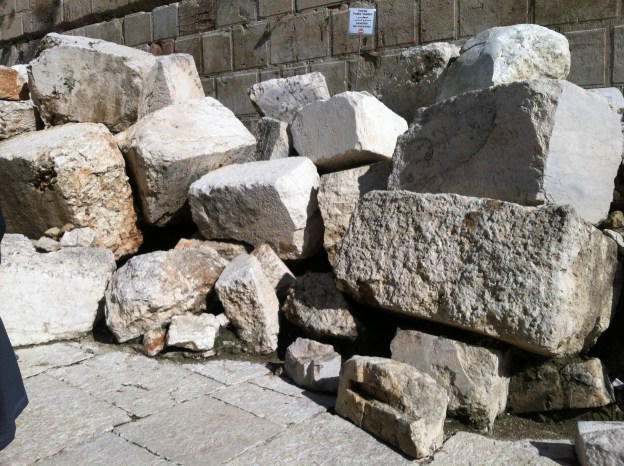
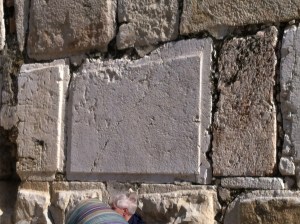
Nothing is left of Solomon’s temple, or even the second temple that the returning exiles built in its place. Dressed stones from Herod’s temple, the temple that Jesus knew, give you some idea of the immensity of the project. These massive blocks are about three feet high and six feet across. When we visited the Temple mount last year, the guide told us we could tell which ones had come from Herod’s temple because of the dressed edge around each stone facing.

great shot not one stone upon anotherThese were the same stones that the disciples pointed out to Jesus. But Jesus refused to be impressed. “You think these are something?” he asked them. I have news for you. “Not one stone will be left upon another. All will be thrown down.” (Matthew 24:2; Mark 13:2; Luke 21:6)


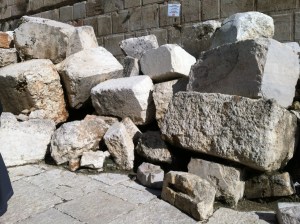
2015-01-12 11.57.08Herod would cut new stones for the temple he built, but the returning exiles had only the materials at hand, and that meant the stones that had fallen when Solomon’s temple had been destroyed.


This wasn’t neat and tidy work, as it had been in Solomon’s day, when the stones were carefully dressed at the quarry and set together without tools. This was slap-dash, “fill in the chinks with mortar, don’t take time to make it pretty” work. Solomon had built out of strength and glory. This foundation was laid out of weakness and fear.

Ezra describes for us the noisy business of laying this foundation:

“10 When the builders laid the foundation of the temple of the Lord, the priests in their vestments were stationed to praise the Lord with trumpets, and the Levites, the sons of Asaph, with cymbals, according to the directions of King David of Israel; 11 and they sang responsively, praising and giving thanks to the Lord, “For he is good, for his steadfast love endures forever toward Israel.” And all the people responded with a great shout when they praised the Lord, because the foundation of the house of the Lord was laid. 12 But many of the priests and Levites and heads of families, old people who had seen the first house on its foundations, wept with a loud voice when they saw this house, though many shouted aloud for joy, 13 so that the people could not distinguish the sound of the joyful shout from the sound of the people’s weeping, for the people shouted so loudly that the sound was heard far away.” (Ezra 3:10-13)

“For he is good, for his steadfast love endures forever toward Israel.” This was the same song sung at the dedication of Solomon’s temple (2 Chronicles 5:13) but this song of praise was “mingled with weeping from those who had seen the temple in its former glory.”[2] Those who could remember Solomon’s great temple found it impossible to celebrate this new foundation. Instead, they wept at this puny substitute. Yes, it was time to celebrate the fulfillment of prophecy, but what a disappointment that fulfillment was to them! Instead of joy, the ones who could remember the good old days felt only loss.

When we are discouraged and we harbor disappointment, we are most vulnerable to opposition. There isn’t much room for courage and determination in the middle of a pity party. This is when attacks can do the most damage, and that’s exactly what happens next in the story of the returned exiles. Their neighbors began to challenge their right to build, even their ability to build. Their neighbors made it as difficult as possible for the work to continue, and under this pressure, the work stopped. Ezra writes,

“4 Then the people of the land discouraged the people of Judah, and made them afraid to build, and they bribed officials to frustrate their plan throughout the reign of King Cyrus of Persia and until the reign of King Darius of Persia.” (Ezra 4:4-5)

2015-01-12 12.00.10

The work halted when opposition came along, as opposition always will. For many years, the stones lay stacked and ready to build, but no one did the building. Instead, they focused their attention on building their own homes. Life in Israel was a struggle. Building the temple got moved to the back burner, as the people turned their attention to their own needs and desires.

Haggai rose up as a prophetic voice to call the people back to the work they had been given to do.

Thus says the Lord of hosts: These people say the time has not yet come to rebuild the Lord’s house. Then the word of the Lord came by the prophet Haggai, saying: Is it a time for you yourselves to live in your paneled houses, while this house lies in ruins? Now therefore, thus says the Lord of hosts: Consider how you have fared. You have sown much, and harvested little; you eat, but you never have enough; you drink, but you never have your fill; you clothe yourselves, but no one is warm; and you that earn wages earn wages to put them into a bag with holes.

 Thus says the Lord of hosts: Consider how you have fared. Go up to the hills and bring wood and build the house, so that I may take pleasure in it and be honored, says the Lord. You have looked for much, and, lo, it came to little; and when you brought it home, I blew it away. Why? says the Lord of hosts. Because my house lies in ruins, while all of you hurry off to your own houses. (Haggai 1:2-9)

Here’s the good news: the people listened to Haggai, and they repented. They got to work building the house of the Lord. It didn’t look like much, especially when compared to the fond memory of Solomon’s temple, but it was the Lord’s. And the people prospered.

In the second chapter of Haggai, the Lord asks the people, “Who of you is left who saw this house in its former glory? How does it look to you now? Does it not seem to you like nothing? But now be strong, … Be strong, all you people of the land, and work. For I am with you,’ declares the Lord Almighty.  And my Spirit remains among you. Do not fear.’” (Haggai 2:2-5)

Today is the first Sunday of the season of Lent. During these forty days, God calls us to repentance. Since the very beginning, God has been working out his great purpose in us, to redeem us to himself if we will only turn to him.

In a devotional written for Ash Wednesday, J. D. Walt urges us to “realize that Jesus was not plan B or plan C. Jesus was always plan A. For God to create human beings in his own image meant they would be made in the image of perfect love. To be made in the image of perfect love meant they would be endowed with perfect freedom. And to be endowed with perfect freedom necessarily required the possibility of choosing something other than the will of God, which is the way of love. … God is not love because he loves. God loves because he is love. In similar fashion, a person is not a sinner because he sins. Rather, a person sins because he is a sinner.”

But we don’t have to stay stuck in that identity, anymore than the returned exiles had to stay stuck in their self-pity over the loss of the great temple they remembered from long ago. They repented of living in fear instead of courage. They repented of putting themselves before God. They repented of leaving the work for someone else to do. They repented, and started building.

Here we stand at the beginning of Lent, but also at the beginning of a process called Healthy Church initiative. It’s a process that gives us the opportunity to use the stones of our past that are still good and sound, to build a foundation for the future into which God is calling us.

Now is our time to return to the call God made on this congregation 158 years ago when a German Methodist missionary named Henry Singenstreu came to New Ulm to reach people who didn’t even know they needed Jesus.

Now is our time to repent of living in fear instead of courage.

Now is our time to repent of putting our own comfort and interests ahead of God’s call on our lives.

Now is our time to repent of leaving the work for others to do.

Now is our time to repent of the grudges we’ve held and the hurts we’ve nursed, to let go of our skepticism and our pride.

It’s time to admit to Jesus what he already knows — “that [we] are tired of living from the stuck identity of sinners, which is death, and that [we] are ready to live from the unleashed identity of [beloved children of God], which is life.” As J. D. Walt puts it, “It’s time to repent and believe the Gospel, which isn’t so much trying harder to stop sinning and start loving as it is to stop seeing oneself as a sinner and start seeing oneself as a lover…. And what is the Gospel? It is this: “But God demonstrates his own love for us in this: While we were still sinners, Christ died for us.” (Romans 5:8)[3]

The Jews who returned to Israel had to figure out what it meant to live into a future that they could not see, but they knew God was creating right in their midst. What was past was past. But God was kindling a new hope in them, and he promised that his Spirit would remain with them. They had no reason to fear or be discouraged. God didn’t need a fancy new temple of stone. God wanted to establish his temple in the hearts of his people.

God speaks through the prophet Haggai to us, more than 2500 years later.

“My Spirit remains among you. Do not fear. … The glory of this present house will be greater than the glory of the former house,’ says the Lord Almighty. ‘And in this place I will grant shalom,’ declares the Lord Almighty.”

The work that lies ahead may discourage us. We may long for the glory days of this congregation’s past. But we don’t have to stay stuck there. God calls us to repent, and to start building. What God calls us to build probably won’t look anything like what some of us remember. But God promises to be with us, and God asks us to have courage and not fear. “The glory of this present house will be greater that the glory of the former house,” says the Lord Almighty.

May it be so.

Next week – Kindling Hope: For Such a Time as This (Esther’s Story)

[1] Michael J Chan http://www.workingpreacher.org/preaching.aspx?commentary_id=2570

[2] Ibid.

[3] J. D. Walt  http://dailytext.seedbed.com/2016/02/10/ash-wednesday-2/ 

Centered and Sent – Sermon on Jeremiah 1:4-10 Epiphany 4C

January 31, 2016
View a video of this sermon here.

I do not think it is a coincidence that the passage we are studying this week in our trek through The Story also happens to be the OT lesson from the Revised Common Lectionary for this fourth Sunday after the Epiphany. This coming together of two paths through scripture – the one we’ve been traveling since September, and the one we would have traditionally traveled had we not followed The Story this year – brings us to an important crossroads.

We find the nation of Israel torn apart, and the northern tribes have long ago been carried off into exile. In the southern kingdom, more evil kings have sat on the throne than good ones. Jeremiah is called into his prophetic ministry during the reign of Josiah – one of the good kings – but his work will continue through four more regimes, and he will see the last of Judah’s kings carried off to Babylon. Jeremiah will witness the destruction of the Temple, and the people of Judah being led into captivity.

His ministry is a long one, but Jeremiah is not what you might call a success story, at least not by human standards. No wonder he is reluctant to answer the call, much as Moses was reluctant to respond to his particular calling centuries before. Yet, “God is constantly equipping people for the call that will come.”[1]

How often do people find themselves called into a line of work they had never considered, given work that they never in their wildest dreams ever thought they would do, only to discover that God had been equipping them for years for that specific task! I know that’s what happened to me. This is exactly what happened to Jeremiah. It must have come as a surprise to Jeremiah that God had been preparing him as a prophet. Jeremiah had good reason to feel confused.

The lower story of Israel’s rise and fall is sometimes confusing, but God’s upper story has always been clear. God simply wants his people to love him freely, as he loves them. Time and again, he has called his people to repentance and faithfulness. Even when they fail and turn away, he does not give up on the people he loves. Once again, he calls someone to speak his words into the ears and hearts of his people.

4 Now the word of the Lord came to me saying, 5 “Before I formed you in the womb I knew you, and before you were born I consecrated you; I appointed you a prophet to the nations.” 6 Then I said, “Ah, Lord God! Truly I do not know how to speak, for I am only a boy.” 7 But the Lord said to me, “Do not say, “I am only a boy’; for you shall go to all to whom I send you, and you shall speak whatever I command you. 8 Do not be afraid of them, for I am with you to deliver you, says the Lord.” 9 Then the Lord put out his hand and touched my mouth; and the Lord said to me, “Now I have put my words in your mouth. 10 See, today I appoint you over nations and over kingdoms, to pluck up and to pull down, to destroy and to overthrow, to build and to plant.” – Jeremiah 1:4-10

Jeremiah may have been surprised to hear God’s call, but he answered it, however unwillingly. His work would be difficult, and he would suffer imprisonment, persecution, false accusations of treason, and forced exile to Egypt. He would be forbidden to marry or have children, he would see King Jehoiakim destroy his prophetic writing, and he would search for just one righteous person without finding any.

By all accounts, Jeremiah’s ministry would best be described as a failure. His calls to repentance would go unheeded, and his warnings would fall on deaf ears. Through the reign of five different kings, he would risk everything, even his own life, to proclaim God’s word. He wouldn’t do it happily – there’s a reason why his other book in the Old Testament is called “Lamentations.”

Even in this first conversation with God, we get the clear image of a difficult task. No wonder Jeremiah balked. He could see the risks to his personal safety – why else would God say, “Don’t be afraid of the people to whom I’m sending you. I will rescue you from them”? Those aren’t encouraging words, really. And even the announcement that Jeremiah would be appointed over nations and kingdoms doesn’t sound so enticing when the verbs God uses are more negative than positive: “build and plant” have a hard time standing up to “pluck up, pull down, destroy, overthrow.” These aren’t comforting words God gives to Jeremiah. They are challenging words, dangerous words.

In the gospel lesson we heard earlier (Luke 4:21-30), Jesus also issues some challenging and dangerous words to the people of Nazareth. What starts out as a “hometown boy makes good” story ends up with a riot, as the angry crowd drags Jesus to the edge of town, so they can throw him off “the brow of a hill” to stone him for blasphemy.

About a year ago, we were standing on that “brow of the hill” – or at least what is traditionally accepted as the spot. The modern city of Nazareth lies below the hill to the west, and Mt. Tabor can usually be seen off to the east, toward the Sea of Galilee. However, on the day we visited Mt. Precipice, it was rainy and cloudy. As the clouds rolled in over Nazareth, we had to use our imaginations to picture the vista below us. (You can see some photos in this blogpost.)

We could mostly make out Nazareth to the west, but the rich farmland to the south and the valley between us and Mt. Tabor to the east were completely obscured by clouds. I noticed that our little group of tourists reacted to this phenomenon in a surprising way. Keep in mind that we really couldn’t see anything – the view was completely obscured by clouds and rain.

But that didn’t stop us from lifting our phones and cameras. Even in the rain, we took as many pictures as we could. But do you notice something here? Everyone is looking in a different direction.

shawna and amanda taking photos on mt precipice2015-01-09 07.37.48

Here we are at the top of the very hill where Jesus was attacked by his own hometown, where his ministry might have ended before it had really begun…


tourists on mt precipiceAnd we are looking in every single direction, through the fog, for things we cannot see.

If we inch out to the edge of the path, we can look down the hillside and imagine a person being thrown down over those rocks. But the precipice itself is the only thing that is clearly visible, and it does not look too inviting.

The precipice of Mt Precipice 2015-01-09 07.46.49

Jesus knew his ministry was going to be rough. He knew he would ultimately “fail” just as Jeremiah’s had done. But here’s the thing: we don’t get to decide what failure looks like.

God did not call Jeremiah to convert the people of Judah, only to proclaim God’s word to them. If Jeremiah was expecting hundreds and thousands of people to repent and begin living according to God’s plan for them, he was deeply disappointed.

In the same way, Jesus failed to overthrow the Roman government as Messiah was expected to do. Instead, he died a horrible death, nailed to a cross. That looked like failure to many of the people who watched him die. But we don’t get to decide what failure looks like.

God’s idea of success can’t be measured in numbers of converts or military conquests. It can’t even be measured in Average Worship Attendance or Apportionments Paid, important as those things might be to our conference office.

God measures success in lives changed, in relationships restored. God measures success in every soul redeemed, in every person who turns away from death and sin, toward everlasting life. God measures success in the depth of love we show to people who are not like us, in the way our faith grows in maturity and richness, in the way our lives look more and more like the life of Jesus Christ, and less like the broken lives we leave behind when we choose to follow him.

I won’t sugar-coat this for you. We are about to enter a very challenging season, as we look at ways we must change what we do and how we think, if we are going to be faithful followers of Jesus Christ. Growing in faith means taking some risks. It means living into our call, no matter how uncomfortable that makes us.

Pastor Matt Kennedy writes, “ Experts who study organizational change say that groups basically have three phases of any transition they face: stability, de-stabilization, and new orientation. Every transition involves all three, and the most anxious moment in any change is going from stability to de-stabilization. This is what you see in the story of Israel in the Wilderness. When you enter that moment of destabilization, there is a strong gravitational pull back to the stable place, even if that stable place was being a slave in Egypt.” But for transitions to lead us into the new beginning God has in mind for us, we must be strong in faith, centered on Christ Jesus, depending completely on the power of the Holy Spirit to lead us through the anxiety of wilderness.

Because going through the wilderness is the only way to get to the promised land.

What does it mean for us to be centered and sent? Will we limit our view to a cloudy vision, constricted by a tiny lens in a viewfinder? Or will we open our eyes wide to the possibility God has in mind for us, and take in the broad vision of God’s call? It will not be easy. I assure you of that. But it can be fruitful, and we can experience spiritual renewal in ourselves that leads to a spiritual awakening in our community.

Following Jesus is very risky business, and we don’t get to decide what success looks like. Sometimes clouds of doubt obscure our vision, and we are unwilling to take a risk. Sometimes we are simply looking in the wrong direction, unaware that the broad vista behind us shows the magnitude of God’s grace. Sometimes we just have to step out on faith, depending on the Holy Spirit to guide us through the murkiness until we can see, in 20/20 hindsight, that every step of the way was part of God’s plan for us.

It may feel like we are teetering on the edge of a precipice, and the fog is obscuring our path. It may feel like we are entering the wilderness as we move through the changes we see necessary for our own growth and deepening discipleship. It may even feel, at times, like we are failing miserably. But God gives us his promise that He will be with us every step of the way. Let us claim that promise, and go with God. Amen.

[1] http://cep.calvinseminary.edu/sermon-starters/epiphany-4c/?type=old_testament_lectionary#sthash.s4Sd3EnI.dpuf

A Visit to the Precipice – thoughts on Luke 4:21-30

21Then he began to say to them, “Today this scripture has been fulfilled in your hearing.” 22All spoke well of him and were amazed at the gracious words that came from his mouth. They said, “Is not this Joseph’s son?”23He said to them, “Doubtless you will quote to me this proverb, ‘Doctor, cure yourself!’ And you will say, ‘Do here also in your hometown the things that we have heard you did at Capernaum.’” 24And he said, “Truly I tell you, no prophet is accepted in the prophet’s hometown. 25But the truth is, there were many widows in Israel in the time of Elijah, when the heaven was shut up three years and six months, and there was a severe famine over all the land; 26yet Elijah was sent to none of them except to a widow at Zarephath in Sidon. 27There were also many lepers in Israel in the time of the prophet Elisha, and none of them was cleansed except Naaman the Syrian.” 28When they heard this, all in the synagogue were filled with rage. 29They got up, drove him out of the town, and led him to the brow of the hill on which their town was built, so that they might hurl him off the cliff. 30But he passed through the midst of them and went on his way.

modern nazareth from mt precipiceAbout a year ago, we were standing on that “brow of the hill” – or at least what is traditionally accepted as the spot. The modern city of Nazareth lies below the hill to the west.

And Mt. Tabor can usually be seen off to the east, toward the Sea of Galilee. However, on the day we visited Mt. Precipice, it was rainy and cloudy.

2015-01-09 clouds over NazarethAs the clouds rolled in over Nazareth, we had to use our imaginations to picture the vista below us.


We could mostly make out Nazareth to the west, but the rich farmland to the south and the valley between us and Mt. Tabor to the east were completely obscured by clouds.

2015-01-09 mt precipice toward tabor clouds


2015-01-09 mt precipice clouds


I noticed that our little group of tourists reacted to this phenomenon in a surprising way. Keep in mind that we really couldn’t see anything – the view was completely obscured by clouds and rain. But that didn’t stop us from lifting our phones and cameras …

shawna and amanda taking photos on mt precipice2015-01-09 07.37.48

tourists on mt precipice


But do you notice something about these pictures? Everyone is looking in a different direction.

Here we are at the top of the hill where Jesus himself was dragged, just so he could be thrown down the hillside and stoned to death for blasphemy. And we are looking in every single direction, through the fog, at things we cannot see. If we inch out to the edge of the path, we can look down the hillside and imagine a human being thrown down over those rocks.Amanda looking down from mt precipice


But the precipice itself is the only thing we can clearly see. Ponder that.

The precipice of Mt Precipice 2015-01-09 07.46.49


“Who Is My Neighbor?” – Sermon on Luke 10:25-37 Epiphany 2C

Preached at Oakwood United Methodist Church on January 17, 2016

A newer sermon on this text is here.

Here’s the set up to today’s gospel reading, from the earlier verses of Luke 10. Keep this in the back of your mind as we move forward into the reading. What has just happened was the sending of the 72, two by two, into the villages and towns where Jesus plans to go next. These disciples are the advance team, and their mission is successful.

The 72 have just returned, and Jesus has prayed a prayer of thanksgiving and praise to the Father, rejoicing in the Holy Spirit – that’s an interesting detail we won’t explore today – and has blessed these disciples. Everyone’s feeling pretty good about what has just happened. If this were a television show, the commercial break would come right about here.

Luke sets off today’s famous story with one of his signature introductions: “And behold.” Luke acknowledges what has just happened, and connects it to this story with “and.” But there’s that “behold” to show us that we are about to hear something new.

The Parable of the Good Samaritan

25 And behold, a lawyer stood up to put him to the test, saying, “Teacher, what shall I do to inherit eternal life?” 26 He said to him, “What is written in the Law? How do you read it?”27 And he answered, “You shall love the Lord your God with all your heart and with all your soul and with all your strength and with all your mind, and your neighbor as yourself.”28 And he said to him, “You have answered correctly; do this, and you will live.”

29 But he, desiring to justify himself, said to Jesus, “And who is my neighbor?” 30 Jesus replied, “A man was going down from Jerusalem to Jericho, and he fell among robbers, who stripped him and beat him and departed, leaving him half dead. 31 Now by chance a priest was going down that road, and when he saw him he passed by on the other side.32 So likewise a Levite, when he came to the place and saw him, passed by on the other side. 33 But a Samaritan, as he journeyed, came to where he was, and when he saw him, he had compassion. 34 He went to him and bound up his wounds, pouring on oil and wine. Then he set him on his own animal and brought him to an inn and took care of him. 35 And the next day he took out two denarii and gave them to the innkeeper, saying, ‘Take care of him, and whatever more you spend, I will repay you when I come back.’ 36 Which of these three, do you think, proved to be a neighbor to the man who fell among the robbers?”37 He said, “The one who showed him mercy.” And Jesus said to him, “You go, and do likewise.” – Luke 10:25-37 (ESV)


The lawyer who steps up to question Jesus only asks two questions. The first is a test, and if the lawyer were a Presbyterian, as I used to be, that question would sound more like “What is the chief purpose of humankind?” But Jesus doesn’t respond with “to love God and enjoy him forever.” The lawyer’s question isn’t as simple as our modern translations make it seem. “Teacher, I will inherit life eternal having done or fulfilled or acquired … what, exactly?” might be a more literal translation of this question.

As he so often does, Jesus identifies a teachable moment, and answers the question with –you guessed it – another question. Actually, two – and this is important. Jesus wants to know “What is in the law? You’re a lawyer, you know the scriptures; you already have your answer. You tell me what it says.”

But then Jesus immediately follows this question with a much more personal one – “How do you read it?” At once we realize that Jesus does not see the Law as a dead and stagnant set of words that mean the same thing to everyone. The Word of God is living and active (Hebrews 4:12), and how we read it determines how we will respond to God’s message.

The lawyer doesn’t hesitate, but begins by quoting the Shema, “Hear O Israel, the Lord your God is One. You shall love the Lord your God with all your heart, and with all your soul, and with all your might.” (Deuteronomy 6:4-5)

Here’s a little grammar lesson for you. We think of this as a command, but the verb is not an imperative. It’s more of an indication that something will surely happen in the future. You are going to love the Lord your God, because the Lord is the only God there is.

The lawyer adds part of a verse from Leviticus (19:18b), and this blending of two verses gives us what we now call “the Great Commandment.”

Yes, Jesus says, you’ve got it. Go do it. But just as Jesus turns back to his friends, who are still celebrating their successful mission trip, the lawyer adds a new question, and this isn’t a test, it’s an attempt to justify himself. This guy who was challenging Jesus a moment ago suddenly feels the need to get his approval, so he asks, “Yes, but … who is my neighbor?

I can imagine the others getting quiet as Jesus looks at the lawyer. They have a hunch they know what Jesus is going to do. I imagine Jesus pausing a moment, considering the best way to teach this lawyer about the high cost of discipleship. He decides to take on this expert in the law, and everyone else settles in to listen. They know that a story is coming.

Jesus sets the scene. It’s the road between Jerusalem and Jericho. About a year ago, my husband and I were on that road. We stopped at a Bedouin camp to get a good view of what is commonly called The Valley of the Shadow of Death.

2015-01-14 Valley of the Shadow

When we were there last January, it was the rainy season, so there was a bit of green showing here and there, but when we looked out across the Valley toward Jerusalem, it was hard to imagine anyone walking through this wilderness.

2015-01-14 UP to Jerusalem


That’s Jerusalem off in the distance, on the very rim of the horizon.


2015-01-14 Good Samaritan road


And when we turned and looked down the valley in the other direction, we could almost make out 2015-01-14 Jericho in the distanceJericho.


In between is treacherous wilderness, and the distance was too great to be traveled on foot in a single day. This made travelers vulnerable to the robbers and nomads who spent their lives scrabbling out an existence in this wasteland.


The place where our bus stopped was actually a Bedouin camp. At first, we thought it had been abandoned, but the tour guide assured us that it was not.

bedouin homes

The guide also warned us to take valuables with us when we got off the bus, and keep them close. We were also encouraged to not buy anything or try to bargain with these Bedouins. And whatever we did, when the children asked us for candy, even if we had some, we should refuse. It might be a ruse to get us to open our bags or pockets – something you should never do in front of a Bedouin child. You also should not let them catch you taking their pictures.

Bedouins on the run to meet the bus 2015-01-14 10.35.17

Sure enough, as soon as the bus stopped, here they came.


I was careful to wait until the children weren’t looking to take a snapshot.

Bedouin girl 2015-01-14 10.36.45


This charming little guy had a backpack full of trinkets he was trying to sell us. Everything was “one dollar.” When we declined, he held out his hand and asked “Candy? Gum?” From salesman to beggar in the blink of an eye. Bedouin boy with backpack 2015-01-14 10.36.01


As I tried to imagine someone walking from Jerusalem to Jericho, it wasn’t difficult for me to think that maybe these Bedouin children were somehow connected to the robbers in Jesus’ story. Clearly, they were not a real threat to us. We were in no danger of being stripped and left to die on the side of the road. But if this was the road Jesus and his listeners were imagining as he told the story, I could see why you wouldn’t have wanted to travel it alone.

Whenever Jesus tells a parable, he invites us into the story. There is almost always one character or another with whom we identify. Quite often, there’s a twist somewhere in the story that surprises us. It tells us we’ve been identifying with the wrong character all along, if we really want to be followers of Christ. The story of the Good Samaritan is no exception.

The first two people who accidentally happen by are a priest and a Levite. They both hurry over to the other side of the road. They probably wanted to avoid contamination – touching this man, who looked like he might be dead, would make them ritually unclean.

But if you were the man lying in the ditch, who better to come along than someone whose life is dedicated to God? At the very least, you would expect no further harm to come to you. Yet, neither of these men stop to help.

It is the third traveler who is moved to compassion. Finally, someone who can do something! He gets down off his camel or donkey, cleans the man’s wounds with wine and oil, bandages him up and puts the man on the camel – or donkey. But there’s a catch. This kind person, whose care has saved a life, is – a Samaritan. The very last person on earth you would want taking care of you. The Enemy.

We tend to want to identify with the hero in the story. The disciples and the lawyer who heard Jesus tell this parable might have had a hard time figuring out who the hero was. You’d think it would be the priest or the Levite, and it might be easy to justify their failure to help by remembering they were just trying to stay clean. We’d all like to identify with the person who does the right thing, but he turns out to be a Samaritan – just about the worst possible ethnic group any of the disciples could imagine.

The difference between the Samaritan and the first two holy men who happened along that road between Jerusalem and Jericho wasn’t a matter of eyesight. All three of them saw the man lying in the ditch. The difference is what they did when they saw him. The first two made a beeline for the opposite side of the road. Only the Samaritan saw the man and had compassion.

And Jesus says, “Go be like the Samaritan.” Go be like the person you snub. Go be like the person you think you’re too good to be around.

A few days after we returned from the Holy Land, one of those people we snub, a person we think we’re too good to be around,  died in my driveway. My husband found him lying in front of our garage door without a shirt, ankles crossed, eyes staring at the sky. We spent the day wondering about this man. What circumstances had put him in our driveway on one of the coldest nights of the year, without a shirt?

Across the street, we could see children playing on the school playground while, behind our house, the police worked to discover what had happened to this man. We didn’t know his name then. We learned it later, and the newspaper identified him as homeless. The stark contrast between children playing across the street and a man dying unattended in my driveway gave me a new sense of urgency to do something about the homeless people who move unseen here in New Ulm, particularly those who are most vulnerable, the children. Which of those children playing, I wondered, might end up like this man someday, if we don’t do something? If we don’t see and have compassion, as the Samaritan did?

We know that homelessness and poverty are inextricably linked. We also know that children born to single mothers are among the most likely to suffer from poverty. When these families become homeless, they have very few resources available to help them turn their lives around and get back on their feet.

That’s why the Ministerial Association has been working to establish NUMAS Haus for homeless single mother families. We want to do more than just give them a place to sleep for a few nights. We want to help them turn their lives around. You can learn more about the programs and services we plan to offer at the NUMAS Haus website.

I am grateful to serve in a congregation that is willing to partner with other churches to fulfill this God-sized vision. As the project moves forward and dreams become reality, I urge you to think about who your next neighbor might be. Who needs our compassion? Who hungers to know the love of God and the saving grace of our Lord Jesus Christ? And who among us is ready to be like the Samaritan, willing to identify with the outcast for the sake of serving Jesus? As we pass through the Valley of the Shadow of Death, will we see and cross over to the other side of the road, or will we see and be consumed by gut-wrenching compassion for any and all whose need lies before us?

When Jesus finished his story, he asked the lawyer, “Who proved to be a neighbor to the man who fell among the robbers?” The lawyer said, “The one who showed him mercy.” And Jesus said to him, “You go, and do likewise.”

He says the same to each of us. You go, and do likewise. Amen.

 

“A House Divided” – Sermon on Mark 3:22-26 and 1 Kings 12:1-19


Baptism of Our Lord C
January 10, 2016

We’re back in the Old Testament this week, returning to the sequence of events we left behind to celebrate the stories of Christmas and Epiphany. In a few moments, we will remember Christ’s baptism in the Jordan River by touching that same water and renewing our own baptismal covenant vows. But now, it is time to return to the Jerusalem of an earlier century. The great kings David and Solomon have died, and Solomon’s son Rehoboam has just taken the throne. He’s young and rash, and he’s eager to demonstrate his kingly power over the nation of Israel.

Maybe a little too eager. I get the idea as I read about Rehoboam that he’s trying to convince himself of his royal authority, as much as anyone else. Instead of showing mercy to his subjects, and gaining their gratitude and loyalty, Rehoboam acts tougher than he probably is. Instead of recognizing that his people have been overtaxed and overworked by Solomon, Rehoboam is only worried about appearing stronger than his father. So he threatens the people with even harsher conditions than they have already suffered.

It’s the straw that breaks the camel’s back, and the people rebel. 1 Kings 12: 16 tells us, “And when all Israel saw that the king did not listen to them, the people answered the king, “What portion do we have in David? We have no inheritance in the son of Jesse. To your tents, O Israel! Look now to your own house, David.”

It didn’t take long for the smirk on Rehoboam’s face turned to dismay, as he realized his mistake. He had to run for his life to escape being stoned to death. Instead of ruling the whole kingdom of Israel with an iron fist, he’s left with only two small tribes who remain loyal, as the other ten tribes head off to their own territories, following Jeroboam’s leadership. The kingdom is ripped in two, just as God told Solomon it would be.

It’s just at this point in the story that I have to wonder what God is up to here. After all, God had told Abraham he would make his descendants into a great nation, and it would be through God’s people, the nation of Israel, that God would bless the whole world. God had promised David that his descendants would rule over this great nation. But here we are, in the middle of a civil war, only two generations into David’s line. Instead of blessing the other nations of the world, Israel is torn in two, and chaos erupts. If we were to analyze the literary elements at work here, this would be the point in the story where “the plot thickens.”

On June 18, 1858, just about the time our church was being established here in the young city of New Ulm, a Republican candidate for US Senator stood up in the Illinois State Capitol to accept his party’s nomination. The speech he gave didn’t help him win that election to the Senate, but it did rally Republicans across the northern states around the issue of slavery, and it became one of Abraham Lincoln’s most famous speeches. Maybe you remember reading – or even memorizing – this passage from the beginning of that speech:

“A house divided against itself cannot stand. I believe this government cannot endure, permanently, half slave and half free. I do not expect the Union to be dissolved — I do not expect the house to fall — but I do expect it will cease to be divided. It will become all one thing or all the other. Either the opponents of slavery will arrest the further spread of it, and place it where the public mind shall rest in the belief that it is in the course of ultimate extinction; or its advocates will push it forward, till it shall become lawful in all the States, old as well as new — North as well as South.” [1]

Lincoln wasn’t the first to quote Jesus on this issue of division. Wikipedia, that source of infinite and undisputed knowledge, tells us that:

  • “Saint Augustine, in his book Confessions (Book 8, Chapter 8) describes his conversion experience as being ‘a house divided against itself.’
  • Thomas Hobbes, in his 1651 Leviathan (Chapter 18), stated that, “a kingdom divided in itself cannot stand.”
  • In Thomas Paine’s 1776 Common Sense, he describes the composition of Monarchy as having, “all the distinctions of a house divided against itself.”

There’s a reason why all these famous people have borrowed these words from Jesus: they are true. So let’s take a moment to go to the source, Jesus himself, and learn from him directly.

And the scribes who came down from Jerusalem said, “He has Beelzebul, and by the ruler of the demons he casts out demons.” And he called them to him, and spoke to them in parables, “How can Satan cast out Satan? If a kingdom is divided against itself, that kingdom cannot stand. And if a house is divided against itself, that house will not be able to stand. And if Satan has risen up against himself and is divided, he cannot stand, but his end has come.” – Mark 3:22-26

Last June, we looked at this passage in its context of the early stages of Jesus’ ministry. Now, we see it in the broader context of the whole story of God and his relationship with Israel. When the scribes accuse Jesus of casting out demons by being in league with the devil, Jesus comes back at them with a reference to Jewish history. He might as well have said, “A house divided against itself cannot stand. If Satan has risen up against himself and is divided, he cannot stand, but his end has come… just look at what happened to Rehoboam and the nation of Israel!”

But the scribes don’t catch the history lesson, apparently. They only care about the way Jesus challenges their authority. As far as they are concerned, Jesus is a heretic. They accuse him of being possessed by demons, trying to discredit Jesus in front of the crowds around him. They oppose his purpose by questioning the source of his power. When the scribes accuse Jesus of working with Beelzebub, they don’t realize that they have given Jesus precisely the words he needs to prove his point.

The name Beelzebub[2] comes from a Hebrew play on words. By the time the scribes use it, Beelzebub is just another name for the devil, and they may not have even known about its origins. But those origins go right back to the Old Testament.

Be-el-ze-vuv sounds an awful lot like Be-el-ze-vul, which means “Ba-al the exalted.” It’s what the Canaanites called their god, Baal, back in First and Second Kings, and you will read more about Baal and his prophets next week in Chapter 15 of The Story. While Be-el-ze-vuv sounds a lot like Be-el-ze-vul, it means something completely different. It means “lord of the flies.” And we all know where flies like to congregate. Around dead, smelly things.

Beelzebub is the lord of death, and his defeat is in division. Jesus names the blasphemy of the scribes for what it is: defiance against God. Claiming that God’s saving grace is the work of demons puts the scribes in opposition to the One who saves. Just as Rehoboam’s arrogance cost him the chance to rule over the entire nation of Israel, the scribes miss an opportunity to align themselves with God’s purpose in Jesus. A house divided cannot stand.

This is the point in the story where we come in. Just like Rehoboam, we are given a choice, and the decision we make will determine whether we find unity with God in Christ Jesus, or falter and tumble under our own arrogance. Our choice will either unite us with God or against God.

Abraham Lincoln said, “I do not expect the house to fall — but I do expect it will cease to be divided. It will become all one thing or all the other.” Lincoln was not so much afraid that the United States would be torn apart, the way Israel was, but that it would be unified around the wrong ideal: slavery instead of freedom.

We face the same dilemma in our own lives. Will we follow Jesus in full obedience, even as Jesus was obedient in his own baptism, ministry, and death on the cross? Or will we follow Beelzebub, the lord of the flies, who leads us only to eternal death and separation from God?

Our spiritual integrity is at stake. If Rehoboam’s folly teaches us anything, it is that breaking apart what belongs together is much easier than restoring what is broken. Jesus came to earth in human form for that very reason – to heal our brokenness, mend our divisions, and restore us to unity with God.

Long before Abraham Lincoln gave his “house divided” speech and this congregation was founded in New Ulm, Charles Wesley wrote a hymn called, “Blest Be the Dear Uniting Love.” The words go like this:

Blest be the dear uniting love that will not let us part;
Our bodies may far off remove, we still are one in heart.

Joined in one spirit to our Head, where he appoints we go,
And still in Jesus’ footsteps tread, and do his work below.

O may we ever walk in him, and nothing know beside
Nothing desire, nothing esteem, but Jesus crucified!

We all are one who him receive, and each with each agree,
In him the One, the Truth we live, blest point of unity!

Partakers of the Savior’s grace, the same in mind and heart,
Nor joy, nor grief, nor time, nor place, nor life, nor death can part.

The psalmist writes, “Teach me your way, O Lord, that I may walk in your truth; give me an undivided heart to revere your name” (Ps 86:11).

This is what it means to follow Jesus with an undivided heart. It means giving ourselves completely to him, so that he can fill us completely with his love and grace. Each of us was created with a space in our souls that only God can fill. We can try to fill that space with other things, just as Rehoboam tried to fill it with his desire for power, but nothing can fill the emptiness inside us except God. Everything else we try will only separate us from God, and tear us up on the inside.

You’ve probably experienced this in your own life. Maybe you’ve tried to fill that place inside you with things that promised to give you pleasure, only to experience pain and emptiness. Maybe you’ve tried to fill that place with doing good deeds, so others would think highly of you, or working long hours, or accumulating material goods. None of these things will satisfy the longing you have for God. Maybe you have given up, and decided that the hole in your heart can never be filled, so you’ve dumped bitterness and envy and disappointment into it, hoping that these things will get swallowed up like dying stars in a black hole in outer space.

Only one thing can fill that place in your life. Only one thing can satisfy your longing. It is Jesus, who came to earth as a tiny human child, and grew in favor with God and people, who taught that God’s radical love is available to all who believe that Jesus is the Son of God. Jesus, who died in our place, so that our sins might be forgiven, and we might be restored to the God who created us for just this purpose: to be loved so completely that our only desire is to love God back with all of our being.

If you have never accepted this precious gift of God’s grace, I invite you to do it now as we pray A Covenant Prayer together. If you have been letting other things try to fill the God-sized hole in your life, I invite you to surrender them to Christ right now, as we pray this prayer. You can be made whole. You can be united to Christ by giving your life completely to him. God wants you back. Let us pray.

A Covenant Prayer in the Wesleyan Tradition     (UMH #607)

I am no longer my own, but thine.
Put me to what thou wilt, rank me with whom thou wilt,
Put me to doing, put me to suffering,
Let me be employed by thee or laid aside by thee,
Exalted for thee or brought low by thee.
Let me be full, let me be empty, let me have all things, let me have nothing.
I freely and heartily yield all things to thy pleasure and disposal.
And now, O glorious and blessed God,
Father, Son, and Holy Spirit, thou art mine, and I am thine. So be it.
And the covenant which I have made on earth, let it be ratified in heaven. Amen.

[1]  The Annals of America, vol. 9, 1. Source document: Political Speeches and Debates of Abraham Lincoln and Stephen A. Douglas 1854-1861, Alonzo T. Jones, ed., 52-74.

[2] http://www.behindthename.com/name/beelzebub


Chicken Tortellini Soup

This makes a fast supper (if you have a microwave, and who doesn’t?)

2-3 boneless skinless chicken breasts

2 cups (or one small bag) frozen mixed vegetables

1 package fresh, frozen, or dried cheese tortellini

1 clove garlic

4-6 cups chicken broth or water

salt, pepper, Italian seasoning to taste

In the microwave, thaw 2-3 boneless skinless chicken breasts. Cut into 1″ cubes (you can cut the frozen chicken into cubes if you have a heavy knife or cleaver, and skip the thawing out step, but it will take a little longer to cook the chicken).

In a heavy pot, toss the chicken cubes with some olive oil and a clove of garlic, crushed or minced. Stir frequently as you cook the chicken over medium high heat, until it is cooked through (no pink!). Add 2 cups of frozen mixed vegetables and enough chicken broth to cover. Use a couple of chicken bouillon cubes and a quart of water if you don’t have any broth. Plain water also works, but you will want to add some extra seasoning, particularly salt.

When the soup comes to a boil, add the tortellini and seasonings. Simmer until the tortellini is soft and opaque. Add more water if you need to. Serve with good bread and cheese. Dinner in under 30 minutes.