Mercy and Justice

This is not a blog post about Martin Luther King Day, even though we celebrate 50 years of “I Have A Dream” today. This is not a blog post about the presidential inauguration. Four years ago was history in the making. Today is just confirmation that it wasn’t a fluke. Frankly, I don’t have a thing to say on either of these topics that someone else hasn’t already said better and more eloquently. (And I am not talking about Mark Driscoll, who seems to have forgotten that bit about “judge not, unless you wanna be judged.”)

What burns my oatmeal right now is the awareness that, as much as we say mercy and justice matter to us as Christ-followers, most of the Christians I know are not too comfortable making mercy and justice a reality for others. We are grateful when it comes our way, but showing mercy – real caring for another that costs us – is something we simply don’t know how to do very well. We can pray for another’s need. We can talk about a problem we see. But when it comes to forgiving someone who has wronged us or putting another’s welfare and safety ahead of our own, we look more like Mark Driscoll than Jesus.

And do we even know what justice really is? The mission statement for my denomination, the Evangelical Covenant Church, focuses on the desire to see more disciples among more populations in a more caring and just world, but what exactly does that mean? Whose justice are we talking about here? And who gets to decide what that justice looks, smells, and feels like?

Jesus came into the world to shine light into our darkness, to make wrong things right again, to heal brokenness and offer hope where there is no hope. He calls each of us to participate in that same work. So I have to ask myself: What am I doing to show that kind of mercy and build that kind of justice? What are you doing to make this a more caring and just world? 

Packing Up Christmas

Christmas Eve 2012

Christmas Eve 2012

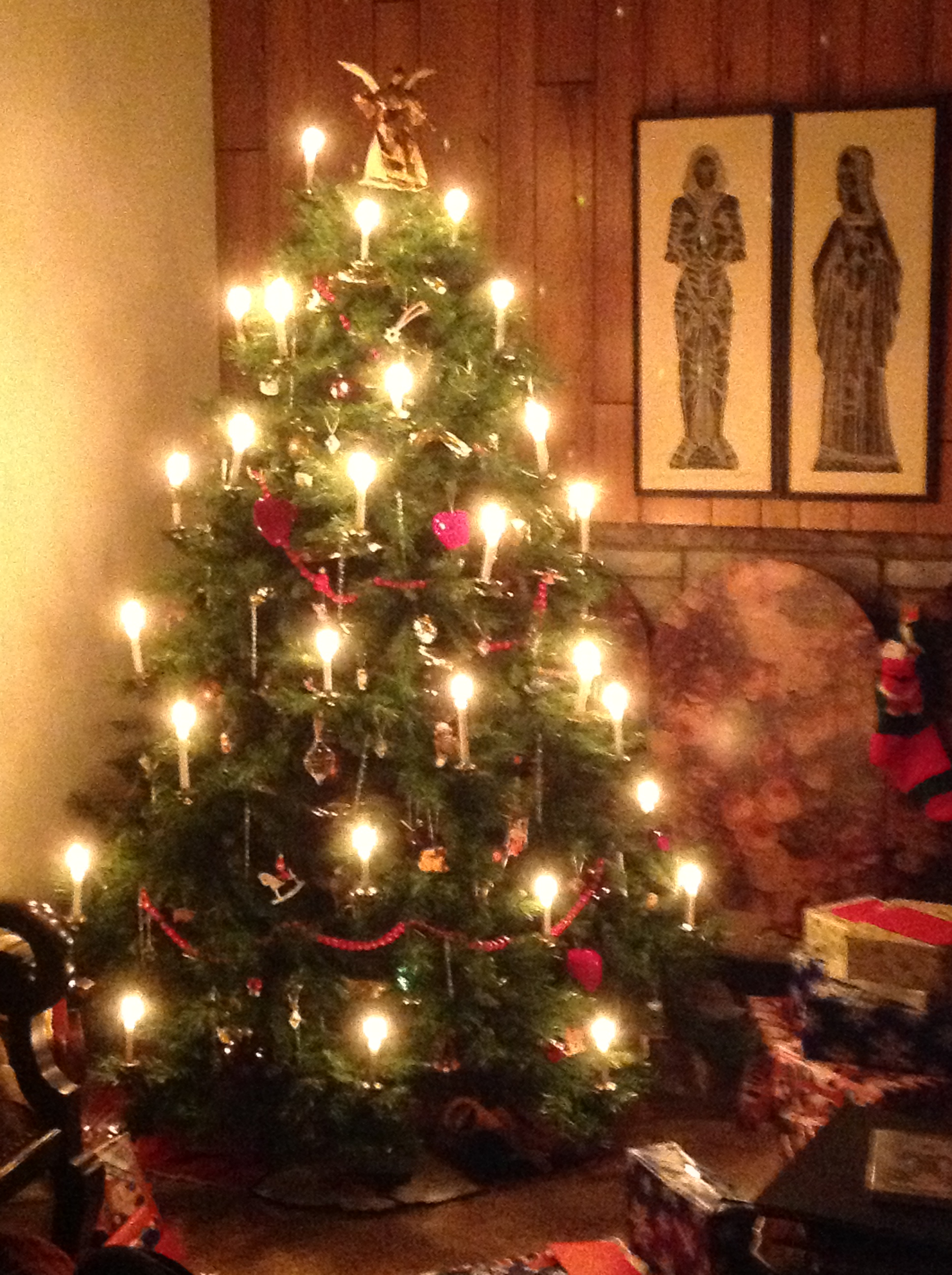
We finally took down the tree and put away all the Christmas decorations today. Don’t worry. It isn’t a live tree, so we weren’t creating a fire hazard by leaving the tree up so long. In fact, it’s the flame retardant quality of a fake tree that we like so much, since we burn real candles on our tree every year. Yes, we do. Maybe only a couple of times, unless we have guests during the Christmas season, but we never fail to light the tree the first night it is up, and Christmas Eve is the other non-negotiable candle-lighting event. Other than that, we usually only light the tree for company. And that is why we waited until now to take everything down – we had company that couldn’t come until well after Epiphany. What a great excuse to leave the tree up another week or two, right? I’ll take any excuse I can get.

To tell the truth, I would leave the house decorated for Christmas right up to Lent, if I thought I could get away with it. (One year, we almost did!) The place always looks so stark and empty after the decorations are put away. It looks …. colder.  Even when the tree isn’t lit, it adds warmth to the room. When it’s gone, I miss more than the candle glow. I miss the tiny sparkle of glass icicles, the memory attached to each ornament that hangs there. I miss the expectation, the hopefulness, the anticipation of joy.

That is why there are two items that remain in place, while everything else is packed away for another eleven months (okay, ten and a half months). One is the wreath at the front door. The first year we lived in Minnesota, we were amused to see Christmas yard decorations and light displays still evident through February. We chalked it up to the fact that no one wants to get out in the snow in sub-freezing weather to take down lights or the reindeer from the front lawn. But the wreaths hanging on everyone’s door, sometimes right into March, completely befuddled us. What’s so hard about taking down a wreath, after all?

Not a thing. That’s the point. It isn’t laziness; it’s defiance. That wreath will keep looking fresh all through the winter, if you just leave it alone. It’s a beautiful paradox: frozen greenery. Think about it. Leaving the wreath on the door says, “You can’t beat me, Winter. I will stay green no matter what.” And we do. We may be frozen, but underneath the ice, we are still green.
Still alive.

The other thing that stays in place is the Christ candle from the Advent wreath. The candle burns on Sunday nights, if we remember to light it, and stays in place until it’s time to get a new one for the next Advent wreath. This Christ candle carries us through Lent, into Easter, through Pentecost and the long season of Ordinary Time. It is a reminder that the Light of the World has broken into our lives, and will not be extinguished, no matter what. The expectation, the hopefulness, the anticipation of joy is still present every day of the year, for God is with us. We are still green.

WARNING: Contents Under Pressure | Worship Connect

Here’s my monthly post over on the WorshipConnect blog: WARNING: Contents Under Pressure | Worship Connect.

I realized after I wrote it that it has been a full month since I wrote anything on my own blog! I’m sorry to have dropped the ball. We were dealing with a few family crises (on top of the ones happening at church) at Chez Taylor. Short story: had to buy a new kitchen stove, deal with family illness, Christmas! and accompanying travel, and … my husband lost his job. (I won’t insult you with a frowny face icon. Just know that he is taking it a lot better than I have been, but I’m coming around to his positive take on the whole thing. And if you need a grant writer, send me a message so I can put you in touch with him!)

Soooo…. here we are halfway through January, and it’s time to get back in the swing of things. I have lots of scribbled notes that I have accumulated over the past month, and my plan is to post something on Monday, Thursday, and Saturday each week. Tonight’s post is just a bonus to get the gears meshing again.

Would love to hear from you, too! How was your Christmas? What  resolutions have you already broken this New Year? How have you found the Light of the World illuminating your own personal darkness?

Ready for Christmas?

Once a month, I contribute to the Worship Connect blog on the Covenant Church website. Here’s the link to today’s post – and a promise to write more regularly in the New Year. until then, Merry Christmas!

Ready for Christmas?

Grieving together – from Rachel Held Evans

Since I can’t find words, I’ll connect you to Rachel Held Evans, who has wise words about  Grieving together.

There are no words

Samuel Barber’s Agnus Dei

Unspeakable sorrow.

Unimaginable pain.

Loss. Tragedy.

None of these words has enough depth of meaning when I think of the suffering more than two dozen families are experiencing as I write this. My petty little sorry-I’ve-been-too-busy-to write-anything planned bit of cheerfulness just got swept away in the horror of death. Children, gone. Like that – just, gone.

Where is the invitation to wait for the coming of our Lord in glory, amid all this senselessness? It is here, amid this senselessness. Precisely amid this senselessness, we wait. We hope. We struggle to comprehend. We sorrow for the brokenness that could allow such a terrible thing to happen. We remember that Herod slaughtered little boys when Jesus was born, just as tragically, just as senselessly. And Rachel wept, as we weep now.

Loss. Tragedy.

Unimaginable pain.

Unspeakable sorrow.

Behind the Storm

Weather fronts fascinate me. I love to watch a good thunderstorm roll in, a wall of black cloud against the sky, the atmosphere full of wind and lightning. The line between calm and storm can sometimes be so well-defined that it looks like God took out a ruler to draw it in the sky. The stark change of temperature that comes with a new front can give me goosebumps. There is nothing like weather to make me keenly aware of God’s power.

If you’ve been following the weather news over the past few days, you know that we had a huge snowstorm swirling over the Twin Cities all day yesterday. The front that came through here dumped half as much snow on us in 24 hours as we had all last winter. The snow on our back deck is about 13 inches deep right now. Yes! This is why we love living in Minnesota: winter is really winter here. Once the plows come through to scrape up the last bits of packed snow, we can settle down to Winter As It Was Meant To Be, and a white Christmas is pretty much a sure bet.

Our first winter here in Minnesota, I noticed that people were a little jumpy, easily offended, and even grumpy when we didn’t have snow by Thanksgiving. Something just wasn’t quite right. Then the first snow fell, and everyone relaxed, let out a sigh of relief, and got back to work. Once the weather front had moved through, everyone knew what to expect. Everyone knew it was finally winter, and winter is a known commodity here. We can deal with it.

What follows the snow, though? What happens when the clouds have exhausted their moisture, the barometer goes back to normal, and the sky is blue again? When, exactly, does that happen, anyway? Why is the coming storm so much easier to detect than its aftermath? Why is the approaching front so much more impressive than the trailing vapor of calm that sneaks in behind the blizzard?behind the storm

You might be wondering what all this nonsense about the weather has to do with Advent, with Waiting, with God coming near to us as one of us in the Person of Jesus. I’m not going to insult you by giving you an answer. Just think about it for a bit. Wait in the expectancy of an approaching front. Wait as the clouds vaporize into nothing. Keep waiting …

Where do you find God? Is he most evident in the power of an approaching wall of cloud? Does God make himself known to you mostly during the storm? Do you find God in the calm stillness that follows the wind and weather? 

More and more

Yesterday’s reading from 1 Thessalonians is one of my favorite passages from the Apostle Paul. He clearly loves this church and thinks they are on the right track. His encouragement is more than cheerleading, however. He has no intention of letting this church rest on its laurels, satisfied with a job well done. “You’re doing the right things,” Paul affirms, “so keep doing them more and more.” Paul raises the bar for the church at Thessalonika, just as any good coach would do. “Great job” sounds hollow and meaningless. “You did that really well. Want to go one step higher? Here’s what you need to do to get to the next level …” – now that is coaching.

Finally, then, brothers, we ask and urge you in the Lord Jesus, that as you received from us how you ought to walk and to please God, just as you are doing, that you do so more and more. For you know what instructions we gave you through the Lord Jesus. For this is the will of God, your sanctification: that you abstain from sexual immorality; that each one of you know how to control his own body in holiness and honor, … For God has not called us for impurity, but in holiness. Therefore whoever disregards this, disregards not man but God, who gives his Holy Spirit to you.
Now concerning brotherly love you have no need for anyone to write to you, for you yourselves have been taught by God to love one another, for that indeed is what you are doing to all the brothers and sisters throughout Macedonia. But we urge you, brothers and sisters, to do this more and more, and to aspire to live quietly, and to mind your own affairs, and to work with your hands, as we instructed you, so that you may walk properly before outsiders and be dependent on no one. – I Thessalonians 4:1-4, 7-12

As this first week of Advent draws to a close, and we prepare to light the second candle on the Advent wreath, it’s clear that Waiting requires more and more of us. More loving each other, more self-control, more quiet living, more minding our own business, and more working with our hands. This is the stuff of the Kingdom of God, the Kingdom that is already here among us, but not yet complete. It is for this Kingdom that we wait, more and more.

Whose War?

Maybe it was because I avoided Black Friday and Cyber Monday, but somehow, I managed to forget about this whole “War on Christmas” thing that seems to be raising people’s blood pressure. Today, I read three blog posts on the topic. Sean Palmer started it all. Then my good friend, Matt Nightingale, added his perspective to the Worship Connect blog on the Evangelical Covenant Church website. Finally, someone referenced a blog written by Jason Sanders, which – though it was written back in October – does a great job of summing up what Christians ought to be doing instead of griping about clerks saying “Happy Holidays” as they hand over the credit card receipt.

I don’t think Jesus ever gave two hoots about being politically correct. Jesus cared about the poor, the sick, the hungry, the oppressed, the outcast, the orphans, and the widows. Jesus cared about giving hope to those whose hope had run out. If I really want to follow Jesus, as I say I do, shouldn’t I be caring about them, too? This is the real war, as Sean Palmer notes: the one that rages inside me every time I ignore someone I should be loving in Jesus’ Name.

The first week of Advent is almost over. We are nearly one quarter of the way into the waiting. Take a few minutes – you have time for this, so don’t give me any excuses – and go read those other three blogs. Comment on them if you want to.

Then come back here and tell me how your Advent is coming along. Let me know how your waiting is going. What ugly truths and joyous realizations are coming to your attention during this expectant season? How are you dealing with your own War on Christmas?

I really want to know.

What Waiting Is Not

Waiting may look like a passive activity, but I have news for you: waiting takes every fiber of my being. Waiting is not sitting around, lazily doing nothing. Waiting is the hard work of self-restraint. I may look serene to the casual observer who sees me motionless, apparently fixed in space and time, but I am no such thing. I am waiting on hyper-alert, expecting who-knows-what. That low-frequency hum you hear is me, waiting.

Waiting is not giving up control – how can I explain this? – it is not the abdication of responsibility that I always find so annoying in a “let go and let God” approach to life. Waiting is a conscious decision to trust God to keep his promises, even when there is no evidence to support that belief.

Waiting is faith.

Waiting is deciding to stop doing and start being.

Start being more aware.

Start being more compassionate.

Start being more humble.

Start being less anxious.

Start being less self-absorbed.

Start being less indifferent.

Waiting is knowing with certainty that what I offer to God will not come back empty.

Waiting is trusting God to let me know when it’s time to get out of the chair.

How do you wait for God? What keeps you from trusting him to do what he promises?