
Author Archives: pastorsings

Unknown's avatar

About pastorsings

Follower of Jesus/Pastor/Singer/Teacher/Wife&Mom

Glory Next Door – Sermon on John 1:1-18 (Christmas 2A)

The prologue to John’s Gospel is one of the most read – and perhaps least understood – passages in Scripture. We hear part of it every Christmas Eve, just before the Christ Candle enters the room. The poetic structure of the first few verses has led some scholars to believe that it was  a hymn already being sung by the early church before John set down his version of the gospel story. Others, of course, dispute that theory. Whether the Evangelist borrowed this ‘Hymn to the Word’ from another source or composed it himself, countless Christians have been moved and encouraged by John’s simply worded, yet deeply profound, introduction to the story of Jesus, the Son of God.

John tells his gospel story differently than the other evangelists do. Unlike Matthew and Luke, there is no “birth story” in John’s gospel. Unlike Mark, John does not begin with an explanation of the ministry of John the Baptist, though the Baptizer does have an important role to play in this prologue to the gospel. We might wonder, “Why did John find it necessary to write  a gospel at all? Mark had already set down his urgent rough draft, and both Matthew and Luke had refined that telling, filling in gaps and explaining the confusing parts. And why did John begin his story in such  a peculiar way, leaving out those shepherds and magI we enjoy remembering during this season of Christmastide?

Ancient tradition holds that the Evangelist wrote from Ephesus, near the end of the first century. The temple had probably already been destroyed by the time John wrote, and the Jews had been dispersed, leaving Jerusalem behind as they resettled in other cities. John’s story is directed to these Jews, who have been scattered throughout the provinces, bereft of a location they could call their spiritual home. John also was writing for Greeks who had been converted to the Jewish faith.

John’s purpose for writing his distinctive gospel message is woven throughout today’s passage, but he states it most clearly in chapter 20, near the end of the story: “These things have been written that you might believe that Jesus is the Christ, the Son of God, and that believing, you may have life in his name.” This phrase “that you might believe” may be interpreted two ways. First, that you may come to faith, believing in Christ for salvation, but also, that you might persevere in faith, continuing to believe. John wrote the gospel story to convince those Jews who remained skeptical, that Jesus was, in fact, the Messiah for whom they longed. And to those who already believed, John hoped to encourage their faith and sustain them through the hardships the early church was beginning to face. Those Christians needed – as we often do –  a reminder of what they had first believed: that Jesus was the Christ, and that they belonged to God.

Today’s passage is the introduction, the prologue to John’s story. Let us prepare our hearts to hear the Word of the Lord, as given to us by John the Evangelist.

In the beginning was the Word,
and the Word was with God,
and the Word was God.
He was in the beginning with God.
All things came into being through him,
and without him not one thing came into being.
What has come into being in him was life,
and the life was the light of all people.
The light shines in the darkness,
and the darkness did not overcome it.

There was a man sent from God, whose name was John. He came as a witness to testify to the light so that all might believe through him. He himself was not the light, but he came to testify to the light. The true light, which enlightens everyone, was coming into the world.

He was in the world,
and the world came into being through him,
yet the world did not know him.
He came to what was his own,
and his own people did not accept him.
But to all who received him,
who believed in his name,
he gave power to become children of God;
who were born,
not of blood
nor of the will of the flesh
nor of the will of man,
but of God.
And the Word became flesh and lived among us,
and we have seen his glory,
the glory as of  a father’s only son,
full of grace and truth;

 (John testified to him, and cried out, “This was he of whom I said, ‘He who comes after me ranks ahead of me, because he was before me.'”)

From his fullness we have all received,
grace upon grace.
The law indeed was given through Moses;
grace and truth came through Jesus Christ.
No one has ever seen God;
It is God the only Son,
who is close to the Father’s heart,
who has made him known. – John 1:1-18

Scholars have puzzled over this prologue to the Gospel of John for centuries. John opens his story the same way Genesis starts; “In the beginning…”, drawing his Jewish readers into the creation story that is, for them, familiar, comfortable ground. Ah yes, “in the beginning” – we know how this goes, they think.  But John adds  a shocking twist to those familiar thoughts: In the beginning was the Word. And the Word was with God, and the Word WAS God. The Evangelist uses simple vocabulary, but his message is far from simple.

The Greek word ‘logos’ means ‘word,’ but it can indicate the action of speaking a word as well as the actual word being spoken. John’s use of logos to describe God’s act of creation draws on this idea. Both Jews and Greek converts to the Jewish faith would connect the action of God, speaking the world into existence, with the word God had pronounced to accomplish this creative act. The Word as  a flesh-and-blood person, however, would have been  a startling idea to both Greek and Hebrew readers. I think that was John’s intent. Identifying the Word of the Creation story with  a real human ought to have grabbed the attention of the Fourth Gospel’s first readers– and it should also grab ours.

Sometimes we need to be shaken up a little. We need to be reminded that this miracle of grace we have experienced cannot be taken for granted. Otherwise, we run the risk of becoming complacent, lukewarm. So John the Evangelist uses language meant to grab us and shake us up. First, he uses poetry when referring to the Word, then he interrupts the poem with a story about the witness of John the Baptist. Or maybe it’s the poetry doing the interrupting, giving us a summary of the whole gospel’s message. That message is this: God has broken in on our everyday lives, just as John’s poem about the Word breaks through the story of the Baptizer’s witness to the Son of God. God has come among us, interjecting himself into human lives through the person of Jesus Christ. John was among the last alive who had seen and known Jesus, and he feared for a church that might forget what it was to personally know the Savior. “I have seen him,” John says. “ I bear witness, just as John the Baptizer did, that this man who lived among us is God.”

A few years ago, archeologists uncovered a small house, about 900 square feet, in the old city of Nazareth, dating from the time Jesus lived there. Nazareth was a small village of maybe 50 families, probably very poor, and quite likely related to one another. As the archeologists were digging, it was easy to speculate how Jesus might have played and worked in the very spot where they were standing. The personhood of Jesus seems more real when holding a shard of  a pot he might actually have touched. The Word became flesh, John writes. And we have seen his glory.

Imagine, if you can, being told that a guy who went to high school with you, graduated in your class, grew up with you and hung out with you under the bleachers while your brothers played Little League together, spitting hulls from sunflower seeds  – that guy … is God. John was doing exactly that in this introduction to his gospel. John was bearing witness to what he himself had seen and heard. He knew ‘that guy’ – and he recognized that Jesus was more than just a buddy hanging out under the bleachers: he was God, and he was God from before the beginning, before the creation of the world. John’s point is that God has revealed himself in one very like us, and yet not like us at all. The light has come into the world, full of grace and truth, and we have beheld his glory.

Not only have we seen the Light, John tells us, that Light coming into the world, invading our reality, cannot be overcome – or even ‘understood’ by the darkness. But that light can transform our darkness, if we believe. Last week, we considered how God is present with us, even in the face of great darkness, even in the midst of unspeakable evil. While God is continually present with us in the brokenness of our world, God’s presence can only begin to change us and the darkness around us when we trust in God, when we believe in the saving grace God offers us through his Son, Jesus Christ. This is the question each of us must answer: Do you believe?

Do you believe that Jesus of Nazareth – that guy – is the Son of God? If you have not yet made that leap of faith, I urge you to take up John’s gospel and read it through, today. Football can wait. And if you haven’t taken down your Christmas tree yet, another day is not going to matter. It is John the Evangelist’s deepest desire that you come to believe that Jesus of Nazareth is the Christ, the Son of the Living God. As we approach the Communion Table today, this is also my deep desire for you.

John writes, “But to all who received him, who believed in his name, he gave power to become children of God.” Names mean something in the Bible.  A name represents all that a person is; it reflects a person’s character and identity. God’s name was considered sacred by the ancient Hebrews because it represents all that God is. For John, believing in the Name meant believing that Jesus bore God’s name, that he was, in fact, divine.

“… he gave power to become children of God.” We who believe in his Name, who believe that Jesus is the Son of God, we have the power to become children of God. This word, translated as ‘power’ in the NRSV, and as ‘right’ in the NIV, is the Greek word for ‘authority’. We have been given authority to become children of God. 1 John 3:1-2 exclaims, “How great is the love the Father has lavished on us, that we should be called children of God – and that is what we are!” God has granted us authority to claim God as our Father. And this authority bears with it some responsibility.

Just as Jesus humbled himself to go into the world to seek and to save that which was lost, so he calls us to go into the world, seeking out those who need God, who hunger for truth, who could use a little grace in their lives. Claiming our authority as God’s children, we have a job to do: we are to be salt and light in the world around us. And we are to be grace and glory for one other, too, as we receive grace and truth from our brothers and sisters within this faith community.

The language is simple, but the truth it expresses is deeply profound. It may be difficult to understand completely, but our task is not to try to make sense of it. Our task is to let it make sense of us.[1] As we submit ourselves to the Word of God, the Word that was made flesh and lived among us, full of grace and truth, we are changed. We become the children of God. This transformation is grace. We dare not keep it to ourselves. Like John, we must eagerly share this good news, so that others might come to believe, and might keep on believing.

Amanda Highben puts it another way in her poem, “Let us believe”. She writes:

Let us believe in the bright light now before us.

Brighter still is this—
the knowledge that I have placed your love
like  a smooth seed in my heart, and there it pulses
and stirs in  a hope-hollowed space,
deep in dark soil cradled.

We have not come so far, this far, for nothing.
We have come that we might be changed.

And let us believe that, in time, we will come to love
our bright and curving world
without inclining towards fear.

For I have come to believe in this bright truth—
quietly, from the core, we change
and quietly, from the core, we love.   – Amanda Highben (b. 1978)

God calls us to be transformed, so that we can go out into the world, bearing his light and his truth. Our transformation begins in God’s mercy and grace. It develops through our belief in his Son, Jesus Christ. And our transformation is made complete when we can love, as Jesus loved, those around us who need God’s saving grace. Quietly, from the core, let us grow in faith and love. Openly, as children of God, let us share the good news that Jesus Christ is Lord.

Almighty God, you have filled us with the light of the Word, who became flesh and lived among us; let the light of faith shine in all that we do; through Jesus Christ our Lord, who lives and reigns with you in the unity of the Holy Spirit, one God, now and for ever. Amen.


[1] (William H Willimon, Pastor, 150).
Rubbing Elbows

“Nothing gives an arts donor greater pleasure,” the consultant said, “than rubbing elbows with the sweaty artists.” The topic was post-concert receptions, and the consultant was encouraging performers to spend time with the patrons who support them.
“I thought about going into music,” the insurance agent said, “but there was this guy in high school who just blew the rest of us out of the water. I knew I could never compete with talent like that. So I majored in math instead of music.” The classmate went on to become a world-famous orchestra conductor. The insurance agent enjoyed telling stories about rubbing elbows with the famous conductor when they were in high school together.
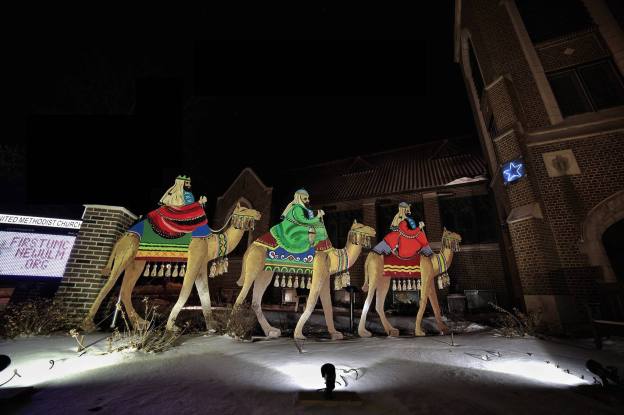
A few years ago, archeologists found the remains of a small first-century house in the village of Nazareth, where Jesus grew up. It might have even been the same house where Joseph and Mary raised their family. At the very least, given that Nazareth probably had no more than fifty homes in it, this little house belonged to someone Jesus knew when he was a child. Imagine what it must have been like to live right next door to the Son of God! What would it be like to rub elbows with the sweaty carpenter’s kid, to hang out as a teenager with the smartest guy in Hebrew class? I wonder…
“The Word became flesh and made his home among us.” – John 1:14

No Consolation – Sermon on Matthew 2:13-23

Have you already taken down your Christmas decorations at home?  We haven’t.  We leave them up as long as possible.  In fact, one year, we barely got Christmas put away in time for Ash Wednesday!  I grew up in a church that did not really observe the liturgical seasons of Advent, Christmas, Epiphany, Lent, Easter, and Pentecost.  For us, Christmas was a day, or two at most, if you counted Christmas Eve.  The twelve days between Christmas Day and Epiphany were nothing more than a vacation from school. Continue reading

How is this good news?

Pharaoh murders innocent babies, but Moses escapes in a basket.
Herod murders innocent babies, but Jesus escapes into Egypt.
Rival factions in South Sudan have killed more than a thousand, but over 100,000 have escaped into neighboring countries until the conflict can be resolved.

How, exactly,  is this good news?

Biblical scholars say, “You have to keep the Big Picture of God’s story in mind.” I get that. I understand that God does not desire for anyone to perish, but for all to believe and to have eternal life. I know that Bad Things Happening to Good People has more to do with our sinful human condition than God’s will for us. If I want to blame someone for atrocities, I might as well go all the way back to Adam and Eve. There are times when I’d like nothing better than to pound their chests with my fists and yell, “What were you thinking!”

All that knowledge doesn’t help much when I sit next to a woman whose son died, and she asks me, “How could a loving God let this happen?” A voice was heard in Ramah, wailing and loud lamentation, Rachel weeping for her children; she refused to be consoled, because they are no more (Matthew 2:18). How do you comfort a grieving parent who refuses to be consoled?

You don’t.

Just because I can’t explain it doesn’t mean I can shrug off the sorrow.  Just because I know God has a bigger plan in mind for eternity doesn’t diminish the pain of the here and now. It’s a dangerous thing to be human, to be vulnerable, to face the fact of our mortality. The Good News is not always sweetness and light. That pretty baby in the manger grows up to die on a cross. God has to watch his own Son, his only Son, die a horrible death. And God grieves.

God grieves all the Herods and the Pharaohs and the murderers of innocent children. God grieves us when we turn away from him. God grieves as only a bereft parent can grieve. How do you comfort a grieving parent who refuses to be consoled?
You don’t.
You weep, too.


Quiet Christmas

It’s Christmas Day.  The flurry of activity that led up to Christmas Eve has settled into a quiet day of rest and family time.  Later, I will put together the lasagna for our Christmas supper, and tomorrow will be filled with cleaning up after last night and preparing for Sunday’s worship, making visits and phone calls, and getting ready for next week.

But this is Christmas Day. It marks the beginning of the season of Christmas. Isn’t it good to know that there are still twelve days to celebrate peace on earth, good will to all?

Christmas Pageant

“You are out of your mind,” I thought, as I heard myself say out loud, “We should do a children’s Christmas pageant!”  I had seen those things.  I had managed to avoid being connected to them in any way for my entire adult life. I had been an elementary school music teacher, and had still escaped from getting sucked into the Christmas pageant frenzy.

But this is a new calling, and I’m pastoring a church that has plenty of kids.  “We’ll keep it simple,” I said.  “Let’s just have fun with it,” I said.  “It doesn’t need a lot of lighting or sets or new costumes – we can work with what we have in the storage closet,” I said.

“I can put it together in four rehearsals, I’m pretty sure,” I said.

At the first rehearsal, I realized the script I had was too wordy to keep the children engaged in the story.  We had sheep climbing up with the angels and shepherds staring off into the hallway instead of lovingly looking at Baby Jesus.

The day of the second rehearsal,  the schools closed because of the weather, and when the schools shut down in this town, everything shuts down.  We had to cancel.

By the third rehearsal, I’d found a Christmas Eve Children’s message that I could adapt into a simple script. It had the children repeating just one line at intervals throughout the brief narration, and it got the whole Christmas story right, without being cute or overly romanticized.

Then someone volunteered to take care of the costumes.  Someone else volunteered to bring hay for the manger.  Someone came and read a picture book to the children that explained what a manger was, what a stable was, what a shepherd was … and the children listened.  Someone organized a treat bag filling party. Someone borrowed a spotlight for the angel, that we decided we didn’t need, after all.  Someone baked Happy Birthday Jesus cupcakes to eat after the Wednesday night presentation (aka, dress rehearsal).

Then the angel said, “Don’t be afraid.”

And a sheep crawled up the steps to sit next to the angels.

And when Joseph didn’t show up because he’d caught the bug that’s been going around and was home sick in bed, one of the shepherds turned into a wise man, and a wise man became Joseph, and no one whined or argued about it.  They just did it.

The parents sang as many stanzas of “Silent Night, Holy Night” as it took to get three shepherds transformed into wise men, but it only took two stanzas, not three.

And the wise men marched up the center aisle, exactly five rows apart, just as they’d practiced.

At the end of the story, we sang, “Go, Tell it on the Mountain” while the wise men filed slowly out, and the shepherds led the sheep (and one cow) down the center aisle, followed by the angels, Joseph, and Mary with the Baby.  Parents applauded.  Children beamed.

Somewhere in there, Christmas happened.

Magnify – Sermon on Matthew 11:2-11 and Luke 1:47-55

In the traditional church calendar, the third Sunday of Advent is called “Gaudete” Sunday. Gaudete is Latin for “Rejoice!” and it is the first word of this Sunday’s customary opening sentence, or introit, taken from Philippians 4:4, “Rejoice in the Lord always.” We light a rose-colored candle, to contrast with the purple or blue candles used on the other three Sundays of Advent. In many churches, Advent is still considered a penitential season, much like the season of Lent, and there was even a time when fasting during Advent was quite common. Gaudete Sunday was a break from that fast, a time to rejoice in the nearness of Christmas, less than two weeks away.

One of the features of Gaudete Sunday is the use of Mary’s song from the first chapter of Luke in place of a Psalm. We used the beginning of it earlier, as our call to worship. Here’s the whole song:

My soul magnifies the Lord, and my spirit rejoices in God my Savior,
for he has looked with favor on the lowliness of his servant.
Surely, from now on all generations will call me blessed;
for the Mighty One has done great things for me, and holy is his name.
His mercy is for those who fear him from generation to generation.
He has shown strength with his arm;
he has scattered the proud in the imagination of their hearts.
He has brought down the powerful from their thrones, and lifted up the lowly;
he has filled the hungry with good things, and sent the rich away empty.
He has helped his servant Israel, in remembrance of his mercy,
according to the promise he made to our ancestors,
to Abraham and to his descendants forever.” – Luke 1:47-55

Mary’s song echoes the song Hannah sang when she brought her son, Samuel, to the temple and dedicated him to the Lord. You may remember that Hannah had been childless, and had begged God to give her a son. When Samuel was born to her, Hannah kept her promise to God, and gave him over to the priest Eli, to serve in the temple. Samuel became the last of the judges, and it was Samuel who anointed Israel’s first king, Saul. Later, Samuel also anointed Israel’s greatest king, David.

When Mary learned that she was to become the mother of Emmanuel, God With Us, she went to visit her relative, Elizabeth, who, much like Hannah, had become pregnant after many years of childlessness. Mary imitated Hannah’s song, while Elizabeth reflected Hannah’s story. Mary and Elizabeth may have been related to one another by blood, but they were both related to Hannah in spirit. When Hannah sang, she prophesied that Israel would one day have a King. Mary’s baby would become King of Kings, and Elizabeth’s baby would be the prophet who introduced that King to the world.

Fast forward about thirty years. Just last week, we heard Elizabeth’s son, John, proclaiming, “Repent, for the kingdom of heaven has come near.” This is the one of whom the prophet Isaiah spoke when he said, “The voice of one crying out in the wilderness: “Prepare the way of the Lord, make his paths straight.'(Matthew 3:2-3”)

In today’s lesson, John is in prison, and Mary’s son, Jesus, has established his own ministry of preaching and performing miracles. But John wonders if the Kingdom he foretold is really as near as he thought it was. John isn’t sure that Jesus is THE King, because he isn’t bringing down the judgment that John expected Messiah to bring. Hear the Word of the Lord, from Matthew 11:2-11:

When John heard in prison what the Messiah was doing, he sent word by his disciples and said to him, “Are you the one who is to come, or are we to wait for another?” Jesus answered them, “Go and tell John what you hear and see: the blind receive their sight, the lame walk, the lepers are cleansed, the deaf hear, the dead are raised, and the poor have good news brought to them. And blessed is anyone who takes no offense at me.”

As they went away, Jesus began to speak to the crowds about John: “What did you go out into the wilderness to look at? A reed shaken by the wind? What then did you go out to see? Someone dressed in soft robes? Look, those who wear soft robes are in royal palaces. What then did you go out to see? A prophet? Yes, I tell you, and more than a prophet. This is the one about whom it is written, “See, I am sending my messenger ahead of you, who will prepare your way before you.’ Truly I tell you, among those born of women no one has arisen greater than John the Baptist; yet the least in the kingdom of heaven is greater than he.

A lot has happened since John ate locusts and honey out in the wilderness. Now, John has found himself in prison. In the first century, prison was not a final destination, but a place where one remained until trial, waiting to be acquitted or condemned. This waiting could be a cause of great anxiety, and John’s circumstances may have contributed to his doubt. After all, if Jesus really was going to inaugurate a new Kingdom, wouldn’t getting his friends out of jail be a high priority? What was he waiting for? Wasn’t it about time for Jesus to overthrow King Herod’s corrupt government, and then get Israel out from under the oppressive rule of Caesar? This wasn’t panning out the way John had hoped it would. Jesus wasn’t measuring up to John’s expectations for a Messiah King.

Perhaps we can take courage in John’s disappointment. After all, if the greatest prophet who ever lived can wonder whether or not Jesus is the real deal, maybe our doubts and disappointment are a little more understandable. As we frantically try to get ready for Christmas, we may find that fear and doubt come creeping in. If we’re just scraping by, how can we afford to buy presents for those we love? When we get sick, or we lose people we love, when stress rises and hope fades, how can we pretend to be cheerful? How can we sing “Joy to the World” when our personal worlds are crumbling around us? Where is God when we really need him? Maybe we can understand John, as he paces around his prison cell, wondering if he made a mistake. When will the Kingdom finally show up? Could he have been wrong about Jesus? There’s only one way to find out, and since he can’t go himself, he sends his disciples.

Jesus tells those disciples, “Go tell John what you are seeing and what you are hearing. The Greek tense used here indicates continuous action, not a one-time event. Look at the evidence that is right in front of you, Jesus says. That work is continuing all around you. There’s an old adage that says, “When your work speaks for itself, don’t interrupt.” Jesus must have heard that saying, because instead of going into a long defense of his kingship, Jesus quotes the prophet Isaiah and says, “Look around. The blind see, the lame walk, the lepers are cleansed, the deaf hear, the dead are raised, and the poor have good news brought to them.” In John’s Gospel, we read that Jesus says, “the very works that I am doing bear witness about me that the Father has sent me” (John 5:36). In other words, this is the kingdom. No matter what you were expecting, this is what it looks like.

The problem isn’t with the kingdom, it’s with our view of it. John’s disciples were looking for the wrong thing. We fall into that trap, too. We don’t see the kingdom at work around us, because we are looking for the wrong thing. We may be looking for more people attending church, or larger offerings, or better publicity in the community. And we miss seeing the healing, the resurrection, the good news happening right under our noses.

John was expecting military power and swift judgment, but Jesus came offering forgiveness.

Others were anticipating a king in a palace, wearing soft clothes, but Jesus came to die on a cross, wearing only a crown of thorns.

We may be looking for a quick solution to all our problems, but Jesus calls us to take up our cross and follow him.

“And blessed is anyone who takes no offense at me,” Jesus says. Blessed is anyone who is not scandalized by me, might be another way to put it. If John was offended by the way things were turning out, Jesus wanted him to know that this was the way God intended his kingdom to come. Jesus wasn’t trying to ignore John or belittle his work. Jesus knew that John was in a very dangerous situation, and he also knew that his own ministry had depended on John’s “preparing the way” before him. Instead of downplaying John’s importance, Jesus lifts him up to the crowd as the greatest person who has ever lived, up to now. And yet, …

John was great, but the least in the kingdom of heaven will be greater than John. How can John be both the greatest person ever born, while the least in the kingdom of heaven is greater than John? The answer lies in John’s unique place in human history. John’s ministry marks both the end of the old order, and the beginning of the new. He is the bridge between the kingdoms of earth and the Kingdom of Heaven.

John is the climax of the old order. Biblical scholar Donald Hagner writes, “He is the one in whom the OT expectation has finally been distilled into one, final, definitive arrow pointing to the presence of the Messiah. Thus from a human point of view no one greater than John has ever been born.”[1] John lies at the turning point of history. This is the point where promise becomes fact, where prophecies become reality. Nothing can ever be the same again. This is the beginning of a new era. This is where grace takes over, and the kingdom of God breaks into our world in the person of Jesus Christ. John is the pivot point between the old and the new, between the prophecy and its fulfillment, between what was, and what is now.

John himself says of Jesus, “he must increase, while I must decrease” (John 3:30). John knows that his job description has changed. No longer is he the voice of one crying in the wilderness. Now, John must exchange his prophetic stance with that of a disciple, whose only job is to magnify the Lord. Instead of preparing the way for Messiah, John must learn to follow him. John is no longer the messenger, the one who goes before Christ, announcing the way of the Lord. John must become a disciple if he is to participate in the kingdom that has come, is coming, and will come in Jesus Christ. Theologian Karl Barth says that “true discipleship [is] simply to point to all that God has done for us in Christ.”[2]

John the Baptist asks, Who is Jesus? Jesus asks the crowds, Who is John?
But the real question we must face is this: Who am I, then?

It’s a question every Christian asks at some point. In John the Baptist, we find an answer: to be a disciple is no longer to look backward or forward or even deep into our own hearts, but rather to look only at Christ. In pointing to him alone, our identity finally becomes clear. It isn’t who we are, but whose we are that matters.

Once we grasp this truth, that we belong to God as followers of Jesus Christ, we have a job to do. Like Mary, our job is to magnify the Lord, showing Jesus to others so they can see God better. That’s our mission here: pointing people to Jesus, so they can experience the same grace we have experienced, choosing to follow Jesus as we follow Jesus.

Here we are on the third Sunday of Advent, Gaudete Sunday, preparing to welcome the Savior on Christmas Day. As we make our hearts ready, our joy may be mixed with disappointment. Like John, we may be wondering where God is in the midst of all the trouble that swirls around us, trouble that seems to be magnified by the pressures that go with making a holiday merry and bright. Yet, Mary calls us to remember that God has done mighty things, and is continuing that amazing work right under our noses, right now, right here. Rejoice! Again I say it: Rejoice! The Kingdom of God is at hand!


[1] Donald Hagner, Word Biblical Commentary (Vol. 33a): Matthew 1-13, 305-306.

[2] As quoted by John P. Burgess, in Feasting on the Word, Year A, Vol. 1, 72.

A pause in the middle of Advent

Three pots of chili are cooling on the back porch, along with the chicken that will be boned and chopped into bite-size bits to make chicken soup (for those who don’t like chili). Three big pans of cornbread are ready. We have no idea how many people will show up to go caroling tomorrow afternoon, but those who sing will be fed a bowl of something warm. In the midst of all the cooking, a call comes from the hospital’s ICU unit. The mood in our kitchen switches from joy to concern in a heartbeat.
Tomorrow is Gaudete Sunday, the Sunday of rejoicing in Advent. Christmas is less than two weeks away, and Mary’s Song beckons, encouraging us to rejoice in God our Savior as we see the many ways God’s Kingdom has broken into our world, turning things right-side-up that were upside down before.
Yet, in the middle of our rejoicing, another voice can be heard: John the Baptist, wondering from his prison cell, “Hey, Jesus! Are you The One? Or should we look for another?” John’s question may come from his own discouraging situation – wasn’t the Messiah, for whom John had been preparing the Way, supposed to overthrow this corrupt pseudo-king, Herod, and set things right? What was taking him so long?
Here we are, in the middle of Advent, and Mary’s rejoicing can swing into John’s concern in a heartbeat.
Then Jesus says, “Look. The Kingdom is right in front of your face. Maybe you are hunting for the wrong thing. This King doesn’t sit in a fancy palace, wearing soft robes. This King is busy healing, caring, sharing good news.”
Rejoice, then.
The Kingdom of God is at hand.

Preparing the Way of the Lord – Sermon on Matthew 3:1-12 – Advent 2, 2013

December 8, 2013 – Hanging of the Greens

 When Bruce and I moved to New Ulm, one of the first things we did was subscribe to the New Ulm Journal.  We are big believers in print news, and we knew we would learn things about this town through the local paper that might take us years to learn by other means.  We were delighted, then, to find that most of our favorite comic strips run in the Journal.  We’ve always loved “Shoe” and “Frank & Earnest,” because we love bad puns.  “Dilbert” and “For Better or For Worse” have just the right touch of real life to help us laugh at ourselves.  But we were especially glad to see that the New Ulm Journal carries “Sally Forth.”  (If you love bad puns, you have to love a comic strip with a name like “Sally Forth,” right?)

Sally is preparing for Christmas this week, and she has had to come to terms with the fact that Hilary, her daughter, has reached an age when decorating the house as a family is not nearly as important as spending time with her boyfriend.  Sally has been reminiscing about years past, when Hilary participated in the traditions of Christmas decorating with a little more enthusiasm.  Just as in real life, Sally’s cartoon memories of happier times might have suffered from too much sentimentality.  Like her memory of the year, when Hilary was five, and Sally tried to explain to her how an Advent calendar worked.  Sally remembers this as a moment of togetherness, but in reality, Hilary has pushed aside the goal of finding a piece of chocolate behind a little door every day.  What she wants to know is this: “Are any of those doors direct portals to Christmas Day?”  Hilary would skip all the decorating, all the chocolate even, if she could somehow jump directly from the Thanksgiving table into the joy of Christmas morning.

The Hanging of the Greens we have just experienced this morning might be the trigger for some of us to wish, along with Hilary Forth, that one of those little doors in the Advent calendar might be a direct portal to Christmas morning.  I mean, it looks like Christmas in here, doesn’t it?  What are we waiting for?

But we aren’t there yet.  We’d like to skip over the hard work of Advent if we could, and get right to the presents and eggnog, but here’s the reality: getting prepared for Christ to come into our lives takes more than garlands and wreaths.  Advent is, after all, the season of waiting.  We might think that seventeen more days is a long time to wait for Christmas to come, but the people of Israel had been waiting for hundreds of years, in expectation of the Messiah.  Prophets had been promising for centuries that God would send a Redeemer.  That kind of longing, that patient expectation, puts our impatience for Christmas to get here in a little different perspective, I think.

As John the Baptist began his ministry, some hoped that perhaps he was the promised Messiah.  He certainly spoke with prophetic authority.  But … he was a bit strange.  He lived out in the wilderness, for one thing, and ate whatever he could find.  His message was relentless, and he didn’t seem to care whom he offended with his preaching.  Matthew introduces John early in his gospel, knowing that the story of Jesus had to begin with a prophet preparing the way for the One who was to come.  John knew, even if the people who heard him preach did not, that he was not the Promised One.  He was eagerly waiting for the prophetic word he preached to be fulfilled.  John knew his job was to prepare the way for the Savior, and that the time was very near.  Hear the Word of the Lord, as we find it recorded in the Gospel of Matthew, chapter three, verses 1 through 12.

In those days John the Baptist appeared in the wilderness of Judea, proclaiming, “Repent, for the kingdom of heaven has come near.” This is the one of whom the prophet Isaiah spoke when he said, “The voice of one crying out in the wilderness: “Prepare the way of the Lord, make his paths straight.’ ” Now John wore clothing of camel’s hair with a leather belt around his waist, and his food was locusts and wild honey. Then the people of Jerusalem and all Judea were going out to him, and all the region along the Jordan, and they were baptized by him in the river Jordan, confessing their sins. But when he saw many Pharisees and Sadducees coming for baptism, he said to them, “You brood of vipers! Who warned you to flee from the wrath to come? Bear fruit worthy of repentance. Do not presume to say to yourselves, “We have Abraham as our ancestor’; for I tell you, God is able from these stones to raise up children to Abraham. Even now the ax is lying at the root of the trees; every tree therefore that does not bear good fruit is cut down and thrown into the fire. “I baptize you with water for repentance, but one who is more powerful than I is coming after me; I am not worthy to carry his sandals.  He will baptize you with the Holy Spirit and fire. His winnowing fork is in his hand, and he will clear his threshing floor and will gather his wheat into the granary; but the chaff he will burn with unquenchable fire.”

Hmm, that’s not really an encouraging message, is it?  I don’t know about you, but being called a brood of vipers doesn’t really make me want to curl up by the Christmas Tree with a cup of hot cocoa.  No wonder John had enemies.  No wonder his ministry was a short one.  He certainly doesn’t sugar-coat anything. “Repent, for the Kingdom of heaven has come near!” he shouts.  “Get ready!  The Messiah is coming, and you don’t want to mess with him!  This Messiah you’ve been waiting for is going to judge the whole world, so you’d better confess your sins and repent of them, before it’s too late!And yet, even though John’s message is harsh, people flocked out to hear him preach.  Instead of going to the center of town to stand on his soapbox where more people could hear him, John lives out in the wilderness, in the wild country, where no one wants to go.  Yet people from Jerusalem, even all of Judea, come out to hear him, and to be baptized by this prophet of God.

John’s baptism is a curious thing.  Like his camel-hair clothing and his diet of bugs and honey, John’s baptism just doesn’t fit into any idea of “normal.”  You must understand that baptism had been around for a long time.  It was a ritual cleansing practice for gentiles who wished to convert to Judaism.  Converts were baptized to signify that they had been purified, and could now enter the temple to worship.  Jews who were born Jews needed no such purification ritual; normal washing and following Kosher laws were enough.  But a gentile coming into the faith was completely immersed, to show that sin had been removed, and the new convert was now acceptable in the temple.

So why were all these Jews going out to the wild lands by the Jordan river – not the cleanest river in the area, by all accounts – to be baptized by this strange man?  They were already practicing Jews.  In fact, Matthew tells us that even the Sadducees and Pharisees, the most influential and faithful groups of Jewish leaders, were coming out to hear John and be baptized.

But John’s baptism wasn’t a standard ritual.  John’s baptism was a symbol of repentance, of turning away from sin.  The people who came to John to be baptized wanted to be ready when the Messiah came.  Like their ancestors, they had fallen into complacency; taking for granted their status as the chosen people of God, going through the motions of ritual worship, without experiencing the presence of God in their lives.  John’s preaching had awakened in them a memory of what it meant to be God’s people, holy and set apart.  John’s preaching also awakened in them a hope for the future, and the expectation that the future was nearer than they’d thought.

The Sadducees and Pharisees, as the most religious Jewish leaders, thought their very Jewishness would be enough to save them.  John says, “Not so – you need to repent, too.”  What’s more, John tells us, we need to bear fruit that is worthy of repentance.  Our lives need to show evidence that we have turned away from sin, and have turned toward God.

So what does that look like?  How do we prepare the way of the Lord?

According to theologian Alyce McKenzie, “The way not to prepare is to rely on our spiritual credentials.” “We have Abraham as our ancestor” the Sadducees and Pharisees proudly argued.[1]  But John tells them that isn’t enough.  McKenzie continues, “Presumably, relying on any other assurance or past accomplishment than God is not the way to prepare.  Inaction is not the way to prepare.  Making excuses is not the way to prepare.  Being distracted from Jesus’ coming kingdom by possessions, prestige, and power is not the way to prepare.  Not then and not now.”  You can read her entire essay here.

Preparing our hearts for Jesus looks a little different than preparing the Sanctuary, as we have just done.  The season of Advent is a time for us to prepare, not by putting up more greenery or strings of lights, beautiful as they may be.  Decorations can help us remember the deep truths they represent, but they can also sometimes be the way we cover up the messiness of our lives, the dark places in our hearts.

The season of Advent is a time to reflect, to ponder, preparing ourselves for Christ to enter into us, and transform our lives into something new, something holy.  This season is an opportunity for each of us to allow God to work in us.  Just as we prepare the sanctuary for Christmas with garlands and wreaths, we prepare our hearts for Christ through repentance.  Repent, for the Kingdom of heaven has come near!  Repent and believe the Good News: In Jesus Christ, your sins are forgiven.

Prepare the way of the Lord.  It doesn’t take much, really.  Just a turning away from our own desires, as we turn toward God’s deep desire for us.  That’s what repentance is, after all. Turning away from our sinful selves, as we turn toward God’s love for us.  It doesn’t take much space to turn around, but we have to do the turning.

Last year, Mary Luti wrote an Advent hymn that might give us a clue to preparing the way of the Lord, in the world, and in our own hearts.  You can find it here.

Our lives need to show evidence that we have turned away from sin, and have turned toward God. But we can’t manufacture that evidence. It just shows. As you find the “little room” God needs in your heart this Advent season, don’t worry too much about making sure your “fruit worthy of repentance” is showing.  Trust that it will.  Trust that God can change you, if you just give him a little room.  Amen.


[1] Matthew 3:9

Advent Two – A warning for worship

You’ll get the sermon here around noon (CDT) today, but in the meantime, know that lots of people pray for worship every week, and one of those is Martha Spong. Here is a link to her prayer for pastors this cold, cold morning. The roads are treacherous for so many this second Sunday of Advent, but the Word of the Lord looks even more daunting, in some ways. Prophets always tell the truth, and the truth is often something we’d rather not hear.

So whether you travel (drive carefully, as if there is a raw egg between your foot and the accelerator!) or turn on a television broadcast of worship today, be alert for the unexpected. And know that, whatever our expectations, God will show up in surprising ways. See you at church….