Category Archives: Worship

Children’s Message for Trinity Sunday

Today is Father’s Day. Wave at your dad.  What do you usually call him?  What does your mom usually call him?  How about your grandpa and grandma, his parents? Just like your dad can have three different names, depending on how he is related to the person calling him, God is known to us in three different ways that all depend on how we relate to God in a specific instance. For example, we often think of God the Father, because that’s what Jesus called him, or sometimes we think of the Father as the Creator, like we heard earlier in the story from Genesis that starts out, In the beginning, God created… And we also think of Jesus as God’s Son, or  – if we look at  his relationship to us – we might call him God the Redeemer or Savior.  And last week, we celebrated another way God is present with us, as God the Holy Spirit. Remember how the disciples received the Holy Spirit at Pentecost?  Sometimes we call the Holy Spirit our Comforter or Sustainer. Three different ways we recognize God, but it’s all just One God.  As you look around the church you may notice symbols in groups of three – that’s to represent the three ways we know God, and we call it the Trinity. So today, when you get bored, try looking around for things that are in groups of three, and you can tell me during coffee time what you found, okay? Let’s pray.

God our Maker, or Savior, our Friend, help us to know you and love you, no matter what we call you. We pray in the name of the Father, Son, and Holy Spirit. Amen.

Pentecost Ponderings – “What Does It Mean?”

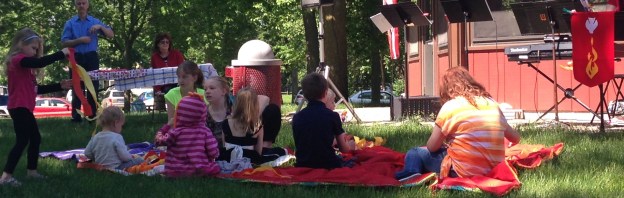
This isn’t really a sermon – Peter gets the honors on that one for Pentecost Sunday – but here are my reflections on the texts for the day, which will be interwoven with songs and other worship elements as our congregation worships in the park tomorrow, then stays around for a potluck church picnic. Weather won’t be an issue, since we have shelters reserved. Children made flame streamers and coffee filter doves and spinning toys on Wednesday night, so we will use these props as we tell the stories together. Here goes…

Reflection on Numbers 11:24-30

Moses was in the middle of a crisis. The people had rebelled and tested God, whining for meat in addition to the manna that had been provided for them. Moses was exhausted from leading them and arguing with them, and he also complained to God.

The key verse in this story happens just before today’s lesson begins, after Moses has wondered aloud how God can possibly provide a month’s worth of meat for over 600,000 people out in the middle of the desert.:

23 The Lord said to Moses, “Is the Lord’s power limited? Now you shall see whether my word will come true for you or not.”

Then God had Moses gather 70 elders. 70 is an important number in the OT – perfection times 10. And God gave each of them a portion of Moses’ spirit, to help him lead the people, and they all began to prophesy, or speak the word of the Lord with authority. However 

Two who did not join the group at the tabernacle, remained in the camp, and they also received the Spirit and began to prophesy. This upset the status quo. Joshua got indignant – this was outside the box! These unauthorized prophets  should be silenced!

But Moses said, “I wish every one of God’s people would be prophets and the Lord would put his spirit on them.”

This number – 70 or 72 – comes up again in scripture. Remember the disciples that Jesus sent out ahead of him, to heal the sick and announce that the Kingdom of God is near? It’s in Luke 10 if you want to read it sometime. Jesus said, “The harvest is plentiful, but the workers are few. Ask the Lord of the harvest, therefore, to send out workers into his harvest field” (Luke 10:2). What is interesting is that, in the passage from Numbers, there is some disagreement whether Medad and Eldad were part of the original 70, but they just didn’t report to the tent of meeting with the others, or if they were two more. In Luke, some translations list 70, while others say 72 were sent.

God is not limited by our ideas of what the perfect number might be. God is always more than we can imagine. He pours out his spirit abundantly on the perfect number, and then spills it onto two more, completely unexpectedly. God’s spirit cannot be contained, even among rebellious, whiny children. Hold that thought. There’s more to come. …

Then we sing a couple of songs, and read the Gospel lesson together as a responsive reading. It’s only a couple of verses, and needs no commentary. Jesus says, “Let any who are thirsty come to me, and let the one who believes in me drink.” Then we sing “Jesus Loves Me” as the children gather and prepare the props for distribution to the congregation.

The Pentecost Story – Acts 2:1-21

A couple of weeks ago, we heard the story of the Ascension. Before he ascended, or rose up, into heaven, Jesus told the disciples to go back into the city and wait to be “clothed with power from on high.” (Luke 24: 49) So the disciples went back to Jerusalem rejoicing and they praised God every day in the temple. In Luke’s second book, the one we call “Acts of the Apostles” or just “Acts,” we learn that the disciples were staying together in an upstairs room. This might have been the same room where they ate with Jesus on the night before he was crucified, and where they waited together on Easter morning. But they waited together, and that is the important part.

There was a big festival fifty days after Passover – and remember it was during Passover that Jesus was crucified – and sometimes people who lived far away from Jerusalem would come to the city for Passover, and then just stay for the festival of Pentecost a few weeks later. So Jerusalem was pretty crowded, and there were people there from many different countries, all of them speaking different languages. It must have been pretty noisy.

Then, on the morning of Pentecost, while the disciples were still together – remember the bundle of sticks from last week, and how important it is that we stick together to stay strong in our faith? – well, on that morning, the disciples received what Jesus had promised them, that “power from on high.” But no one expected it to happen the way it did. Remember in our earlier story about Moses and the elders, how God’s spirit spilled out onto Eldad and Medad, even though they stayed in the camp? Well, listen to this, and you can help me tell the story.

 Acts 2:1-21:

When the day of Pentecost had come, they were all together in one place. And suddenly from heaven there came a sound like the rush of a violent wind, and it filled the entire house where they were sitting. (blow pinwheels, make wind sounds by rubbing hands together)

Divided tongues, as of fire, appeared among them, and a tongue rested on each of them. (wave flame streamers, keep wind noise going, hold construction paper “tongues” over a few heads.)

All of them were filled with the Holy Spirit and began to speak in other languages, as the Spirit gave them ability.

What do you think they were saying? I wonder what it must have felt like, to be speaking a language you didn’t even know yourself, but others could understand. What do you think?

Now there were devout Jews from every nation under heaven living in Jerusalem. And at this sound the crowd gathered and was bewildered, because each one heard them speaking in the native language of each.Amazed and astonished, they asked, “Are not all these who are speaking Galileans? And how is it that we hear, each of us, in our own native language? 

Remember that there were people there in Jerusalem from many different countries, and they all spoke different languages. So there must have been at least a dozen different languages happening at the same time. Do you remember the story in Genesis (11) about the people who were trying to build a tower to heaven, so God “confused their speech” by giving them different languages, so they couldn’t understand each other? Right, it was the Tower of Babel. Well, this was just the opposite. Now, because the disciples were speaking in so many different languages, everyone had a chance to hear the good news in a way they could understand it. But it probably sounded pretty noisy from far away. Let’s try an experiment. Adults, I want you to think of a song you like to sing in church, maybe your favorite hymn. If you don’t think of yourself as a singer, you can use a kazoo (redistribute kazoos, if necessary). Now, the children are going to count to three, and on three, would you each please start singing your own song? While the adults sing, we are going to listen from over here first, to see if we can understand any of them. Then I’d like the adults to spread out away from each other, but keep singing. I’d like each of you children to go stand right in front of someone who is singing, and see if you can tell what their song is. Ready? One, two, three, sing!

Did you notice that it’s easier to hear just one song if you are standing right in front of the singer, while the other songs are in the background? I think that’s what happened here at Pentecost. Suddenly, the disciples aren’t hiding away in the upper room any more. Suddenly, they are out in the street, or maybe the temple square, where everyone else can hear them. And as they spread out, it makes it easier for the people who were there from other places to hear and recognize their own languages.  Let’s see where they were from:

Parthians, Medes, Elamites, and residents of Mesopotamia, Judea and Cappadocia, Pontus and Asia, 10 Phrygia and Pamphylia, Egypt and the parts of Libya belonging to Cyrene, and visitors from Rome, both Jews and proselytes, 11 Cretans and Arabs—in our own languages we hear them speaking about God’s deeds of power.” 

People came from all over to Jerusalem for the festival of Pentecost. In fact, the places that are mentioned here have been grouped according to where they appear on a map. (Show Bible map) The Parthians, Medes, Elamites and Mesopatamians would have come to Jerusalem from the east, the Judeans were the people who lived right around Jerusalem, the Cappadocians and people from Pontus and Asia, Phryigia and Pamphylia came from the north, the Egyptians, Libyans, Romans and Cretans came from both sides of the Mediterranean Sea west of Jerusalem, and the Arabs came from the south. But the word of the Lord was not just for foreigners, it was also for the people who lived right there in Jerusalem, in the middle of Judea. And it wasn’t just for the Judeans, it was for people from as far away as Egypt and Rome. The good news is for everyone.

For the disciples, that meant Jews AND Gentiles from different places. For us today, it might mean something different. What are some ways we think of people as being different from each other now? Poor, rich, smart, not so smart, shy, popular, bullies, victims of bullying… but the good news is for everyone, even people we think are not like us at all – especially for people we think are not like us at all.
Let’s find out what happened next.

12 All were amazed and perplexed, saying to one another, “What does this mean?” 13 But others sneered and said, “They are filled with new wine.”

14 But Peter, standing with the eleven, raised his voice and addressed them, “Men of Judea and all who live in Jerusalem, let this be known to you, and listen to what I say. 15 Indeed, these are not drunk, as you suppose, for it is only nine o’clock in the morning. 16 No, this is what was spoken through the prophet Joel:
17 ‘In the last days it will be, God declares,
that I will pour out my Spirit upon all flesh,
    and your sons and your daughters shall prophesy,
and your young men shall see visions,
    and your old men shall dream dreams.
18 Even upon my servants, both men and women,
   in those days I will pour out my Spirit;

        and they shall prophesy.
19 And I will show portents in the heaven above
    and signs on the earth below,
        blood, and fire, and smoky mist.
20 The sun shall be turned to darkness
    and the moon to blood,
       before the coming of the Lord’s great and glorious day.

21 Then everyone who calls on the name of the Lord shall be saved.’

This is the good news: everyone who calls on the name of the Lord shall be saved. Some may laugh and make fun of us for believing in Jesus, just like the people who accused those disciples of being drunk at 9:00 in the morning. But there will always be people asking “What does this mean?” and we have an answer to give them.

The Holy Spirit is here among us. The Holy Spirit gives us power to speak boldly so everyone can hear and understand that Jesus is Lord. The Holy Spirit cannot be contained, but spreads out and overflows. Sons and daughters will prophesy – they will announce God’s good news with authority. Many signs and wonders will let us know that the day of the Lord is coming, and all who call on the name of the Lord shall be saved. That’s what it means to have rushing wind, tongues of fire, and every known language spoken at once. It means that God’s Spirit is filling the world, filling the church, filling you and me. But that’s not all. There’s more! God has given us so much, we need to give back to God. We have one more reading from the New Testament, and it will tell us what living in the spirit means for us.

Offering time, then an introduction to the Epistle reading for the day:

What have we learned so far, as we heard the story of Moses, and the story of Pentecost? God’s spirit is not limited by our ideas of how things “ought” to be. God’s spirit is poured out on all people who call on the name of the Lord, no matter what they look like, where they come from, how smart they are, or whether they are rich or poor. We need to trust God to do more than we can imagine, knowing that God will pour out his Holy Spirit on us, giving us power to do the work of the Kingdom of God.

In order to do that work, we need to recognize how the spirit acts in each of us, giving each of us particular spiritual gifts, to use for the building up of God’s Kingdom. Hear the final reading for this day of Pentecost, from Paul’s letter to the Corinthians,  1 Corinthians 12:4-13.

Then we close with a Pentecost prayer, which will include a prayer distributed at the recent Minnesota UMC Annual Conference  Session for God to unleash us as a fearless, spirit-led church, and we sing a final song before blessing the food that follows worship, sharing a benediction to be sent out as spirit-led, spirit-filled, spirit-gifted people of God. Come, Holy Spirit, come!

So, what does your Pentecost party look like?

A Messy Business

The confirmands looked serious as they read scripture, imposed ashes, and offered bread and cup to the congregation,

And there were babies crying and toddlers talking loudly,

And the ashes got all over everywhere, and the bowls were slippery with the glycerine we smeared on our fingertips to keep the ashes from sticking to our hands;

And the gluten-free bread crumbled into the chalice as we dipped big chunks of it, then handed them to congregants who seemed surprised to receive so much;

And the children came with their parents, eager eyes shining, and hands outstretched to receive the bread, dipped in grape juice just for them;

And the people had to hold hymnbooks and follow the printed order of worship, because there was no slide show projecting the words of each song on the wall;

And they didn’t seem to mind.

And we confessed our sin,

And we were pardoned.

With ashes everywhere, and bread crumbs on the floor,
And grape juice dripping down our fingers,
We accepted Christ’s body and blood, broken and shed for us.

And we remembered that following Jesus is messy business.

A Word for Children – Brownies Aren’t Done Until…

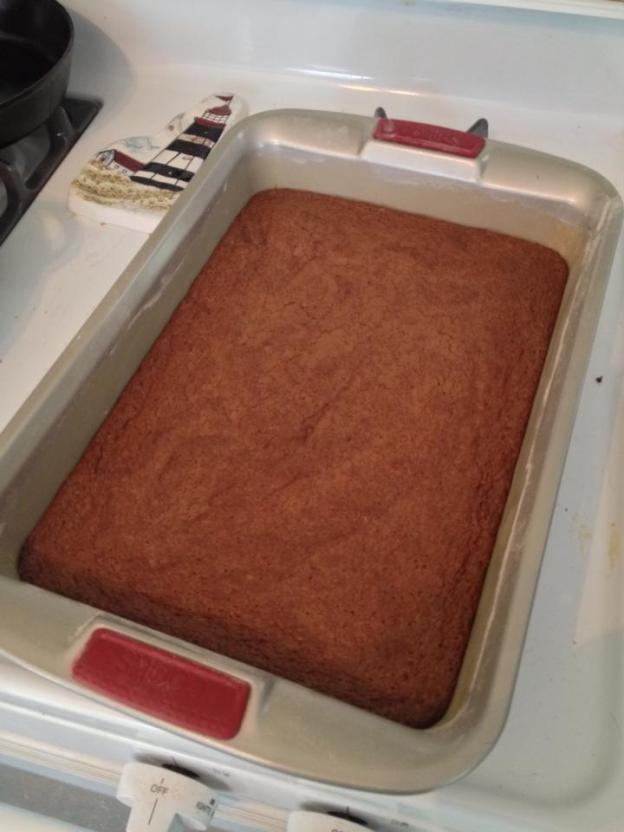
Photo used with permission from April Fool Virtual Bakery. Thanks, Mark!

Last weekend, as members of our church council gathered together, Jane S. gave a great devotional message about the importance of our various gifts. God has given each of us a particular set of talents and abilities, and God wants us to use these gifts well as we grow in our faith. But, as I was thinking about today’s scripture, it occurred to me that the same example Jane used to teach us about our gifts could also apply to the thing Jesus tells us today (Matthew 5:48). As Jesus was teaching his followers about the way God works, he kept telling them, “I expect more out of you than just following the rules. I want you to be changed into something new. I want you to be perfect, completely like God, so you can show the rest of the world how much God loves every single person on earth.”  That sounds impossible, doesn’t it? But we don’t change into something new by ourselves: God does it. And it doesn’t happen in the blink of an eye – it takes a while.

So here’s the deal: I have some ingredients here, and I need you to help me change them into something new. (Distribute ingredients for Brownies, each in its own resealable bag) Do all these ingredients look like something you would want to eat? If we mixed them up together, what do you think we would get? (Cream together butter and sugar, add egg, then flour, baking powder, cocoa, salt) Now what do we have? It has changed, but can we eat it yet? Can you tell what it’s going to be? (Spread batter into pan) They aren’t brownies until we bake them, so let’s get some help with that. (Give an adult the brownies for baking in the church kitchen during the rest of worship) Just like the brownies, we aren’t done yet. God is still working inside each of us to change us into people who make the world a better place. He’s making each of us more and more like him every day, just like those brownies, baking in the oven, will become more and more like something you could eat after church. Let’s pray.

God, keep working on us to make us more like you. Change us into people who care more, who help more, who love more, so we can be more like Jesus. Amen.

Water and Spirit – Sermon on Matthew 3:13-17 (Baptism of Our Lord 2014)

Can you remember your baptism?  If you were baptized as an infant, chances are good that you have no memory of the actual event. I was baptized by my pastor – who also happened to be my father – when I was a young girl. I am grateful that my baptism could happen in a clean, heated baptistery, instead of the cold muddy river our church used for baptisms in its earliest years. I remember stepping down into the water, wearing one of my dad’s white shirts with the sleeves rolled up. I remember losing my footing as my dad laid me down into the water, baptizing me in the name of the Father, and of the Son, and of the Holy Ghost. But Dad didn’t let me drown. He held onto me until I could get my feet back under me, and then helped me back up the steps, where my mom waited with a clean towel. It’s a good memory. I couldn’t really put my finger on it, but I knew something was different about me after that. I knew I’d been changed for good.

The third chapter of Matthew’s gospel describes a slightly different process, as John the Baptist preaches a message of judgment and baptizes repentant sinners in the Jordan River. The water is cold and murky. Since John’s call to repentance inspires a spontaneous desire to be baptized among his listeners, their Moms probably aren’t waiting on the riverbank with warm towels. But the people coming up out of the water know they’ve been changed for good. They might not be able to put their finger on it, but something is different.

Then, an amazing thing happens. The long line of baptismal candidates has dwindled down to the last three, then two, then only one person standing in front of John in the river, waiting to be baptized. And John recognizes this one. It’s his cousin, Jesus. Hear the Word of the Lord, as given to us in the third chapter of the Gospel of Matthew, beginning at the thirteenth verse:

Then Jesus came from Galilee to John at the Jordan, to be baptized by him. John would have prevented him, saying, “I need to be baptized by you, and do you come to me?”  But Jesus answered him “Let it be so now; for it is proper for us in this way to fulfill all righteousness.” Then he consented. And when Jesus had been baptized, just as he came up from the water, suddenly the heavens were opened to him and he saw the Spirit of God descending like a dove and alighting on him. And a voice from heaven said, “This is my Son, the Beloved, with whom I am well pleased.”  Matthew 3:13-17

Whether you were sprinkled, poured over, or dunked, your baptism required water. Water is essential to life, and we can’t live very many days without it. The average human body is about 65% water. Water plays a major role in the biblical story, all the way from Genesis, with Creation and Noah’s Flood, through the Exodus, as God provides water in the desert, into the New Testament, where Jesus lives and teaches by the Sea of Galilee, right through to Revelation, where the River of Life flows through the City of God. Jesus told the Samaritan woman at the well that he, himself, was the source of Living Water. Water also washes us, and the origins of baptism in Jewish worship included the symbolic act of washing and being purified through water. New converts to Judaism were baptized, you may remember, as part of the initiation ritual that demonstrated they were now clean, ready to enter the Temple. As John baptized repentant sinners in the Jordan River, I wonder if anyone remarked on the irony of being cleansed from sin in one of the dirtiest looking rivers around.

There’s a story in the Old Testament about another man, Naaman, who also walked down into the Jordan River. I have sometimes wondered why it isn’t one of the assigned readings for this Sunday, when we celebrate the baptism of our Lord. Naaman was a powerful general in the army of the King of Aram, during the time of the prophet Elisha. Naaman had a skin disease. His wife’s servant, a young girl who had been captured from Israel by an Aramean raiding party, told her mistress about Elisha the prophet, and said, “I wish my master would go to him and be healed.”  One thing led to another, and soon Naaman was on his way to Samaria with a load of gifts for the King of Israel. You can read the whole story in 2 Kings 5, but the short version is that the king sends Naaman to Elisha, and Elisha doesn’t even come out of his house to meet the great warrior. He sends his servant to tell Naaman to dip himself in the River Jordan seven times. Naaman is insulted. Aren’t there cleaner, nicer rivers back home?  And why doesn’t this prophet come out and wave a magic wand, say some mumbo jumbo and make the disease disappear?  Naaman leaves in disgust. But his servants, who are traveling with him, urge him to reconsider. They remind him that he would have done a great thing if he’d been asked, so why not do this little thing he’s been told to do?  Naaman changes his mind, does what he’s told, and is healed of his skin disease.

Naaman repented. He turned around and went back to the river, and did what he was told to do. He obeyed the Word of the Lord, given through the prophet Elisha, and he was changed for good. His disgust and unwillingness to submit to Elisha’s command was replaced with obedience.

Like Naaman, John also protested, but relented and became obedient. John knew Jesus. We don’t know if these two relatives spent any time together as children, but keep in mind that John was only about six months older than Jesus, and their mothers had been close. So we can speculate that they knew each other as “cousins” before Jesus waded into the river to meet John. But John knew Jesus as something more than a cousin. He recognized that the man standing in front of him was The One for whom he had been preparing the way. John knew that this was the Messiah. John knew that Jesus didn’t need to be baptized. John knew that his own ministry was about to come to a close, because here stood the whole reason for John’s preaching, teaching, and baptizing. John knew that the Kingdom of God was looking him in the eye.

John’s question has troubled Christians from the beginning. Why did Jesus think he needed to be baptized?  He had never sinned; he didn’t need to repent. Yet, here he was, asking John to baptize him along with all those repentant sinners. It’s quite possible that Matthew’s first-century church had argued over this question, and that is why Matthew makes a point of explaining a motive for this peculiar behavior by the Son of God. Jesus tells John, “Allow this to happen for the time being, to fulfill all righteousness.”  “Trust me on this one,” Jesus says to his cousin John. “Even if it seems weird to you, just trust me. God has a plan in mind, and this is part of it.”  So John is obedient, and baptizes Jesus, and righteousness is fulfilled.

That word, “righteousness,” is loaded with meaning. Matthew uses it seven times[1] in his Gospel, and each use signals a slightly different understanding of the word. For Matthew, righteousness is more than “being good.”  Righteousness is closely connected to an awareness of the coming Kingdom. Righteousness means following Jesus as a faithful disciple, and participating in that kingdom. Righteousness is becoming aligned with God’s deep desire to save us. When Jesus tells John, “permit it to be so now, to fulfill all righteousness,” he’s saying, “Let’s do this!  It’s part of God’s plan to redeem the world from sin!”

It’s important to see that Jesus includes John in the plan. They have to do this together. This moment when John lowers Jesus under the water connects the ministry that went before, preparing the way, with the ministry that is just beginning – that is the Way. As Jesus submits to baptism, he puts himself in the same position as the people he came to save, and he does it in a very literal, tangible way that they can see. Three years from this moment, he will take on the sins of the entire world as he hangs on a cross at Golgotha. But in a very real way, his baptism serves as the initiation for that saving work.

So, just as Naaman obeyed Elisha, and John obeyed Jesus, Jesus becomes obedient. In their obedience, Naaman and John are changed for good. In his obedience, Jesus changes us for good.

And then something else amazing happens. The heavens are opened, and Jesus sees the Spirit descend on him like a dove, and a voice says, “This is my Son, the Beloved, with whom I am well pleased.”

The Spirit moved over the waters at Creation, and over Mary at Jesus’ conception. Now the Spirit moves over the waters of Christ’s baptism, labeling him as God’s own beloved Son, and anointing him as both King and servant of all. When we baptize an infant or a new believer, we lay on hands and breathe over the one being baptized, to signify that a New Creation has begun in us. We anoint the newly baptized with oil, as a symbol that the Holy Spirit has marked this one as God’s own beloved child.

Theologian Greg Garrett writes that baptism symbolizes birth and rebirth throughout the Bible, and whenever this happens, “people enter the water as one thing,” [slaves out of Egypt, or wanderers entering the Promised Land, for example] … and emerge as something entirely different”[2]. Jesus entered the water as ‘just another guy’, as far as the crowds around John were concerned. But when he emerged from those baptismal waters, he’d been changed for good. Christ’s baptism marked the beginning of his public ministry on earth, but it also marked him as God’s own Son, the Beloved, in whom God took great pleasure. If Jesus was going to baptize with the Spirit, as John had announced, he had to first experience that anointing himself.

Baptism marks us as belonging to God. The old catechism calls it a visible, outward sign of an invisible, inward grace. It’s important to remember that the Holy Spirit does this work in us; it is not some transaction we perform. It is also important to remember that, once we are sealed with the mark of baptism, that seal is a permanent one. We belong to God, now and forever. He has claimed us as his own.

In a moment, we will renew our baptismal vows using a distinctive Wesleyan liturgy. As we each reflect on our own baptism, we must also consider how we ended up here, in this Methodist Church, living and working together for Christ’s kingdom through this particular congregation. How are we being called to obedience by God’s Spirit working among us?  What is the outward sign of our inward grace, and how are we to show that grace to the community of New Ulm?

You may have noticed that several elements of our worship this morning have drawn on the Wesleyan heritage that marks the United Methodist Church in a unique way. For over three hundred years, the Methodist movement has been “seeking the fulfillment of God’s reign and realm in the world.”[3]  John Wesley held three simple rules that have become known as “The Wesleyan Way.”  Those rules are to do no harm, to do good, and to stay in love with God. They are reflected in the Minnesota Annual Conference Gospel Imperatives to reach new people, cultivate spiritual vitality, and heal a broken world.

As we renew our baptismal promises, we need to make them count for something, to honor them in spirit and in truth as we live out our faith together in this time and place. If this is something you haven’t considered before, or if it’s been a while since you consciously thought about your own discipleship, I encourage you to focus first on Wesley’s third rule: stay in love with God. Cultivating a deep and rich friendship with God gives us a reason to do good, to reach new people, to heal a broken world.

Baptism won’t save you. Baptism isn’t some secret initiation rite with magical properties. Baptism is a sign of obedience. As you touch the water in a moment, maybe making the sign of the cross on your forehead with a wet finger, remember your baptism and be thankful. Remember the promises you made, or the promises that were made on your behalf by your parents and the congregation that witnessed your baptism. Renew those promises to be faithful, to love God and neighbor, to seek righteousness, to be a true follower of Jesus. Then go out, marked by grace, to be obedient to God.


[1] Matthew 3:15; 5:6, 10, 20; 6:1, 33; 21:32

[2] Greg Garrett, Feasting on the Word Year A, Volume 1, 239.

[3] 2012 Book of Discipline, ¶121.

Remember your baptism

A picture hangs in my office, taken sometime in the mid-1950s. A young boy is standing waist-deep in a river, holding a list of names, candidates for baptism.  Next to him is his father, a pastor, preparing to baptize a young girl. The busy river flows around these three figures, and makes me grateful that, by the time that same pastor, who also happened to be my father, baptized me, it was in a heated baptistery filled with clean water.

This Sunday is the celebration of the Baptism of Our Lord, the first Sunday in the season of Epiphany. Matthew’s gospel tells of Jesus going down into the Jordan River, where John was baptizing repentant sinners. Matthew makes it clear that Jesus wasn’t asking to be baptized because of sin, but in order to “fulfill all righteousness” (Matthew 3:13-17).

There’s a story in the Old Testament (2 Kings 5:1-14) about another man, Naaman, who also walked down into the Jordan River. But Naaman didn’t do it voluntarily. In fact, he was angry that the prophet Elisha had told him to do such a degrading thing, and turned away in disgust. But his servants reminded him that he would have done a great thing if he’d been asked, so why not do this little thing he’d been told to do? Naaman changed his mind, and was healed of his skin disease.

I see a connection between John’s baptism “with water for repentance” and Naaman’s repentant plunge into the Jordan River. But I see an even stronger connection between Naaman’s “baptism” and the baptism of Jesus, who had no need to repent, who knew no sin. Naaman may have balked at first, but in the end, he did what he was told to do.  John may have balked when Jesus came to him to be baptized, but in the end, Jesus did what he was told to do, too. Naaman was cleansed of his disease, while Jesus took on the sins of the world. Both  were obedient to God.

Baptism won’t save you. Baptism isn’t some secret initiation rite with magical properties. Baptism is a sign of obedience. As you touch the water this Sunday, maybe making the sign of the cross on your forehead with a wet finger, remember your baptism and be thankful. Remember the promises you made, or the promises that were made on your behalf by your parents and the congregation that witnessed your baptism. Renew those promises to be faithful, to love God and neighbor, to seek righteousness, to be a true follower of Jesus. Then go out, marked by grace, to be obedient to God.

Christmas Pageant

“You are out of your mind,” I thought, as I heard myself say out loud, “We should do a children’s Christmas pageant!”  I had seen those things.  I had managed to avoid being connected to them in any way for my entire adult life. I had been an elementary school music teacher, and had still escaped from getting sucked into the Christmas pageant frenzy.

But this is a new calling, and I’m pastoring a church that has plenty of kids.  “We’ll keep it simple,” I said.  “Let’s just have fun with it,” I said.  “It doesn’t need a lot of lighting or sets or new costumes – we can work with what we have in the storage closet,” I said.

“I can put it together in four rehearsals, I’m pretty sure,” I said.

At the first rehearsal, I realized the script I had was too wordy to keep the children engaged in the story.  We had sheep climbing up with the angels and shepherds staring off into the hallway instead of lovingly looking at Baby Jesus.

The day of the second rehearsal,  the schools closed because of the weather, and when the schools shut down in this town, everything shuts down.  We had to cancel.

By the third rehearsal, I’d found a Christmas Eve Children’s message that I could adapt into a simple script. It had the children repeating just one line at intervals throughout the brief narration, and it got the whole Christmas story right, without being cute or overly romanticized.

Then someone volunteered to take care of the costumes.  Someone else volunteered to bring hay for the manger.  Someone came and read a picture book to the children that explained what a manger was, what a stable was, what a shepherd was … and the children listened.  Someone organized a treat bag filling party. Someone borrowed a spotlight for the angel, that we decided we didn’t need, after all.  Someone baked Happy Birthday Jesus cupcakes to eat after the Wednesday night presentation (aka, dress rehearsal).

Then the angel said, “Don’t be afraid.”

And a sheep crawled up the steps to sit next to the angels.

And when Joseph didn’t show up because he’d caught the bug that’s been going around and was home sick in bed, one of the shepherds turned into a wise man, and a wise man became Joseph, and no one whined or argued about it.  They just did it.

The parents sang as many stanzas of “Silent Night, Holy Night” as it took to get three shepherds transformed into wise men, but it only took two stanzas, not three.

And the wise men marched up the center aisle, exactly five rows apart, just as they’d practiced.

At the end of the story, we sang, “Go, Tell it on the Mountain” while the wise men filed slowly out, and the shepherds led the sheep (and one cow) down the center aisle, followed by the angels, Joseph, and Mary with the Baby.  Parents applauded.  Children beamed.

Somewhere in there, Christmas happened.

Advent Two – A warning for worship

You’ll get the sermon here around noon (CDT) today, but in the meantime, know that lots of people pray for worship every week, and one of those is Martha Spong. Here is a link to her prayer for pastors this cold, cold morning. The roads are treacherous for so many this second Sunday of Advent, but the Word of the Lord looks even more daunting, in some ways. Prophets always tell the truth, and the truth is often something we’d rather not hear.

So whether you travel (drive carefully, as if there is a raw egg between your foot and the accelerator!) or turn on a television broadcast of worship today, be alert for the unexpected. And know that, whatever our expectations, God will show up in surprising ways. See you at church….

Sharing Bread and Cup

In my first few months of pastoral ministry, I have often heard (and often repeated) some variation on the idea that “you never know which cows are sacred until you start making hamburger.” When I suggested that we receive Communion by intinction for All Saints Sunday, the worship committee agreed, but there was a bit of grumbling after worship that week. This congregation is used to coming forward to receive a cube of bread, then moving to the Communion rail to pray and take a little cup of juice before returning to the pews. Dipping bread in a cup seemed … unsanitary, at least to some.

I assured folks that we were only trying it this way for All Saints, and intinction was not going to become the new norm (though I do think we’ll use sturdier bread next time we try it, like pita). I teased a few complainers with the thought that there might be even stranger ways to accept Bread and Cup. Turns out, I was right.

Online Communion  became the hot topic a couple of weeks ago among clergy in the United Methodist Church.  Out of that discussion came another about “self-serve” Communion, and I learned that “drop in” or “self-serve” Communion is something the United Methodist Church frowns upon.  In fact, this practice is in direct violation of the United Methodist Church’s published doctrine of the sacrament of Holy Communion:

Both “self-service” Communion, where people help themselves, and “drop-in” Communion, where the elements are available over a period of time, are contrary to the communal nature of the sacrament, which is the celebration of the gathered community of faith.” – This Holy Mystery

So here I am, just a few months into my first appointment in a Methodist church, where the practice for years has been to offer a “silent” drop-in Communion service half an hour before the Christmas Eve candlelight worship. Whatever my personal views may be about serving the broken body and blood of the Baby Jesus on Christmas Eve, I’m stuck between the proverbial rock and hard place. Do I tell the congregation we’ve been doing it wrong all this time, or do I tell the denomination our tradition trumps Methodist doctrine? Could I get away with a little humor, like these guys did with their Drone Communion proposal? No matter how I turn it over in my mind, I can’t think of a good compromise, and I’m not sure compromise is even a good idea at this point.

So, we aren’t doing it anymore. This year, we will begin worship at 9:30, the time the Communion elements were offered in previous years. We started announcing it in worship, in the newsletter, and in casual conversations last week. If you come to worship at 10:00 pm, hoping to skip the obligatory trip to the Communion rail, you’ll have missed half the service.

But you’ll be just in time for Holy Communion.

What are your thoughts on Christmas Eve Communion? How does your church do it? How would changing that tradition impact your worship on this holy night?

Mundane Ministry

Here’s my blog post over on the Worship Connect page. Leave comments there, or here, or … just don’t talk about me behind my back, right? What’s been on your heart lately?